
Two Mobile County Elementary Schools Close Early as COVID-19 Outbreaks Leave Staff Short-Handed
Dodge and Collier elementary schools closed through Jan. 17 as staff COVID-19 cases mounted one week after MCPSS reopened for in-person classes.
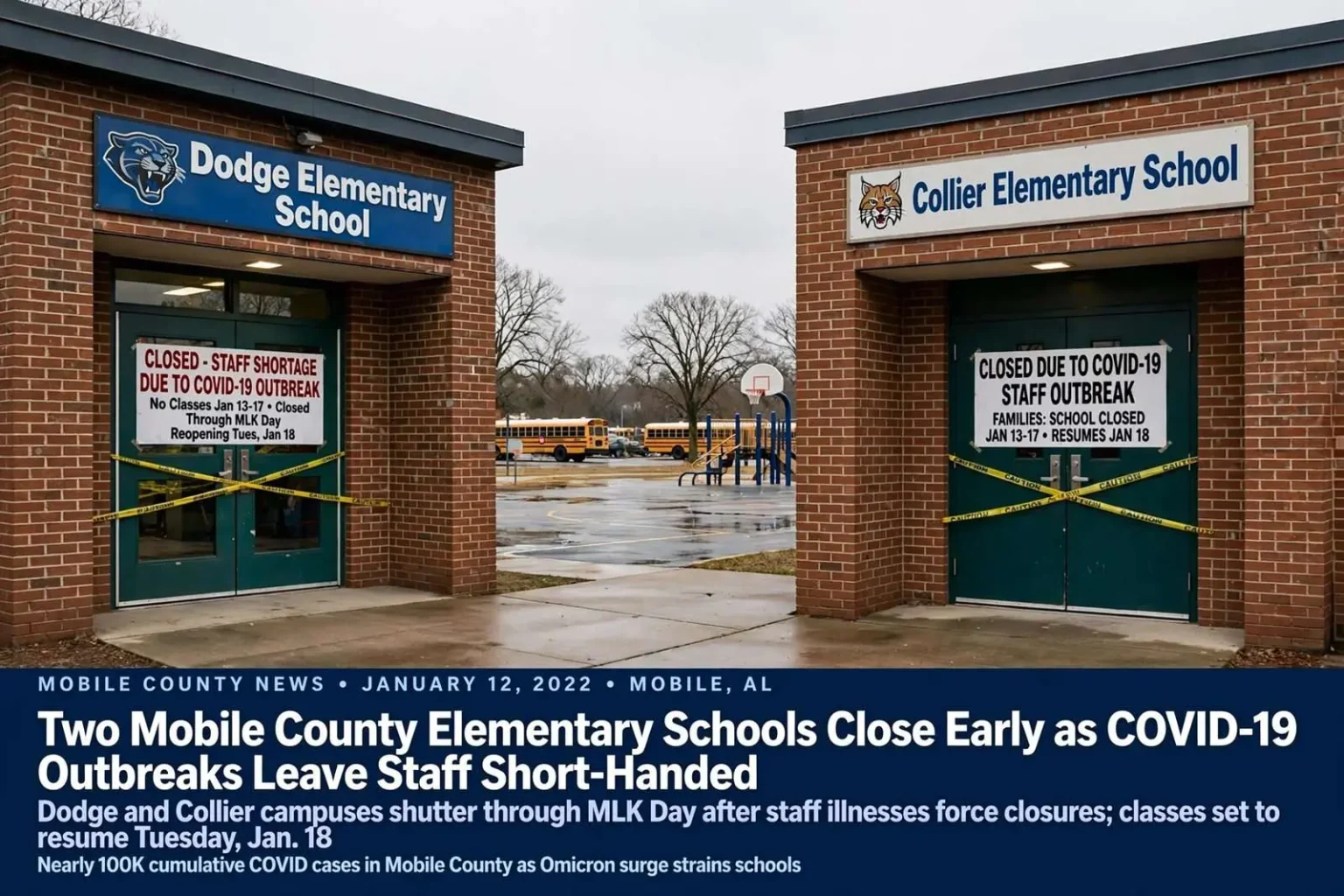
Dodge and Collier elementary schools announced Wednesday they would close for several days after COVID-19 cases among employees left each school without enough staff to operate, barely a week after Mobile County Public Schools returned from winter break. The closures made the two west Mobile-area campuses among the first in the district to shut down entirely during the Omicron surge, and they offered an early sign of the pressure the variant was about to put on schools across the county.
With the Omicron variant driving cases across the county, both schools will close Thursday, January 13, and remain shut through the holiday weekend. Classes are set to resume Tuesday, January 18, following the Martin Luther King Jr. Day observance — giving employees a five-day window to quarantine and recover. The timing meant that what students experienced as a four-day weekend was, for the schools’ workforces, a forced pause intended to break the chain of transmission among the adults who run a building: teachers, aides, cafeteria workers, custodians and front-office staff.
A difficult return to classrooms
The district resumed in-person classes January 5, and reported 156 new COVID-19 cases that same day. By January 12, Mobile County’s cumulative case count had reached 90,860 since the pandemic began. Those figures put the school reopening on a collision course with the fastest wave of transmission the county had seen to that point, and the strain showed first in staffing rather than in student illness. Schools can continue teaching with dozens of students out, but they cannot open a building at all when too many employees are sick or quarantined at once.
Running an elementary school requires a surprising number of adults even beyond the classroom. Covering a teacher’s absence is hard enough when substitutes are scarce, but a building also needs bus drivers, lunchroom staff, nurses, clerks and custodians present to function. During the Omicron wave, districts across Alabama reported that substitute pools were stretched thin because the same variant was sickling the substitutes themselves, leaving principals patching schedules with their own staff and central office personnel.
MCPSS has strongly encouraged students and staff to wear masks and follow CDC guidance, but has stopped short of requiring them. That position runs counter to the recommendation of the Mobile County Health Department, which advised that anyone over age 2 wear a mask inside school buildings. The gap between the district’s stance and the county health department’s advice became one of the recurring tensions of the school year, with health officials pushing for stronger precautions while the district balanced parental sentiment, state politics and day-to-day operations.
Dodge Elementary had not said whether remote learning would be offered during the closure days, leaving families to make arrangements on short notice for young children who suddenly had no school to attend.
What the closures mean for families
For parents, a mid-week closure of an elementary school is a logistical scramble. Young children cannot be left home alone, so the closure days become a sudden search for grandparents, neighbors or child care — or, for working parents, missed shifts and unplanned leave. School districts generally try to give families as much notice as possible, but an outbreak among staff can force a decision within hours, and the announcement of the Dodge and Collier closures the day before they took effect reflected exactly that urgency.
The days off also raise questions about learning time in a year already marked by disruption. The Omicron wave arrived in the middle of the academic calendar, and every closure or quarantine stretch pulled instructional days from a schedule that educators had hoped would finally be stable. For elementary students in particular — where reading foundations are built — the cumulative effect of repeated interruptions was a concern teachers and administrators raised throughout the winter.
Communication from the schools was the other pressure point. Families looked to principals and the district for answers on whether meals would be available, whether buildings would undergo additional cleaning, and whether activities and after-school programs were affected along with classes.
Omicron’s winter wave across Mobile County
The surge that forced the two closures was not unique to the schools. Omicron moved through Mobile County faster than any previous variant, producing case counts in days that earlier waves had taken weeks to reach, and filling testing lines at sites across the county. Health officials described the wave as a race between the variant’s extraordinary transmissibility and the immunity built up through vaccination and prior infection, and in January 2022 the variant was clearly winning. Hospitals reported rising admissions, businesses coped with absences of their own, and schools became one of the most visible fronts because their staffing problems could not be hidden.
The county’s cumulative case count — 90,860 by January 12 since the pandemic began nearly two years earlier — meant that roughly one in five residents had tested positive at some point, a number that itself understated the true total because home tests and uncounted infections were widespread. Mobile County, as one of the state’s largest counties, anchored Alabama’s case totals in the same way its size anchors the state’s economy and school enrollment.
Against that backdrop, the decision to close Dodge and Collier was less a judgment about the schools’ own practices than an acknowledgment of arithmetic: not enough healthy adults, no building. District leaders faced the same calculation at campuses across the county as January wore on, and families braced for the possibility that their school would be next.
The mask divide
The disagreement between the district and the Mobile County Health Department over masking was emblematic of a wider split that ran through the entire pandemic. The district’s approach — encouragement rather than requirement — aligned with the position of state leadership, and reflected the reality that school boards across Alabama had faced intense public pressure over mandates from both directions. The health department’s advice — that anyone over age 2 mask inside school buildings — reflected the standard public health playbook for airborne disease, and its officials argued that consistent masking was the cheapest, least disruptive tool for keeping schools open.
The consequence of the split was inconsistent practice from classroom to classroom. In buildings where most families chose masks, spread was slower and staffing held; where mask use was sparse, the wave hit harder. That unevenness played out campus by campus, and the closure of two elementary schools in the same week was one visible result of it.
Health officials continued to urge the basic measures throughout the surge: keep sick children home, test after exposures, mask up where possible, and take advantage of vaccination for eligible ages. None of those steps required a mandate, and each one lowered the odds that a school would lose the staff it needed to open its doors.
Looking past the closures
The five-day window that the MLK holiday gave Dodge and Collier employees was designed to let quarantine periods run their course so the schools could reopen Tuesday, January 18, with enough staff on hand. Whether remote learning filled the gap, and how much cleaning and communication accompanied the reopening, varied by campus — Dodge had not confirmed its plans as of the announcement. What was clear was that the closures would not be the last staffing-driven disruptions of the season, and that Mobile County’s schools, like others across the state, would be managing the Omicron wave one campus at a time.
For now, families of Dodge and Collier students marked four unplanned days at home, and the district counted the cost of a variant that had made staffing — not teaching — the hardest part of keeping schools running.
Mobile County Public Schools in context
Mobile County Public Schools is the largest school system in Alabama, serving tens of thousands of students across the county from the Mississippi line to Mobile Bay. Its scale cuts both ways during a crisis: the district has more resources to draw on than a small rural system, but it also has more buildings, more bus routes and more employees whose simultaneous absence can disrupt daily life for tens of thousands of families. When a variant like Omicron spreads through a system that size, the effects ripple across the entire county’s economy, since so many employers depend on school schedules for their own workforces.
Elementary schools occupy a special place in that equation. Younger students cannot work independently the way older ones can, remote options are of limited value for children still learning to read, and elementary campuses require a ratio of adults to children that makes staffing shortfalls especially punishing. That is why elementary closures during the pandemic tended to be the hardest-fought decisions — and why, when they came, they landed so heavily on working families.
Dodge and Collier serve neighborhoods on the city’s western side, part of the sprawling growth corridor that has pushed Mobile’s residential footprint west toward the county line over recent decades. Schools in that part of the county draw from large suburban attendance zones, which means each campus carries hundreds of students and an equally large staff whose absence is felt block by block.
How the district’s January unfolded
The sequence that winter was familiar to districts across Alabama. Students returned from winter break on January 5 to a case count that climbed steadily through the first two weeks of the month — 156 new cases on the first day back alone, and a county cumulative total of 90,860 by January 12. Superintendents statewide watched staffing dashboards the way hospital administrators watched ICU capacity, knowing that a building’s fate could turn on a dozen employees’ test results. Some districts shifted individual classes or grades to remote learning; others, like Mobile County did at Dodge and Collier, closed entire schools for a quarantine window aligned with a weekend.
The MLK holiday worked in the district’s favor that year. Because the three-day weekend sat directly on the calendar where the closure needed to fall, students lost fewer instructional days than a mid-week closure would have cost, and the extended gap gave the virus time to move through whichever staff remained contagious. It was the kind of calendrical luck that pandemic-era administrators learned to make the most of.
What came after depended on the wave’s trajectory. Health officials projected the Omicron peak would pass within weeks, and the district’s challenge was to hold its buildings together — with masks encouraged, testing available and substitutes scarce — long enough to reach the other side without wholesale shutdowns.
Lessons for the next surge
The episode at Dodge and Collier became part of a broader conversation about what keeps schools open during a communicable-disease wave. Staffing reserves, substitute pay, ventilation, testing access and community health behavior all feed into whether a campus can keep its doors open, and the districts that weathered the winter best were generally those that could draw on several of those levers at once. Mobile County’s size meant it could not solve its shortages with a handful of retirees, but it also had administrative muscle to reassign personnel and centralize communication in ways smaller systems could not.
For families, the practical takeaway was to keep contingency plans ready — a child care option for closure days, awareness of the district’s notification channels, and a stock of home tests when they were available. The Omicron winter taught Alabama’s school communities that closures could arrive with a day’s notice, that the holiday calendar could soften the blow, and that the adults in the building, not just the students, were the variable on which everything else turned.
Classes at both schools were set to resume Tuesday, January 18, after the Martin Luther King Jr. Day observance — the district’s bet that five days would be enough to bring its people back.


