
Two Mobile Groups Make It Their Mission to Back the Blue
Mobile's Citizens Police Academy alumni and the Law Enforcement Foundation give residents hands-on ways to support local officers.
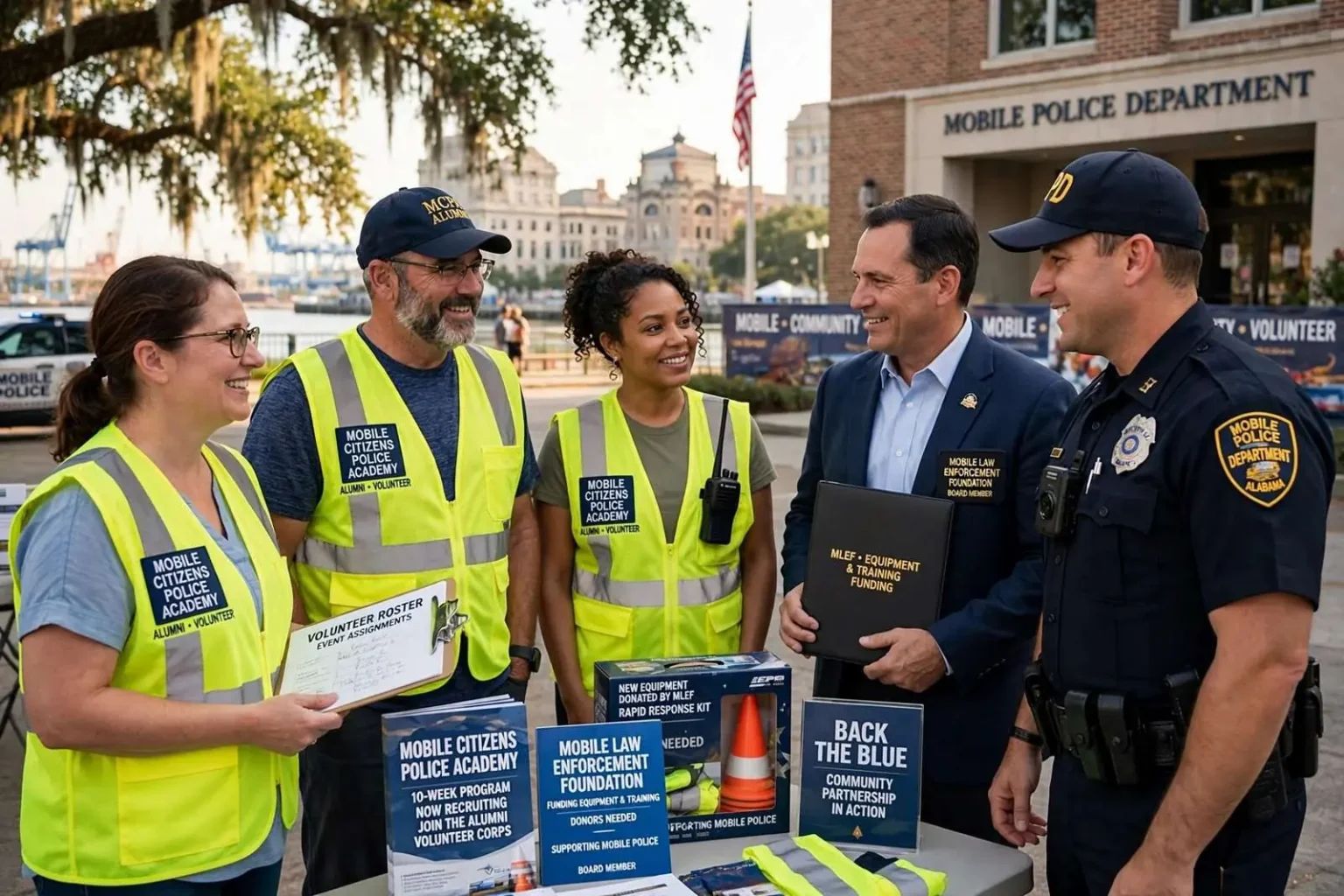
Mobile residents who want to support the city’s police department have more options than simply voicing appreciation — two community organizations are actively recruiting help for the Mobile Police Department, and neither requires a law enforcement background to get involved. The Mobile Citizens Police Academy and the Mobile Law Enforcement Foundation operate on different tracks, but both exist for the same basic reason: the demands placed on a big-city police department routinely exceed what its uniformed roster and its municipal budget can cover on their own.
Together, the two groups form a kind of civic support system around the department. One trains ordinary residents to understand police work from the inside and then puts them to work as volunteers; the other raises private dollars to pay for equipment and training that tax revenue alone does not provide. Officials with both organizations say the need for each has only grown as the city’s population, events calendar, and public safety challenges have evolved.
Learning Police Work From the Inside
The Mobile Citizens Police Academy runs twice a year in ten-week sessions, walking participants through the realities of police training and giving them a first-hand look at what officers do to keep the public safe. Classes introduce residents to the department’s units, procedures, and decision-making, replacing the secondhand impressions many people carry from television and social media with direct exposure to how the profession actually functions.
Graduates can then join the academy’s alumni association, whose members pitch in whenever officers are stretched thin by large events such as fun runs or graduations. Those volunteer assignments may look modest from the outside, but they free sworn officers to remain on their primary duties during events that draw big crowds and create extra demand across the city.
Brad Cooper of the alumni association said the volunteer work fills a real need. In his words, police have “a hard enough job doing what they do day in and day out,” and demands for additional community outreach often exceed what officers alone can cover — a gap the volunteers help bridge. Whether it is staffing a checkpoint at a charity race, assisting with a school event, or lending hands at a community gathering, the association’s members take on the auxiliary tasks that would otherwise pull officers away from patrol.
The model is a common one nationwide: citizens’ police academies spread through American departments in the 1980s and 1990s as a way to build transparency and trust, and alumni groups evolved alongside them. Mobile’s program follows that tradition, turning interested residents into informed ambassadors for the department and, in many cases, into its most consistent volunteers.
Funding the Volunteer Work
To fund that work, the association is holding a gun raffle, with ticket sales paying for its efforts backing up officers at major events. The fundraiser reflects a practical reality for volunteer organizations: even non-sworn support costs money, from supplies and equipment for event duty to training materials and the everyday expenses of keeping a volunteer corps organized.
Raffles are a staple of Alabama civic fundraising, where community groups from volunteer fire departments to youth sports leagues rely on them to bankroll operations. For the alumni association, the gun raffle is a straightforward way to convert community enthusiasm for public safety into the working budget the group needs to stay useful to the department.
A Foundation Fills the Budget Gaps
The other organization getting a renewed push is the Mobile Law Enforcement Foundation. Over the past two years it has seated new board members tasked with courting donations from philanthropic organizations across the region, an effort aimed at rebuilding the financial base that powers its work.
The foundation’s role is deliberately practical: it helps pay for hardware and training that fall outside what the municipal budget routinely covers, giving officers access to equipment and professional development the city might otherwise go without. That can mean specialized gear, updated technology, or courses that keep officers current on evolving standards in policing — categories of spending that are easy to trim when budgets tighten and that departments across the country consistently describe as underfunded.
The structure mirrors a model used in cities across the country, where private foundations exist alongside police departments to channel charitable giving toward public safety. Because foundation dollars are restricted to their stated purposes, donors can direct their support to equipment and training with a degree of specificity that general tax revenue does not allow, and departments gain a funding stream that is insulated from the annual budget cycle.
Why the Support Matters Now
Policing in a city of Mobile’s size involves a wide spectrum of demands: patrol coverage across dozens of neighborhoods, traffic enforcement along corridors that carry port and beach traffic, investigations, and a steady calendar of festivals, parades, races, and gatherings that bring thousands of people into public spaces. Each of those demands draws on the same roster of officers, and each year brings more events competing for their time.
Community support organizations address that pressure from two directions at once. Volunteers extend the department’s effective capacity at big events without adding headcount, while foundation funding pays for capabilities the city cannot easily absorb in its regular budget. Advocates for both groups argue that the combination also strengthens the relationship between officers and residents — familiarity built through the academy and volunteer service tends to pay dividends in cooperation and trust long after any single event ends.
For residents weighing whether to get involved, the entry points are accessible by design. The citizens academy asks for curiosity and a commitment of weeks, not prior experience; the foundation’s board asks for community connections and a willingness to raise funds, not a badge. Both organizations say the departments they serve benefit most when the support comes from a broad cross-section of the city rather than a handful of the already-convinced.
How to Get Involved
Residents interested in the Mobile Citizens Police Academy can watch for enrollment announcements for its twice-yearly sessions, which are promoted through the department’s public channels. Completion of the course opens the door to the alumni association and its volunteer corps. Those with philanthropic capacity or grant-making connections can reach the Mobile Law Enforcement Foundation to learn about current funding priorities, which center on equipment and training needs that fall outside routine municipal spending.
The two organizations describe their mission in similar terms: the men and women of the Mobile Police Department handle a difficult job every day, and a city that wants responsive, well-equipped, well-trained policing has a role to play in making that possible. Whether through ten weeks of classes or a tax-deductible donation, the pathway from appreciation to action is short — and, organizers say, genuinely needed.
The Bigger Picture of Police-Community Partnerships
The rise of groups like Mobile’s reflects a national shift in how cities think about supporting law enforcement. Direct volunteering through citizens academies took root decades ago as departments looked for ways to demystify their work, and philanthropic foundations followed as municipal budgets struggled to keep pace with the cost of modern policing equipment, which has grown far more expensive as technology has advanced. Cities across the country now treat these organizations as standard fixtures of their public safety landscape rather than novelties.
Research and practice both suggest the relationships built through these programs matter as much as the money and hours they contribute. Residents who complete a citizens academy consistently report a better understanding of how officers make decisions, and departments gain a pool of community members who can speak credibly about police work to neighbors, coworkers, and family members. In moments of tension or controversy, that reservoir of informed goodwill can be among a department’s most valuable assets.
The volunteer corps itself also changes the texture of large public events. When trained community members handle supporting roles — traffic direction assistance, checkpoint logistics, runner duties — officers can concentrate on the security functions that require their training and authority. Organizers of fun runs, festivals, and school gatherings in Mobile benefit from that division of labor, whether or not attendees ever notice it.
What the Departments Gain
From the department’s perspective, the two organizations offer complements rather than substitutes. Volunteers cannot replace sworn personnel, and foundation dollars cannot replace the city’s obligation to fund core operations. What both can do is fill the margins: the extra hands at an overloaded event, the piece of equipment between budget cycles, the training seat an officer could not otherwise take. Departments that cultivate this kind of ecosystem typically find they can respond to growth and change faster than the appropriations calendar allows.
There is also a recruitment dimension. Young people who encounter the department through community events, academy-style programs, and well-resourced training are more likely to consider policing as a career, and citizen supporters often become the department’s most effective advocates when it seeks qualified candidates. In an era when many departments report difficulty filling their academy classes, that pipeline effect is nothing to dismiss.
Mobile’s experience mirrors what peer cities along the Gulf Coast have seen: when residents move beyond slogans and into structured support — volunteering time, donating dollars, and learning how the work is actually done — the department’s capacity grows and the community’s understanding deepens. The citizens academy alumni and the foundation board both describe their efforts as investments that compound over time, in safer events, better-equipped officers, and a city that knows its police department as people rather than as patrol cars.
For now, the alumni association’s raffle proceeds and the foundation’s new board energy are the immediate story: two organizations, refreshed and active, working to make sure Mobile’s officers never stand alone at the moments the city needs them most.


