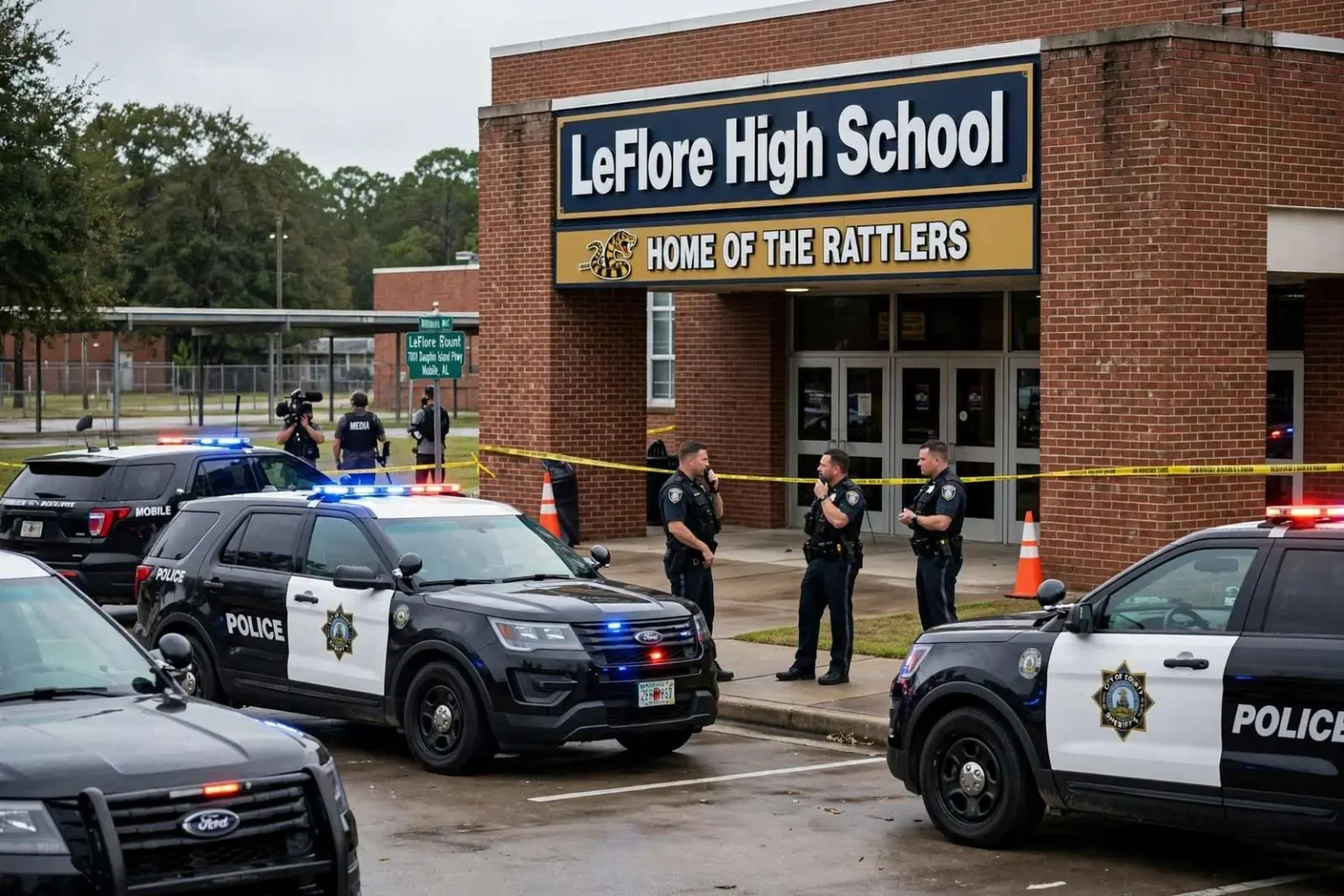
A shooting on the campus of LeFlore High School in Mobile left two students wounded Tuesday afternoon, sending the school into lockdown and prompting a heavy police response before the suspect turned herself in with the help of her parents. Mobile Police Chief Paul Prine said the confrontation broke out around midday and appears to have stemmed from an argument between students.
According to Prine, a female juvenile believed to be 16 years old pulled out a weapon and shot a 15-year-old student involved in the dispute. The 15-year-old suffered a superficial wound, Prine said. A 17-year-old student who was not part of the altercation was also struck in the side by the same round. Both students were taken to a local hospital with injuries described as non-life-threatening.
“There was no threat to any of the other students,” Prine said, adding that the suspect fled the campus immediately after the shooting. The suspect later surrendered to police with her parents’ assistance, according to police. Investigators said they are continuing to work to determine exactly what led to the shooting.
The fact that a single round struck two students — its intended target superficially and an uninvolved 17-year-old in the side — underlined what police and school officials have said repeatedly about gunfire in crowded places: a bullet fired on a school campus does not confine itself to the dispute that produced it.
Lockdown and response
The school went into lockdown as soon as the incident occurred, according to Mobile County Public School System spokesperson Rena Phillips, who said the situation was never an active shooter scenario. The distinction mattered in the first minutes: an argument that flares and ends, as opposed to a shooter moving through the building, calls for a lockdown that contains students in place while officers sweep and clear, not an evacuation.
Police response to a report of shots fired at a school brings every nearby unit. Officers secured the campus, worked to establish whether the shooter was still inside, and began the process of accounting for students while detectives started canvassing witnesses. The suspect had already fled, but the campus could not be released until police were satisfied that no weapon and no second participant remained inside.
“We’re always looking into how we can improve and increase our security measures,” Phillips said. “We’ve hired extra resource officers. We have also brought into a partnership with the sheriff’s department. We’re doing all these things to improve protection. This is what a lot of schools across the country are facing right now.”
Her description of the district’s posture reflected changes made across the Mobile County system in recent years — more school resource officers on campuses, a partnership that brings sheriff’s deputies into the security framework, and daily training for staff on what to do when the worst happens on a campus.
Word of the shooting quickly reached parents, many of whom rushed to the school to check on their children. Traffic around the campus was cleared to allow buses to get students home, and classes, which normally let out at 2:45 p.m., were dismissed 20 minutes early as a precaution. The early dismissal, announced while police were still working the scene, put buses and waiting parents onto the same streets around the campus, which is why officers moved quickly to clear traffic routes.
One parent, who declined to be identified, said no school resource officer was present on campus at the time of the shooting and argued that could have made a difference. “If there had been a resource officer there, we wouldn’t have had this incident,” the parent said. The observation cut to the question the district would face in the days that followed: whether the officer staffing at LeFlore matched the campus’s needs, and what the presence of a single armed officer at the right doorway might have changed.
The mayor’s response
Mobile Mayor Sandy Stimpson arrived at the school not long after the shooting and said he was troubled by what happened, while also cautioning that law enforcement alone cannot solve the underlying problem. “We can’t police our way out of these challenges,” Stimpson said. “It’s going to take the community, it takes the church, it takes everybody. We need the community’s help in solving these kinds of challenges.”
The mayor’s framing — police, community, churches, families — reflected a consensus that had formed in Mobile after years of youth violence: that the city can add officers and cameras and programs, but that a teenager who brings a gun to school to settle an argument is the end point of a failure that began well before the school day. Stimpson’s appearance at the campus within hours of the shooting was itself a signal of how seriously City Hall took the incident.
Phillips echoed the mayor’s call for a broader community response, pointing to the need to keep guns away from teenagers and to provide them with more support and positive role models. “We need to work together as a community to help with our teenagers,” she said. “We need to make sure that guns are not available for them. We need to talk with them, we need to provide positive role models. We train every day for situations like this. When this happened, the staff was able to act very quickly.”
Her emphasis on training pointed to the part of the response that worked. Lockdown procedures, communication with the district office and the police, and the controlled dismissal afterward all functioned as designed. What the training cannot do, she acknowledged, is stop the first shot — the argument that becomes a shooting before any adult in the building knows it is happening.
What comes next for the suspect and the victims
Because the suspect is a juvenile, her case moves through the juvenile justice system unless prosecutors move to transfer it, and details about the proceedings — the charges she faces, the conditions of any detention, the question of where she obtained the weapon — will unfold largely out of public view. The surrender arranged by her parents is likely to be weighed in her favor throughout that process, as is the fact that the weapon was turned in and the injured students recovered.
For the two wounded students, the injuries were physical and recoverable. For the campus, the wounds are slower to heal: a school that has had a shooting in its halls carries the incident in its routines, its parent conversations and its security planning for years afterward.
Investigators were working to trace the argument that preceded the shooting — whether it began at school or online, who else was involved, and how the weapon reached the campus. The answers determine what the school and the district change, because a dispute that starts outside the building arrives at the door every morning whether or not the campus can stop it.
The district’s security review
The Mobile County Public School System has said it is continuing to evaluate its security measures at LeFlore and other campuses, including the possible expansion of its school resource officer program in partnership with the Mobile County Sheriff’s Office. Any expansion runs into the arithmetic that governs every large district: there are more campuses than officers, and each additional officer assigned to a school is a budget line the district must fund and a deputy the sheriff’s office must spare.
LeFlore, a large high school serving a broad section of the city, presents the staffing question in its sharpest form. The parent’s complaint — no resource officer on campus at the critical moment — became part of the record of the day, and the district’s review was expected to weigh single-officer coverage, officer placement during the midday hours when students move between classes, and the speed with which disputes among students are flagged to adults before they escalate.
The episode also fed a conversation taking place in school districts across the country. Guns reach campuses in backpacks and waistbands, disputes that once ended in fistfights now end in gunfire when firearms are within reach, and the officer who catches the argument an hour earlier does more for safety than any number of lockdown drills afterward. That is the gap — between the school’s ability to respond and its ability to prevent — that Phillips, Stimpson and the district’s review were all addressing in their own terms.
What the day at LeFlore demonstrated was both halves of the modern school security picture. The response worked: lockdown held, no one else was threatened, police flooded the campus, the suspect surrendered, and the injured students survived. The prevention did not: a 16-year-old carried a gun into a high school and fired it at a classmate over an argument. Closing that gap is the work that city hall, the churches, the families and the school district all said — in the hours after the shooting — could not be left to any one of them alone.