Underwood Forces Incumbent Dorsey into Runoff for Baldwin County Commission Seat
Billie Jo Underwood's strong primary showing forced incumbent Tucker Dorsey into a July runoff for the Baldwin County Commission District 3 seat.
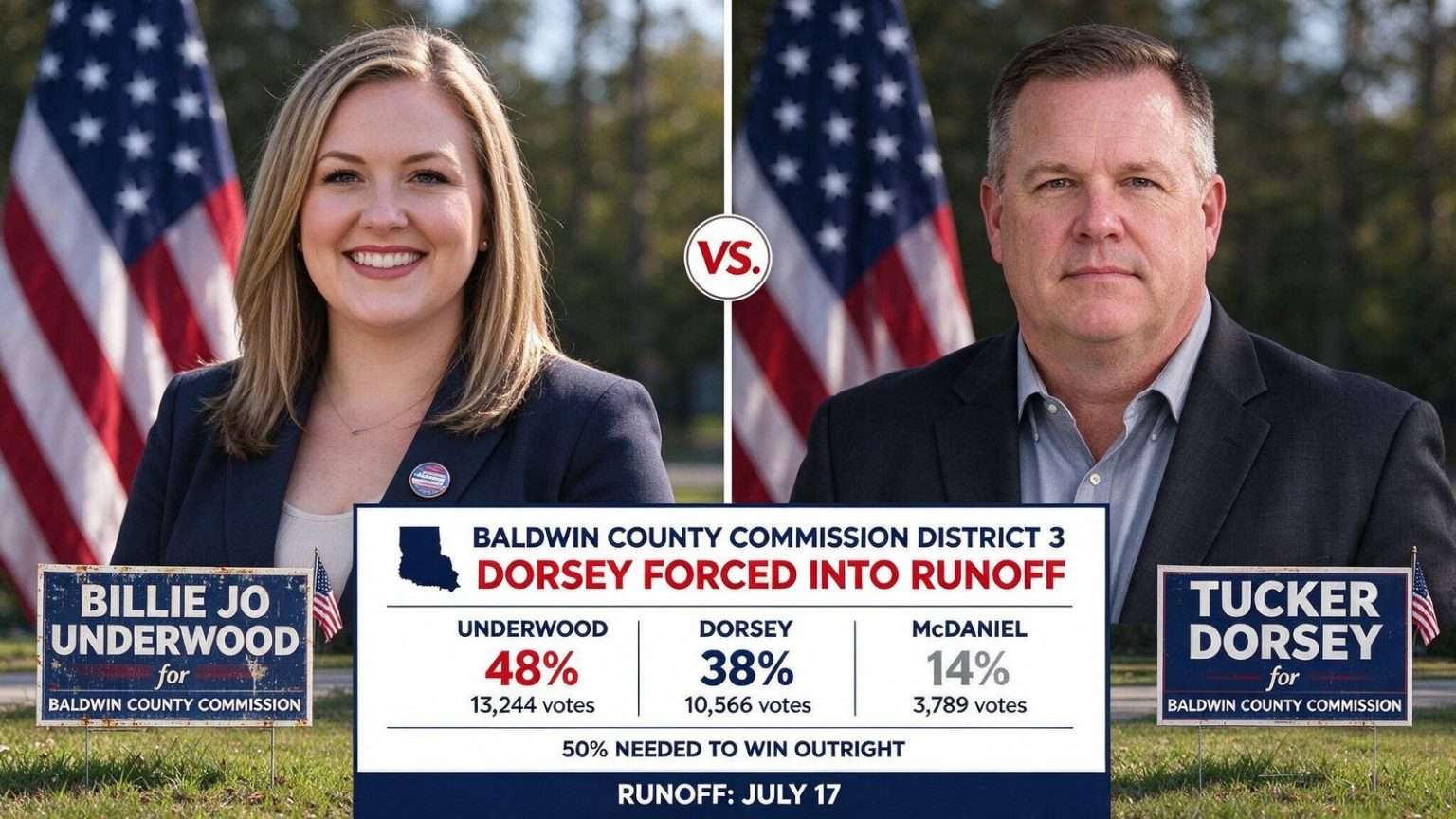
Political newcomer Billie Jo Underwood of Summerdale came within roughly 450 votes of winning the District 3 seat on the Baldwin County Commission outright, forcing incumbent Tucker Dorsey into a July runoff. The result turned one of the county’s most established commissioners into an underdog in his own district, and it set up a six-week sprint between a two-term incumbent and a challenger whose first campaign nearly ended it in a single night.
Unofficial returns from the June 5 Republican primary showed Underwood taking about 48 percent of the vote to Dorsey’s 38 percent, with Will McDaniel a distant third. In a three-way race, the 50 percent threshold stood between Underwood and an outright victory, and the margin that denied it — a few hundred votes spread across a county of nearly a quarter million — underscored how decisively the newcomer had outpolled the man she was trying to unseat.
Dorsey, who was seeking a third term on the commission, received 10,566 votes to Underwood’s 13,244. The incumbent now carries the burden no politician wants into a runoff: having finished second in the first round, he must not only win back voters who chose McDaniel but also persuade a slice of Underwood’s support to change sides, all while she rides the momentum of a strong showing.
Because Baldwin County’s commission seats are decided in the Republican primary — the practical general election in a county where Republicans dominate down-ballot races — the July runoff will effectively decide the seat. No Democratic candidate qualified for the district, making the second round the final word on who represents District 3 for the next term.
A Grassroots Campaign Heads to July
Underwood said she felt honored that voters gave her the chance to compete in the runoff, noting that District 3 was the only county commission district with three candidates in the primary. She said that while there were moments on election night when an outright victory appeared possible, the race ultimately headed to a second round set for July 17.
Underwood’s strength was broad: she won all but 12 of the county’s 49 precincts and carried both the provisional and absentee boxes. That geographic spread matters in a runoff. A challenger who wins by dominating a handful of precincts can be beaten by a superior ground game elsewhere; a challenger who wins nearly everywhere has a base of volunteers, donors, and voters already organized across the entire district.
She described her effort as a true grassroots campaign built on family, friends and hard work, and said her message about changing leadership in District 3 would continue through the runoff. The framing — change against incumbency — is a familiar and durable one in county politics, and Underwood will carry it into a campaign that now has six more weeks of attention, debates, and door-knocking.
The runoff calendar also extends the primary’s intensity through the summer. Voters in the district’s communities — stretching along the Baldwin County shore and inland — will see the race play out in yard signs, forums, and fundraising appeals through early July, culminating in an election that will set the county commission’s direction for years.
Dorsey Leans on Experience
Dorsey framed the runoff as a fresh start, saying the gap between the candidates gives him a clear map of where he performed well and where he needs to concentrate his efforts. He argued that experience matters more than ever with at least two new members set to join the commission next term, and pointed to his two terms of working with county residents as his chief selling point.
The argument has real weight in a county undergoing rapid change. Baldwin County has been one of Alabama’s fastest-growing counties for years, and its commission has steered through road construction, water and sewer expansion, and the pressures of development along the Eastern Shore and the beaches. An incoming commission with multiple new members will lose institutional memory exactly when decisions about growth are most consequential — Dorsey’s case for why his tenure should continue.
Whether that argument overcomes a 17-point first-round deficit is the central question of the runoff. Runoff dynamics favor the candidate who finished first: she can consolidate her coalition while the second-place finisher must both win over the eliminated candidate’s voters and give some of his own supporters a reason to turn out again. But incumbents have survived such deficits before, particularly with financial resources to air a closing message.
Campaign finance reports filed through May 30 showed Underwood had raised about $42,700, spent roughly $38,300 and had around $4,400 on hand. Dorsey’s reports showed he substantially out-raised his challenger, with roughly $45,455 remaining in his account after spending of about $46,160.
The money picture tells the story of the first round: Dorsey raised and spent more, yet finished well behind — evidence that the outcome turned on voters’ judgments rather than advertising volume. But his cash advantage going into July is enormous by the standards of a county commission race, and it gives him the ability to communicate in the runoff’s final weeks on a scale Underwood’s grassroots budget cannot match.
The Rest of the Baldwin Ballot
Elsewhere on the Baldwin County ballot, Jeb Ball defeated longtime incumbent Frank Burt in District 1, and Joe Davis beat John Lake for the District 2 seat vacated by Chris Elliott, who launched a run for the Alabama Senate. The results guarantee that the commission Dorsey hopes to rejoin will look substantially different next term regardless of the runoff’s outcome.
Burt’s loss ended one of the longest tenures in county government, a stretch that spanned Baldwin County’s transformation from a largely rural county into one of the state’s population and economic leaders. In District 2, the seat opened when Elliott — himself a former commissioner who had built a high profile through litigation against BP over spill damages — stepped away to pursue higher office, clearing the field for new leadership.
Davis was set to face Democrat Amber Smith in the November general election, the only commission race to extend past the primary season. Everywhere else on the county commission, the Republican primary and its runoffs would settle the question — a reflection of Baldwin County’s political makeup, where the GOP nomination is, in practice, the election.
For the incoming commission, the turnover carries both opportunity and risk. New members bring fresh perspectives on growth and infrastructure, but they will take their seats needing to master a budget and a road program that touch every corner of Alabama’s largest county by area. That is the context in which voters of District 3 will weigh Dorsey’s experience against Underwood’s call for change on July 17.
What the County Commission Does
The stakes of the District 3 runoff are best understood through the commission’s actual responsibilities. Baldwin County’s five-member commission sets the county’s annual budget, oversees the county highway department, controls zoning and planning decisions in unincorporated areas, and manages services ranging from sanitation to animal control. In a county whose population has grown faster than nearly any in Alabama, those duties translate into daily decisions about roads, subdivisions, drainage, and the infrastructure that either keeps pace with growth or falls behind it.
District 3 stretches across some of the county’s most dynamic territory, taking in communities along and near the Eastern Shore where subdivisions have multiplied and traffic has strained roads built for a smaller era. Commissioners from such districts spend much of their time on constituent road and drainage issues — the unglamorous work that decides how residents experience county government.
Each commissioner also carries a vote on the big countywide questions: how the budget balances tourism revenue from the beaches against infrastructure needs inland, how the county handles the state’s fuel tax distributions, and how development is guided in the corridors absorbing the most growth. With at least two new members arriving next term, whichever candidate wins District 3 will be one of the commission’s more experienced voices — or, if Underwood prevails, part of an even larger incoming class.
Runoff Rules and Timing
Alabama’s runoff system requires a majority rather than a plurality to win a party’s nomination, which is why the June 5 result produced a second round rather than a winner. McDaniel’s supporters now hold the balance: the votes he drew in the primary exceed Underwood’s margin over Dorsey, meaning whichever candidate captures most of them on July 17 will almost certainly prevail.
Underwood enters the runoff with the arithmetic on her side, the precinct map on her side, and a message built for the moment. Her campaign’s task is consolidation — converting a strong first round into a closing majority by reassuring McDaniel’s voters that her leadership represents the change they also sought.
Dorsey’s task is harder on paper but familiar to political veterans. He must raise his own turnout among voters who backed him once, peel away enough of the primary’s third-place support, and use his financial advantage to make the case that his two terms of experience matter in a commission about to absorb new members. His campaign signaled it would treat the six weeks between June 5 and July 17 as a fresh contest rather than an extension of the primary.
Turnout is the wildcard in every Alabama runoff. Second-round elections typically draw a fraction of primary turnout, which rewards campaigns with committed supporters rather than broad but shallow appeal. Both campaigns spent the days after the primary shifting from persuasion to mobilization — the mechanics of identifying voters, recruiting poll workers, and getting their remaining supporters to the polls on a mid-July date when the election will be the only thing on the ballot in the district.
The Campaign Ahead
The six-week runoff calendar gives both campaigns a defined sprint. Underwood’s grassroots operation — family, friends, and the volunteer network that carried 37 of 49 precincts — will work to keep its supporters engaged through the summer lull, when vacation season competes with politics for attention. Dorsey’s campaign will deploy its financial edge in the closing stretch, when voters finally tune in.
For District 3 voters, the choice frames a larger question facing Baldwin County as a whole: what kind of leadership a fast-growing county needs as its governing board turns over. Underwood’s campaign argues the commission needs new leadership to match the county’s changes; Dorsey’s argues that experience is the steadiest hand for a moment of transition. The July 17 runoff will answer it.
Whatever the result, the June 5 primary already delivered its verdict on one point: District 3’s voters wanted a contest. They turned a safe incumbent’s reelection into the county’s marquee race, drove a 48 percent newcomer to within a few hundred votes of an outright win, and guaranteed that the commission taking office next term will answer to an electorate clearly willing to make changes at the top.
Unofficial results will be certified in the weeks after the runoff, and the winner of the District 3 seat will join a reconfigured Baldwin County Commission — one that, no matter its makeup, will spend the next term managing the growth, roads, and budget of one of the South’s fastest-changing counties.