
University of South Alabama Makes Vast Wilson Burton Photo Collection Available Online
The University of South Alabama Archives has made Wilson Burton's collection of Mobile studio portrait negatives available online.
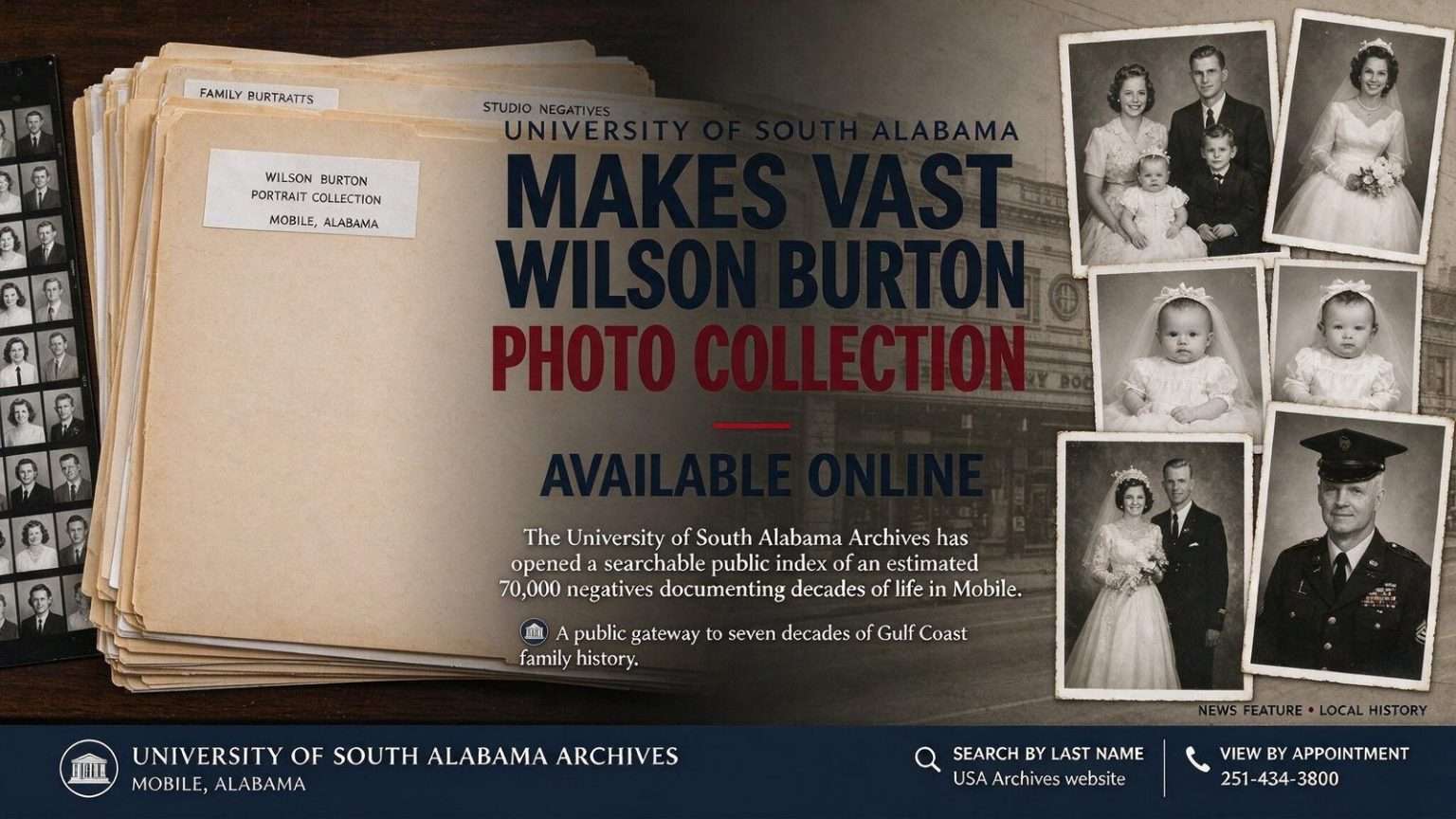
The University of South Alabama Archives has made a remarkable collection of historical photographs accessible to the public through its website, opening a window into decades of life in Mobile through the lens of studio photographer Wilson Burton. The collection, which contains an estimated 70,000 negatives, documents generations of Mobile residents who sat for portraits at Hammel’s Department Store in downtown Mobile or at Burton’s photography studio on Florida Street in Midtown. The images span several decades of the mid-to-late 20th century, offering an unusually rich visual record of the city’s people and culture.
For genealogists, historians and families across the Gulf Coast, the digitized index represents one of the most significant additions to the region’s publicly available photographic record in years. Studio portrait collections of this scale rarely survive intact, and rarer still are they cataloged and opened to public search. The Burton collection captures ordinary Mobilians at milestone moments — first communions and graduations, weddings and anniversaries, babies in their mothers’ arms and veterans in uniform — the everyday celebrations that family albums are built around.
How to Access the Collection
Visitors to the USA Archives website can browse an alphabetical index of the Burton collection by last name. Because Burton typically captured multiple poses during each studio session, researchers may find several negatives associated with a single name. Those who locate a name of interest can contact the archives at 251-434-3800 to arrange a viewing.
The negatives can be examined in person at the archives’ location at 1504 Springhill Ave., housed on the ground floor of the USA Springhill Avenue campus in the former Providence Hospital building. The historic structure, which served the community as a hospital for generations before the university acquired it, now anchors the university’s westside medical operations, and its ground-floor archives space gives researchers a quiet, dedicated place to work with original materials.
For researchers unable to visit in person, the archives may be able to provide scanned copies of the negatives for remote viewing. That option matters for the large number of former Mobilians who scattered across the country over the decades but still trace family lines back to the city, as well as for out-of-state genealogists working on south Alabama family histories.
Prints are also available for a nominal fee, with 5-by-7 prints priced at $7 and 8.5-by-11 prints at $15. The pricing keeps reproduction within reach of families who may want a single portrait restored for a reunion display, and researchers assembling documentary projects who need higher-resolution copies of a dozen images or more.
A Photographer Who Put Subjects at Ease
Burton, who worked as a studio photographer for decades, was known for his ability to make his subjects comfortable in front of the camera. In an era when a formal portrait sitting could feel stiff and intimidating, particularly for children, that temperament mattered. Subjects who relaxed in front of the lens produced photographs that felt lived-in rather than posed, and that quality is precisely what makes the collection valuable beyond its sheer size.
Mobile attorney Nancy Busey, who was first photographed by Burton as a toddler in the early 1960s when her mother brought her to Hammel’s, recalled his warm personality. Burton went on to photograph Busey for her high school graduation, at her wedding, and later captured portraits of Busey’s own daughter — a generational record that speaks to the deep personal trust families placed in a single photographer across the decades.
Her experience was far from unusual. A department store portrait studio or a neighborhood photographer on Florida Street served as the default documentarian of family life for thousands of Mobile households. When a child was born, when school let out, when a couple married, the family returned to the same studio, and the same photographer recorded the occasion. The result, decades later, is an archive that traces family lines the way a genealogical chart does, but in faces and fashions rather than names and dates.
Hammel’s and the Downtown Portrait Trade
Hammel’s Department Store, where many of the collection’s portraits were made, was for decades one of the anchor retailers of downtown Mobile, drawing shoppers from across the city and from Baldwin County and the Mississippi Gulf Coast before suburban malls reshaped retail patterns. Department stores of that era commonly operated portrait studios as a customer draw, and for many families the annual trip downtown for school photos and Christmas portraits was a ritual as fixed as the seasons.
Burton’s own studio on Florida Street served the Midtown neighborhoods that grew up along Mobile’s historic east-west corridors in the postwar years. The area’s bungalows and cottage-style homes filled with young families in the 1940s and 1950s, and those families furnished a steady stream of portrait sittings — children posed on fur rugs, servicemen in dress uniforms, brides in gowns borrowed for the occasion.
The negatives that survive document more than faces. Clothing, hairstyles, military uniforms, christening gowns and graduation caps all change across the decades the collection covers, giving researchers a dense visual timeline of Mobile’s mid-century years. Because Burton worked steadily and kept his negatives, the collection holds images of families who never appeared in newspaper society pages — the waitresses, shipyard workers, schoolteachers and small merchants who made up most of the city.
Why Studio Archives Matter to the Gulf Coast
Collections like Burton’s carry particular weight on the Gulf Coast, where hurricanes and humidity have destroyed uncounted family photograph albums over the decades. Storms from Camille to Katrina pushed salt water through homes across south Louisiana, Mississippi and south Alabama, and countless households lost the photographic record of their own histories. A professionally maintained archive of studio negatives, stored in a climate-controlled facility, preserves a slice of that endangered visual memory for the entire region.
The University of South Alabama Archives, which maintains the collection, serves as a repository for materials documenting the history of Mobile, southwest Alabama and the university itself. Its staff assists family historians, students, authors and documentary producers, and the Burton index adds a searchable layer to that work that few regional repositories can match. Archives staff routinely help first-time visitors navigate genealogical research, and the alphabetical surname index is designed to be approachable even for someone who has never handled an archival finding aid.
For residents of Mobile and Baldwin counties, the practical value is straightforward. A grandparent’s name in the index can produce a portrait no family member has seen since the negative was filed away, at the cost of a phone call and a modest print fee. Family reunion committees, church anniversary programs, obituary preparation and school history projects all present ordinary occasions to search the index.
Researchers planning a visit should call ahead at 251-434-3800 to confirm staff availability and arrange a time, since viewing negatives requires proper handling and equipment that cannot be left out on demand. Those seeking scanned copies should describe the names they are researching when they call so staff can determine what can be reproduced remotely.
With the index now online, the archives has effectively turned a photographer’s commercial records into a public resource. Seven decades from now, the faces Burton photographed on Government Street and in the Hammel’s studio will still be retrievable by name — a small permanence in a city that has learned not to take its memory for granted.
The arithmetic of the collection alone tells the story: an estimated 70,000 negatives means tens of thousands of separate portrait sittings, and at three or four poses per session, likely tens of thousands of individual images available for every name indexed. For a city of Mobile’s size, few private photographers ever accumulated that volume of work, and fewer still had their archives rescued and cataloged rather than discarded when a studio closed.
Local historical societies and libraries across south Alabama have long fielded requests from families trying to replace photographs lost to storms, fires and simple neglect, and the answers have too often been disappointing. A searchable studio archive changes that calculus. A family that knows only that a relative visited Hammel’s sometime in the 1960s now has a concrete place to look, and archives staff can check variants of a surname across the index where a family’s memory of spelling may be imprecise.
The collection also opens doors for teachers and students. Classroom units on Alabama history, mid-century immigration, the civil rights era and the growth of Mobile’s suburbs all become easier to illustrate with images drawn from the community itself rather than stock photography. University instructors already use archival materials in coursework, and a browsing-friendly index lowers the barrier for student projects that draw on primary sources.
Archives officials have emphasized that the online index is the gateway, and that staff assistance remains central to the process. Names associated with the negatives, session dates recorded on envelopes and the condition of individual negatives all require the trained eye of archival staff, who can locate material quickly once a researcher has identified a target name. Researchers are encouraged to be patient with the process, since pulling and reviewing negatives is done carefully and by appointment.


