Unoccupied Car With Wisconsin Plates Pulled From Mobile Lake Near Lakeside Drive
An unoccupied Chevrolet with Wisconsin plates was pulled from a Mobile lake near Lakeside Drive; police believe the car may have been stolen.
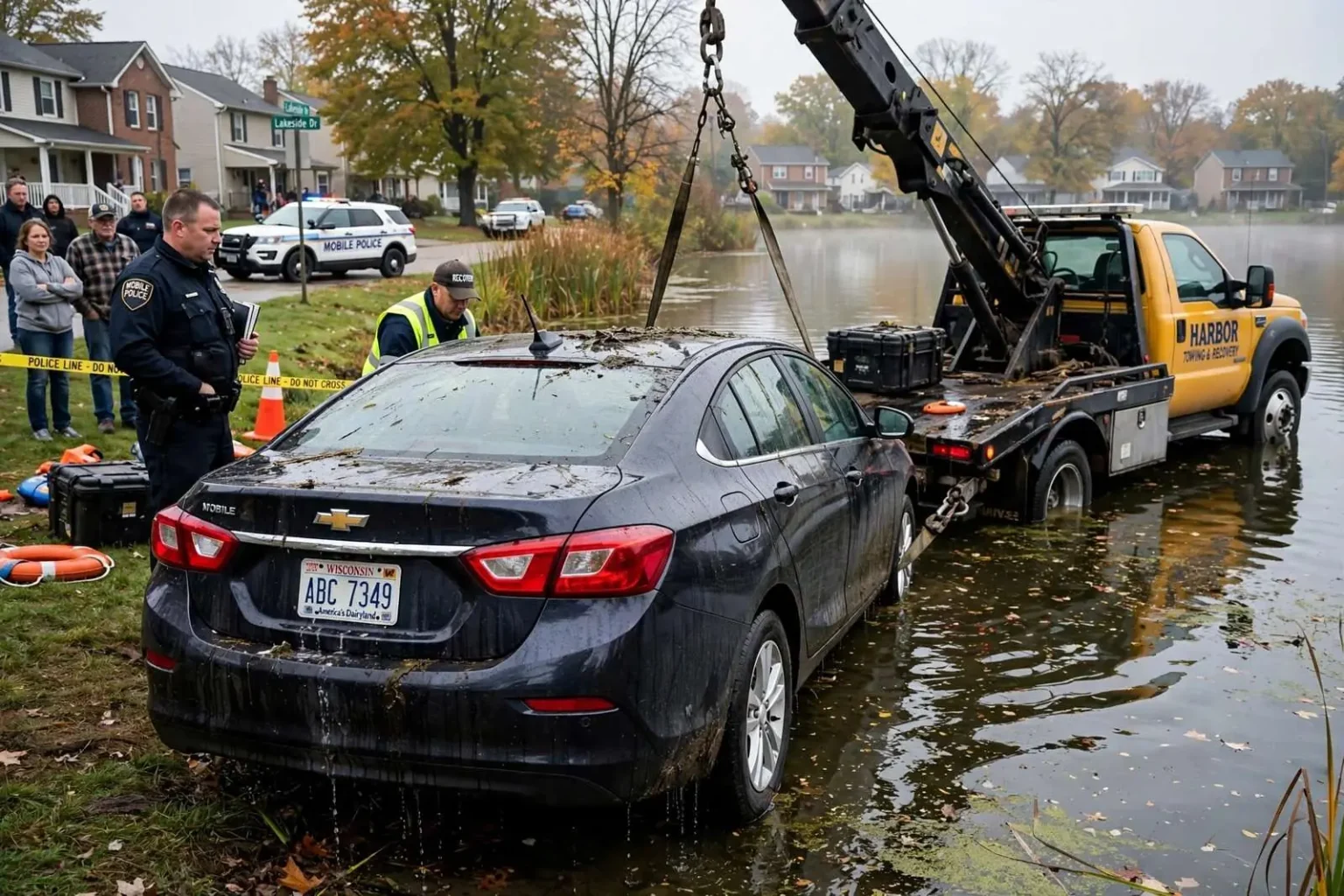
Officers responded to the scene around 8:30 a.m. on a Tuesday in October 2018 after a caller reported a vehicle in the water, and by midmorning a routine Tuesday had turned into a recovery operation on the shore of a residential lake, with neighbors gathering to watch a tow crew work at the water’s edge. A tow crew later pulled the dark-colored Chevrolet from the lake, and police noted an out-of-place detail: the car carried Wisconsin license plates.
Wisconsin is more than a thousand miles from the Gulf Coast, and there is no routine reason for a vehicle registered there to be sitting in a small Mobile lake — no family connection, no tourist route, no obvious explanation that would come up in the first hours of an investigation. The plates added a new question to a case that already had several, and investigators began with the most basic one: whose car is this, and who last had it?
The discovery also raises practical questions that investigators work through methodically. A vehicle submerged in fresh water deteriorates differently than one in salt water, and items inside a car can survive long enough to provide identification clues. How long the car had been in the water — weeks, months, or longer — shapes everything from which missing-vehicle reports might match it to what evidence remains readable once the vehicle is dried out and examined.
A morning call, then a recovery
The vehicle was unoccupied when it was discovered, and its windows were down. That detail matters. Windows-down submersions are consistent with a car entering the water in a way that allowed water to fill the passenger compartment quickly, whether the car rolled in under its own momentum or was pushed. It also means anyone inside would not have been trapped — and, indeed, no one was found with the vehicle when it was pulled from the lake.
Investigators said they believe the car may have been stolen, though they could not say how long it had been sitting in the water before someone spotted it. The stolen-vehicle theory connects the case to a familiar pattern: vehicles stolen in one region are sometimes driven hundreds of miles, abandoned, or disposed of in places — water, wooded lots, rural roads — chosen to delay discovery. A small lake beside a residential street is exactly the kind of spot where a submerged car can sit unnoticed unless the water is low, the light is right, or a passerby happens to look down at the right angle.
The caller who reported the vehicle did exactly what investigators depend on. Submerged cars are remarkably easy to miss; a dark sedan under the surface of a lake can read as a shadow, a log, or simply the bottom of the pond from shore. Reports from alert residents and passersby are regularly how abandoned and submerged vehicles come to official attention, and the morning hour of this call put officers on scene while conditions were calm and visibility was good.
Tracing a vehicle across a thousand miles
Police did not report any injuries connected to the discovery, and no suspect information was released as officers worked to trace the vehicle’s history — from how it traveled more than a thousand miles from Wisconsin to how it came to rest beneath the surface of a small Mobile lake. Tracing that path is the core of the investigation. License plate registration points investigators to the owner or the last known holder of the plate, and a stolen-vehicle report filed in Wisconsin, if one exists, would anchor a timeline for when and where the car began its journey south.
From there, the standard steps are familiar to any property crimes unit: run the vehicle identification number, check regional reports of abandoned vehicles, canvass the Lakeside Drive neighborhood for residents who noticed when the car first appeared in the water, and compare the recovery date against any suspicious-activity calls from the surrounding weeks. Someone in the area, investigators assume, either saw the car go in or noticed it in the days afterward, and a neighborhood canvass is the most direct way to reach that person.
Vehicle thefts that cross state lines also tend to involve review of law enforcement databases shared among agencies, since a car driven from Wisconsin to Alabama would have passed through several states and may have been recorded by automatic plate readers or flagged in intermediate jurisdictions. Reconstructing that route is slow work, but each verified sighting narrows the map and helps establish when the vehicle reached Mobile and what happened to it afterward.
Why lakes and ponds attract abandoned cars
Water is a common final stop for stolen and abandoned vehicles, and the reasons are practical. A car pushed into a lake or pond sinks out of sight quickly, and unless the water body sits where regular foot traffic passes, weeks or months can pass before anyone reports it. Residential lakes like the one near Lakeside Drive are ringed by homes, but even there the view from a backyard or an apartment window may not include the spot where a car entered, and submerged vehicles are hard to distinguish from shadows except in the right light and at the right angle.
For investigators, a water recovery also means working with a degraded crime scene, if it is one. Evidence inside a submerged vehicle degrades quickly, and the longer the car sits, the less remains. That is why the question of how long the Chevrolet was underwater recurs through the early stage of every case like this one — it determines how much of the vehicle’s story can still be recovered and how heavily investigators must lean on witness recollection and paper records instead.
What neighbors can watch for
Cases like this one are typically resolved by ordinary residents paying attention. Unusual vehicles parked for days in unfamiliar spots, signs of activity near a pond or lake at odd hours, and anything that looks out of place in a quiet neighborhood are the kinds of details that fill out a timeline once investigators ask. In this case, the initial report came from a member of the public, and the follow-up canvass of the Lakeside Drive area gives residents a direct role in filling the gaps that remain.
Mobile police had not announced any arrests or identified a suspect in the case as of the recovery, and the department’s early posture — confirming the recovery, noting the Wisconsin plates, and describing the vehicle — is a standard effort to jog memories. A dark-colored Chevrolet with out-of-state plates is a distinctive combination, and the more people who see that description, the better the odds that someone remembers where and when they saw it. Until that recollection arrives, the car sits on a tow lot holding its questions: who drove it south, why they came to Mobile, and why the journey ended at the bottom of a lake.
How the early hours of a water recovery unfold
The sequence on the morning of the discovery followed the pattern familiar from similar recoveries. A caller reports the vehicle; dispatch sends officers to confirm what is in the water and whether anyone is inside; once it is clear the car is unoccupied, the focus shifts from rescue to recovery and evidence. Fire and rescue personnel often assist in the early stage, and a tow operator with recovery experience is brought in to pull the vehicle without losing whatever might still be inside it. From the moment the car breaks the surface, it is treated as potential evidence rather than scrap — photographed, documented, and preserved for examination.
The hours after a recovery are when the vehicle gives up its first clues. The vehicle identification number can be read or recovered from the body even when plates and paperwork are missing or damaged. The interior can be searched for registration papers, personal items, and anything that indicates who was using the car last. The mechanical condition — whether the engine showed signs of recent operation, whether the transmission was in gear, whether the fuel level suggests a long drive — contributes to the reconstruction of the car’s final trip.
Registration and stolen-vehicle checks run in parallel with the physical examination. If the Wisconsin plates match a registration, investigators can identify the recorded owner and determine whether the owner reported the car stolen, sold it, or lost track of it. Each of those possibilities sends the investigation in a different direction: a stolen report points toward the theft-and-disposal pattern described by investigators; a sale points toward whoever took possession most recently; a lost title history suggests the car may have been passed through a chain of informal transactions that ended badly.
The larger picture of abandoned vehicles in Mobile
Water recoveries are the rare edge of a routine workload. Cities deal with abandoned vehicles constantly — cars left in vacant lots, at apartment complexes, and on residential streets — and most turn out to be mundane: a breakdown the owner could not afford to repair, a vehicle left after a move, a dispute over a car loan. The fraction that turn out to be stolen is significant, and the smaller fraction that turn up submerged tend to attract attention precisely because they are unusual and because water raises the stakes of the questions involved.
For the neighborhood near Lakeside Drive, the event was a memorable morning — tow trucks and officers where herons and joggers usually have the scene to themselves. For investigators, it was the start of patient work: database checks, interviews, and physical evidence review, aimed at connecting a dark-colored Chevrolet with Wisconsin plates to a driver and a motive. The department released no suspect information in the early going, which is typical when a case depends on leads that publicity could complicate.
What the department did say was enough to frame the case for the public: a vehicle believed stolen, found unoccupied with its windows down at the bottom of a Mobile lake, carrying plates from more than a thousand miles away. Somewhere between those facts lies the rest of the story, and investigators were working the case on the reasonable assumption that someone — in Wisconsin, along the route south, or in the neighborhoods around the lake — holds the detail that completes it. Anyone with information about the vehicle was encouraged to come forward as the investigation continued.