USA Health Opens New Physicians Building Near Mobile’s Children’s & Women’s Hospital
USA Health System is building a new physicians office building across from Children's & Women's Hospital in Mobile with 153 exam rooms.
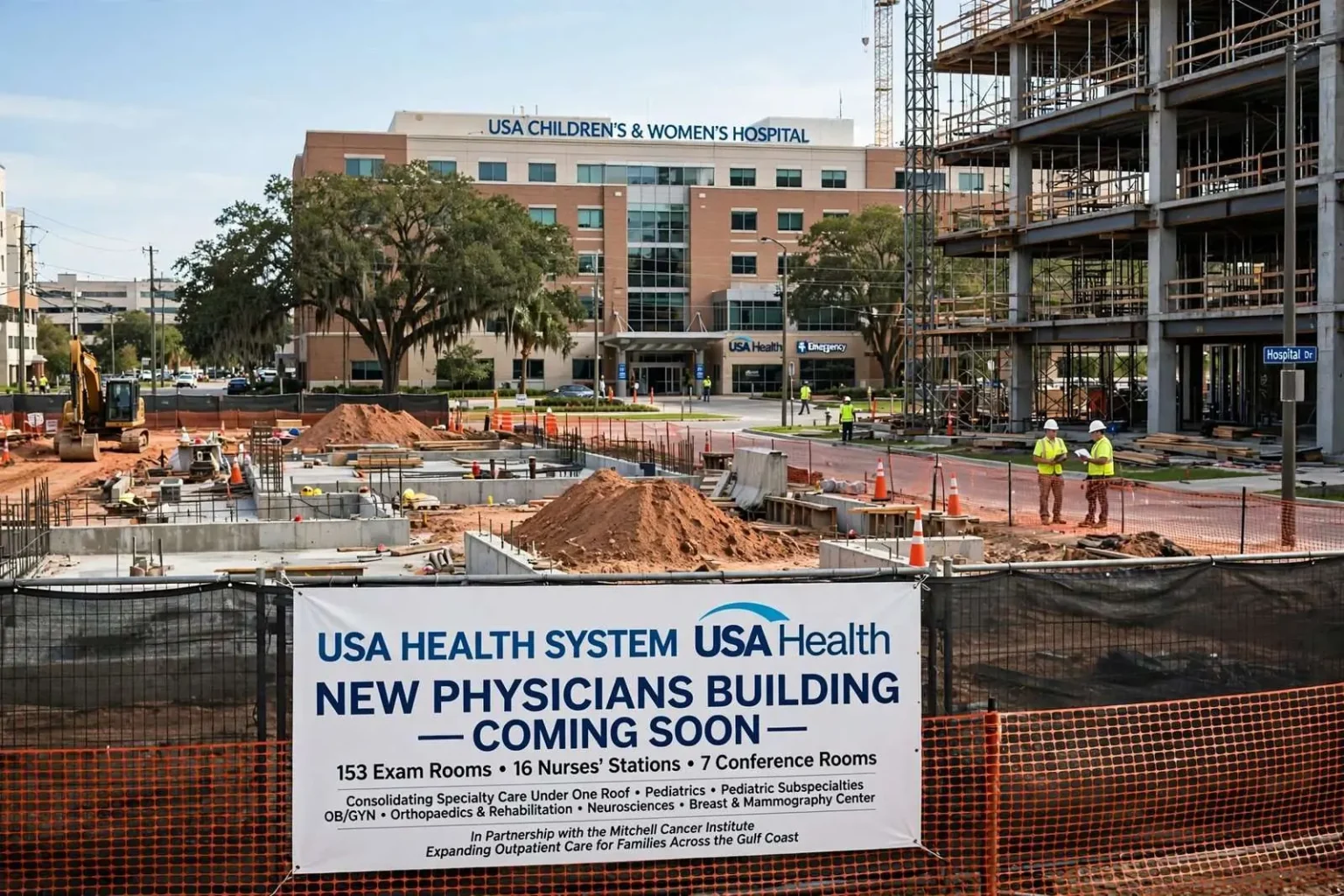
MOBILE, Alabama — A major expansion is underway at USA Health System’s medical campus in midtown Mobile, where crews have spent recent weeks pouring concrete and running utility lines for a new physicians building that will significantly expand outpatient care options for families across the region.
The new facility rises directly across from USA Children’s & Women’s Hospital and, once finished, will house 153 exam rooms along with 16 dedicated nurses’ stations and seven conference rooms set aside for medical education and training.
Consolidating specialty care under one roof
The scale of the project reflects how much the health system’s outpatient practice has grown in recent years. According to Becky S. Tate, who oversees ambulatory services and network development for USA Health System, the building is designed to consolidate a wide range of specialty care under one roof.
She said a substantial share of the USA Physicians Group’s clinical operations — including general pediatrics, pediatric subspecialties, obstetrics and gynecology, orthopaedics and orthopaedic rehabilitation, and neurosciences — will relocate to the new site once construction wraps up.
The move will also bring ancillary services closer to patients who currently have to travel between multiple buildings for testing, follow-up visits and specialty referrals. Families managing complicated diagnoses often spend a full day at the medical campus, moving a child from a pediatric specialist to a lab draw to a follow-up appointment in yet another building; consolidating those stops is the central promise of the project.
Perhaps the most notable addition tucked into the new building is a breast and mammography center that will work in tandem with the Mitchell Cancer Institute, providing oncology care to patients whose treatment often requires coordination across several departments. Housing those services near existing children’s and women’s care means patients dealing with a cancer diagnosis, along with the families supporting them, will not have to travel as far across the medical campus for appointments.
A familiar sight for midtown commuters
For neighbors and commuters who pass the Children’s & Women’s Hospital corridor, the construction has been hard to miss, with heavy equipment and reddish dirt piled along the site for months. Project leaders say the work has been sequenced to keep disruption to hospital traffic as limited as possible while utility connections and foundations go in.
The hospital corridor in midtown Mobile has grown steadily over the years into one of the city’s most important medical districts, anchored by USA Children’s & Women’s Hospital — the region’s dedicated children’s and women’s hospital and the referral center for high-risk pregnancies and critically ill newborns across a wide swath of the central Gulf Coast.
Families from Baldwin County, the Mississippi line and the rural stretches of southwest Alabama routinely make the trip to the campus for care unavailable closer to home. Each additional exam room and specialty suite at the new building translates, in practical terms, into shorter waits for appointments that those families would otherwise schedule months in advance.
The USA Physicians Group serves as the teaching practice for the University of South Alabama’s College of Medicine, meaning the doctors seeing patients in its clinics are also the faculty training the region’s next generation of physicians. The seven conference rooms built into the new facility reflect that dual mission, giving residents, students and faculty space for case reviews, lectures and training sessions on site.
Why outpatient growth drove the project
Health systems across the country have shifted more care from hospitals to outpatient settings over the past generation, and USA Health’s expansion follows that pattern. Routine visits, imaging, infusion therapy and follow-up care that once required a hospital trip now happen in clinic settings — but only if there are enough rooms to hold them.
A physicians building with 153 exam rooms is a bet that demand for outpatient specialty care in the Mobile region will keep climbing. The population of the central Gulf Coast has grown along the I-10 corridor, and as specialist appointments concentrate at a handful of major centers, capacity at those centers becomes the limiting factor on how quickly patients can be seen.
For obstetrics and gynecology patients, proximity to Children’s & Women’s Hospital matters in a particular way: the same campus where a woman receives prenatal care is where she would deliver, and where a newborn in distress would be treated. Putting those clinics steps from the hospital delivery floors shortens the distance between routine care and emergency response.
The same logic applies to pediatrics. A child seen for a subspecialty appointment — cardiology, for instance — often needs imaging, labs or procedures on the hospital side of the campus. A building across the street, rather than across the district, changes what a family’s day of appointments looks like.
What construction means for the campus
Utility work and foundation preparation are the unglamorous first phases of a project of this size, and the recent weeks of poured concrete and trenched utility lines are the visible proof that the building is moving from drawings to steel. The site across from the hospital was chosen in part so the new building can plug into the campus’s existing infrastructure.
Hospital traffic — ambulances, delivery trucks, patient drop-offs — will share the corridor with construction vehicles for the duration of the build. Signs and flaggers direct drivers around the work zone, and hospital officials have encouraged patients with appointments to allow extra time for parking while construction is active.
When the building opens, its operations will bring hundreds of staff and patient visits per day to the corridor, adding to demand for parking and shaping how the campus’s internal shuttle and pedestrian routes work. Campus planners have treated the new building as a piece of a larger puzzle that will continue to be rearranged as USA Health grows.
No opening date for the facility has been announced publicly, and construction timelines for medical buildings depend on everything from weather to equipment lead times. What is certain is that the midtown skyline along the hospital corridor has permanently changed, and that when the doors open, the flow of patients through USA Health’s campus will change with it.
The Mitchell Cancer Institute connection
The planned breast and mammography center stands out among the new building’s services because of its link to the Mitchell Cancer Institute, USA Health’s academic cancer research and treatment center. Breast cancer care typically involves a rotation of specialists — radiologists who read screening images, surgeons, medical oncologists and radiation oncologists — and each handoff between them is a chance for delay.
Co-locating screening and diagnostics near the specialists who act on them compresses that timeline. A mammogram that reveals something suspicious can be followed by diagnostic imaging and a biopsy referral without the patient driving across town between steps, and coordination with oncology care at the Mitchell Cancer Institute becomes a hallway conversation rather than a phone referral.
The arrangement also fits the pattern of modern cancer care, in which early detection is the single biggest factor in outcomes. Screening capacity — enough machines, enough appointment slots, enough reading radiologists — is often the practical constraint on how early cancers are caught in a given region.
What it means for local families
For the families who use USA Health’s clinics, the day-to-day effect of the new building will show up in scheduling. More exam rooms means more appointment slots in the specialties that are routinely backlogged, and more nurses’ stations means more clinical staff working the floor at once.
Parents of children with chronic conditions — the families who visit pediatric subspecialists every few weeks for years — stand to notice the change most. Their lives are organized around the medical campus, and any improvement in how appointments, testing and prescriptions fit together cascades through school schedules, work schedules and household budgets.
The building’s education spaces carry a longer-term payoff as well. The University of South Alabama’s medical training pipeline supplies physicians to hospitals and clinics across the Gulf Coast, and modern training facilities are part of what keeps residency and fellowship candidates interested in Mobile. Doctors who train in a city often stay to practice in it, which is how a physicians building becomes, indirectly, a regional health care investment.
Construction continues in the meantime, with the cranes and dirt piles along the corridor serving as a standing notice that one of Mobile’s most important medical institutions is getting bigger.
Access and transportation around the campus
The medical district’s growth has practical consequences for how patients get there. The campus sits in midtown Mobile, reachable from the I-10 and Airport Boulevard corridors, and its patient lots fill early on weekday mornings when clinic schedules are heaviest. Hospital officials routinely point new patients toward the campus’s drop-off lanes and shuttle connections when visiting for the first time.
For families coming from outside Mobile County, the drive is a real part of the cost of care. A family from Monroeville, Bay Minette or Gulf Shores planning a specialist appointment builds the day around the trip, which is precisely why the health system has worked to cluster services close together — fewer separate trips means less money and time spent on the road.
The expansion also fits into a broader pattern of medical investment along the Gulf Coast, where health systems in Mobile, Pensacola and along the Baldwin County growth corridor have all added capacity in recent years. Competition for patients and for physicians has raised the stakes of modern facilities, and academic health centers like USA Health must keep pace both to serve patients and to recruit the specialists who deliver that care.
As the building takes shape across from Children’s & Women’s Hospital, the project stands as the clearest sign yet of where the health system’s priorities lie: outpatient access, integrated specialty care, and a campus designed around the needs of the families who depend on it. The dirt piles and construction fencing will be gone eventually; the exam rooms, and the care they make possible, are meant to last for decades.