
USS Philippine Sea and Coast Guard Cutter Sail Into Mobile for Mardi Gras Week
The USS Philippine Sea and USCGC Jacob Poroo dock in Mobile for Mardi Gras with free public ship tours during Carnival week.
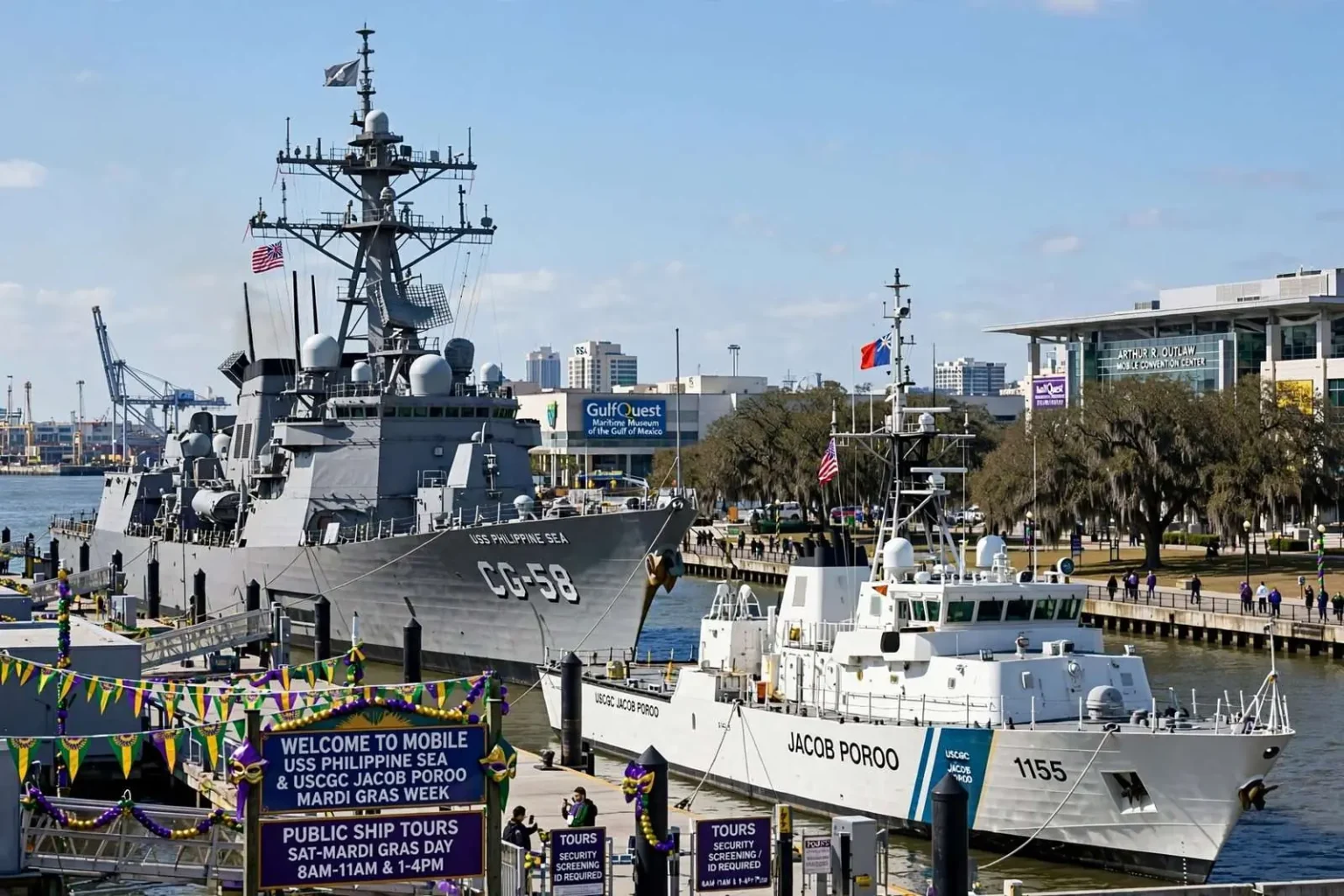
Two visiting vessels are adding a military flourish to Mobile’s Mardi Gras season: the Navy guided-missile cruiser USS Philippine Sea and the Coast Guard fast response cutter USCGC Jacob Poroo are both in port, and both will welcome public tours during the height of Carnival week. The visits pair one of the Navy’s most capable surface combatants with one of the Coast Guard’s newest patrol boats along Mobile’s downtown waterfront.
The Philippine Sea is a Flight II Ticonderoga-class cruiser homeported in Mayport, Florida. The Jacob Poroo, a Sentinel-class cutter, is assigned to Pascagoula, giving the port call a distinctly Gulf Coast flavor: two ships whose crews work the same regional waters, welcomed into Alabama’s only major seaport as the city rolls out its signature celebration.
Ship visits during Mardi Gras have become a valued tradition in Mobile, tying the city’s maritime identity to its Carnival calendar. The city’s waterfront, from the Alabama State Port Authority terminals to the museums and parks along the river, provides a stage where visiting sailors and Coast Guardsmen can step off the ship and into the middle of one of America’s oldest festival seasons.
Welcoming Ceremony Friday
A public welcoming celebration for the Philippine Sea is set for 11 a.m. Friday at the State Port Authority’s Pier 2 Terminal. Visitors can enter through a temporary gate at the north end of the Arthur R. Outlaw Mobile Convention Center on Water Street. The program features high school JROTC units, the Murphy High School band, the Azalea Trail Maids, the USS Alabama Crewmates and local dignitaries.
The lineup of participants reads like a cross-section of Mobile’s civic traditions. The Azalea Trail Maids, the city’s iconic ambassadors in antebellum-style gowns, have represented Mobile at events across the country for decades. The Murphy High School band brings one of the city’s oldest school music programs to the pier, and JROTC units from area high schools give students a direct look at the naval service that has shaped the Gulf Coast for generations.
Welcoming ceremonies of this kind serve as both official greetings and community events, giving residents a chance to see the visiting ships up close before public tours begin. Port officials note that ship visits also carry economic weight, bringing crew members ashore to spend time — and money — in downtown restaurants, hotels and attractions during one of Mobile’s busiest visitor weeks.
For the ships’ crews, a Mardi Gras port call offers a rare break in demanding operational schedules. Sailors and Coast Guardsmen will have the opportunity to experience Mobile’s parades, museums and hospitality, continuing a long tradition of liberty ports along the northern Gulf.
Tour Schedule
According to the Navy League of Mobile and the State Port Authority, tours run as follows: USS Philippine Sea — Saturday, Sunday, Monday and Mardi Gras Day (Tuesday), 8-11 a.m. and 1-4 p.m. USCGC Jacob Poroo — Saturday, 11 a.m.-4 p.m., and Sunday, 11 a.m.-2 p.m. The tour gate for both ships is on the north side of the Convention Center.
Visitors planning to tour should plan for standard security screening at the gate, including identification checks and restrictions on bags, in line with normal military installation practices. Touring a warship involves stairs and narrow passageways, so visitors with mobility concerns are advised to consider the limits of the vessels before joining a tour line.
About the Ships
The USS Philippine Sea is a Flight II Ticonderoga-class guided-missile cruiser, a class built around the Aegis combat system and its distinctive phased-array radar. Cruisers of this class have served as the backbone of the Navy’s air defense for decades, protecting carrier strike groups and operating independently in contested environments. The Philippine Sea takes its name from the pivotal 1944 Battle of the Philippine Sea, one of the decisive carrier engagements of the Pacific war, and carries on the legacy of an earlier carrier of the same name.
Homeported at Naval Station Mayport near Jacksonville, the ship regularly deploys to the Atlantic, the Mediterranean and the Middle East, and visits like this week’s stop in Mobile give inland communities a rare chance to walk the decks of a front-line warship. The cruiser’s crew numbers in the hundreds, and its hull — more than 500 feet long — will dominate its berth at the pier for the duration of the visit.
The USCGC Jacob Poroo represents a different side of the maritime services. Sentinel-class fast response cutters are 154-foot patrol ships designed for law enforcement, search and rescue, and coastal security missions. The class is named for Coast Guard enlisted heroes, and the cutters have become the workhorses of the Coast Guard’s patrol fleet, performing fisheries enforcement, migrant interdiction, drug interdiction and port security missions.
Assigned to Pascagoula, Mississippi, the Jacob Poroo operates regularly in the Gulf, often working alongside Sector Mobile, which oversees Coast Guard operations from the Florida panhandle to the Mississippi Sound. A port call a short run west of its homeport is a homecoming of sorts for the cutter’s crew, many of whom patrol these same waters week after week.
The Waterfront Setting
The Jacob Poroo will be moored beginning Friday at GulfQuest, the maritime museum next to Cooper Riverside Park. The placement is fitting: GulfQuest’s exhibits celebrate the Gulf of Mexico’s maritime heritage, from shipbuilding to commercial fishing, and a working Coast Guard cutter docked alongside gives visitors a living exhibit to complement the museum’s galleries. Cooper Riverside Park, the grassy waterfront park between the museum and the river, has hosted countless public events and offers an easy vantage point for viewing the ship even for those not taking a tour.
The larger Philippine Sea ties up at the Port Authority’s Pier 2, part of the working terminal complex that makes Mobile one of the busiest ports on the Gulf. The juxtaposition is a reminder of the port’s many roles in the same stretch of river: cargo terminals, cruise facilities, museums, parks and now two visiting government vessels sharing the waterfront with the city’s biggest party of the year.
Mardi Gras week is the busiest stretch of Mobile’s calendar. The city’s parades draw large crowds downtown, and hotels and restaurants fill with visitors from across the region. Ship tours add a family-friendly option to the schedule, giving visitors an activity between parades and a look at the maritime infrastructure that most of the year sits behind security fences.
Planning a Visit
Those attending the Friday ceremony or the weekend tours should expect downtown traffic and street closures tied to parade schedules, and organizers recommend arriving early and using parking decks rather than street parking. The tour gate at the north side of the Arthur R. Outlaw Mobile Convention Center on Water Street will be clearly marked, and signage will direct visitors to each ship’s line.
Members of the Navy League of Mobile, which coordinates the visit locally, have long worked to connect the port city with the fleet, hosting ship visits, supporting sailors and their families, and keeping Mobile’s naval traditions visible. The organization’s partnership with the State Port Authority has made Mobile a recurring stop for Navy and Coast Guard vessels transiting the Gulf.
For the duration of the visit, both ships will be visible from the riverwalk and the water, and the sight of a Navy cruiser moored downtown during Mardi Gras is expected to draw crowds of its own. Visitors unable to take a scheduled tour can still view the vessels from Cooper Riverside Park and the Convention Center waterfront, where the ships will be moored through the holiday weekend.
Military participation in Mobile’s Mardi Gras stretches back generations, from naval celebrations in the city’s early history to modern ship visits timed to the season. The USS Alabama, the battleship at the heart of Battleship Memorial Park across the river, anchors that heritage in steel, and events like this week’s tours keep the connection between the city and the sea services alive for new generations.
Local officials emphasize that the visits are more than ceremonial. Port calls support recruitment, give regional residents a tangible connection to national defense, and reinforce Mobile’s identity as a maritime city — a place where the port, the shipyards, the museums and the military all share the same waterfront. With the Philippine Sea and the Jacob Poroo both alongside, downtown Mobile offers one of the most unusual pairings of the Mardi Gras season: armored warships moored a short walk from mask vendors, parade routes and the city’s historic squares.
The tours wrap up on Mardi Gras Day itself for the Philippine Sea, closing out a visit that spans the busiest days of the Carnival season. After the ships depart, the waterfront returns to its usual rhythm, and the crews carry with them a Gulf Coast welcome that Mobile has extended to visiting sailors for as long as there have been ships on the river.


