The Cabal Behind the Stock Board: Five Mobile Brokers Shop for a New Firm
Part twelve of a memoir of a bygone Mobile: five brokers met each afternoon after the boss left for his club, plotting to sell a ready-made Mobile office to a Wall Street firm.
The twelfth installment of a serialized memoir of a bygone Mobile is a story about information — specifically, about a boss whose authority depended on his employees not having any. The five brokers in the downtown office knew almost nothing of the customs of their own industry. Their manager saw to that. He kept them ignorant of the usual arrangements between Wall Street firms and their account executives and told them, repeatedly, how fortunate they were to work for so generous an employer.
The author broke the monopoly with a postage stamp. He wrote to Forbes magazine asking what account executives were normally paid. The magazine printed the letter in its correspondence column with his name beneath it — and the manager was a subscriber. His heart leaped when he saw it, but he heard nothing, and concluded the boss had missed the issue. The answer confirmed his suspicions. Large firms, carrying heavy advertising and research costs, generally paid about 33 percent of the commissions a broker generated. Smaller houses with lower overhead paid 37 percent or more, some as much as 40. On a 37 percent payout, he had been underpaid for years, and so had the colleague who had been there nearly as long. The newer men, with less tenure, had less to be angry about.
Mobile’s financial district in 1962
The setting was Mobile’s financial district, a compact grid of streets between the riverfront and Dauphin Street where the city’s banks, brokerage houses, and insurance companies had clustered since the late nineteenth century. The building at the corner of St. Francis and Royal housed the Mobile office of a regional brokerage firm — not one of the Wall Street names, but a respectable Southern house with roots in Birmingham and Atlanta. The office occupied the third floor, reached by a brass-caged elevator that smelled of cigar smoke and floor wax.
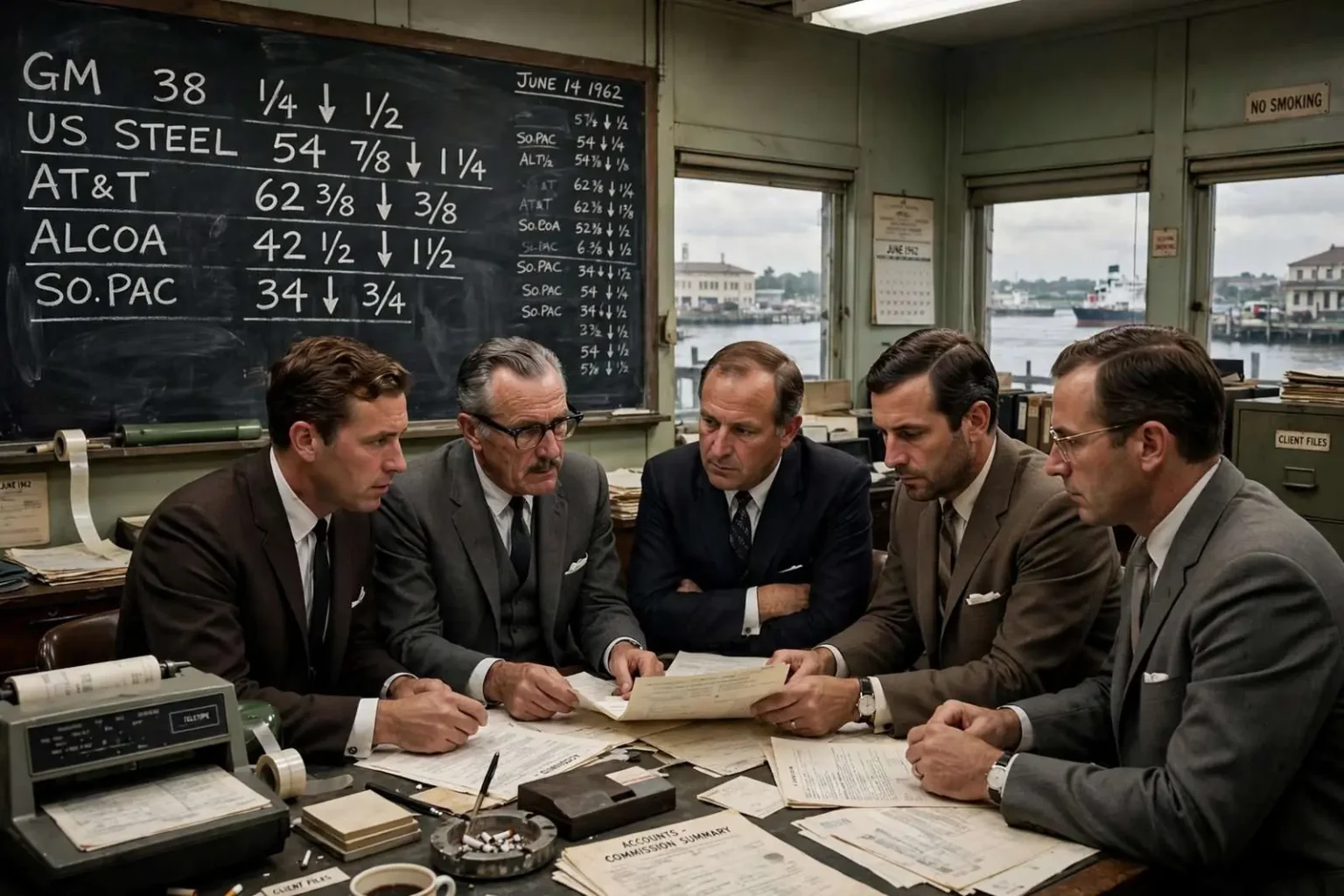
The five brokers shared a single large room with a row of windows looking out over the Mobile River. Their desks were arranged in a semicircle around a central quote board — the “stock board” of the title — where a young woman in a green eyeshade posted prices by hand, chalk on slate, as they came over the ticker tape. The manager, a man named Hendricks, had run the office for 22 years. He wore three-piece suits in the Alabama summer, kept his door closed, and conducted his business by telephone with a voice that never rose above a murmur.
The information monopoly
Hendricks controlled the flow of information with the same quiet absolutism that he applied to everything else. The brokers received no trade confirmations directly — those went to the back office. They saw no commission statements — Hendricks distributed checks in sealed envelopes at the end of each month. They were not permitted to attend industry conferences, subscribe to trade publications, or correspond with brokers at other firms without his knowledge. When a new hire asked about the firm’s partnership track, Hendricks replied that loyalty was its own reward and the subject was closed.
The author, the newest of the five, had been with the firm for eighteen months. He had come to Mobile from Auburn with a business degree and a vague ambition to be a stockbroker, inspired by his father’s stories of the bull market of the 1950s. He found the work baffling at first — the arcane language of puts and calls, the ritual of the morning call, the unspoken hierarchy that governed who spoke to which clients. But he was good at the phone, and he was good at listening, and he began to understand that the real product was not stocks but trust.
Meetings after the close
One spring afternoon in 1962, with the bear market well advanced and business hard, the five held a serious session. They agreed to approach other brokerage houses and ask whether any of them wanted to acquire a ready-made office in Mobile. As spring went on, so did the conspiracy. They met after the close nearly every day, usually in the office itself, which was safe enough because the manager had left for his private club. They stayed out of earshot of the back-office manager and wire operator, though they did not worry about the young women marking the board, reasoning that they could not possibly care.
The back-office manager surely noticed five men gathering for an hour each evening, but he was a company man of twenty years’ standing, and his loyalty to Hendricks was absolute. The wire operator, a taciturn man who spent his days in a glass-walled booth listening to the tickertape chatter, offered no opinion. The young women — there were three of them, all recent graduates of Murphy High or McGill Institute — marked the board with precise, rapid strokes of chalk and asked no questions.
The conspiracy was, in retrospect, remarkably amateurish. They had no lawyer, no accountant, no plan for valuing their book of business. They had only the Forbes article, a shared sense of grievance, and the bear market’s relentless pressure on their incomes. Commissions had fallen 40 percent from the 1961 peak. The newer men were struggling to cover their draws. The author and his senior colleague, a man named Calloway who had been with the firm since 1948, had savings to draw on, but they also had families — mortgages on new houses in Spring Hill, children approaching college age.
The approach
They began by making discrete inquiries. Calloway knew a man at a Birmingham firm who had once mentioned expansion into Mobile. The author wrote to a contact at a New Orleans house. A third broker, a quiet man named Dodd, reached out to a former classmate at a small Atlanta firm. The responses were encouraging. The Birmingham firm sent a partner to Mobile for a quiet dinner at the Battle House. The New Orleans house requested a list of accounts — anonymized, with commission totals. The Atlanta firm asked for a meeting in Atlanta, which the five attended on a Tuesday, driving the four hours in Calloway’s Buick.
Each meeting followed a similar pattern. The acquiring firms were interested — Mobile was growing, the port was expanding, the new interstate would bring more business — but cautious. They wanted to see the books. They wanted non-compete agreements. They wanted the brokers to stay for at least two years. The five conferred, compared notes, calculated. The Birmingham firm offered 38 percent of commissions, a two-year guarantee, and a signing bonus. The New Orleans house offered 40 percent but no guarantee. The Atlanta firm offered 35 percent with a path to partnership.
The confrontation
The end came on a humid Thursday in June. The five had decided on the Birmingham firm. They had drafted a resignation letter — a single page, formal, giving the required thirty days’ notice. They placed it on Hendricks’s desk at 4:55 p.m., five minutes before the close, and waited in the outer office.
Hendricks read it. He did not shout. He did not threaten. He called each of them into his office, one by one, and spoke to them for exactly twelve minutes each. The author was last. Hendricks offered him 38 percent, effective immediately. A partnership track. A new office on the fourth floor. The author said no. Hendricks nodded, opened the door, and said, “Good luck.”
By Friday morning, the office was empty. The quote board was blank. The young women had been reassigned to other departments. The wire operator had retired, effective immediately. Hendricks sat alone in his office, the door closed, the phone silent.
The Birmingham firm made good on its offer. The five brokers moved into a suite in the new First National Bank building on Bienville Square, with air conditioning, a private conference room, and a secretary who brought coffee at 9:30 and 2:30. Their commissions recovered. Calloway made partner in 1965. The author stayed with the firm until 1978, when he left to start his own registered investment advisory practice — one of the first in Alabama.
What the cabal learned
Years later, the author would say that the cabal behind the stock board taught him three things. First, that information is power, and the hoarding of information is the hallmark of a weak leader. Second, that loyalty is a two-way street — Hendricks demanded it but did not return it. Third, that the market always corrects, eventually. The bear market of 1962 bottomed in October. The bull market that followed lasted until 1966. The five brokers who walked out in June rode every inch of it.
Mobile’s financial district has changed beyond recognition. The brokerage houses consolidated, then consolidated again. The quote boards are gone, replaced by Bloomberg terminals. The brass-caged elevators have been modernized. The Battle House burned in 1963, was rebuilt, burned again, and now stands as a luxury hotel. The young women who marked the board are grandmothers now, or gone.
But the lesson remains: a boss who keeps his employees in the dark is not protecting them. He is protecting himself. And the employees who wait for permission to know their worth will wait forever. The postage stamp cost three cents. The Forbes letter took twenty minutes to write. The knowledge it brought changed five lives. That is the arithmetic of information, and it has not changed in sixty years.