Sixteen Tenants in Five Apartments: A Reluctant Landlord on South Lawrence Street
Part seven of a memoir of a bygone Mobile: inheriting his mother's apartment house, the author found himself collecting rent from a cast of tenants the suburbs had left behind.
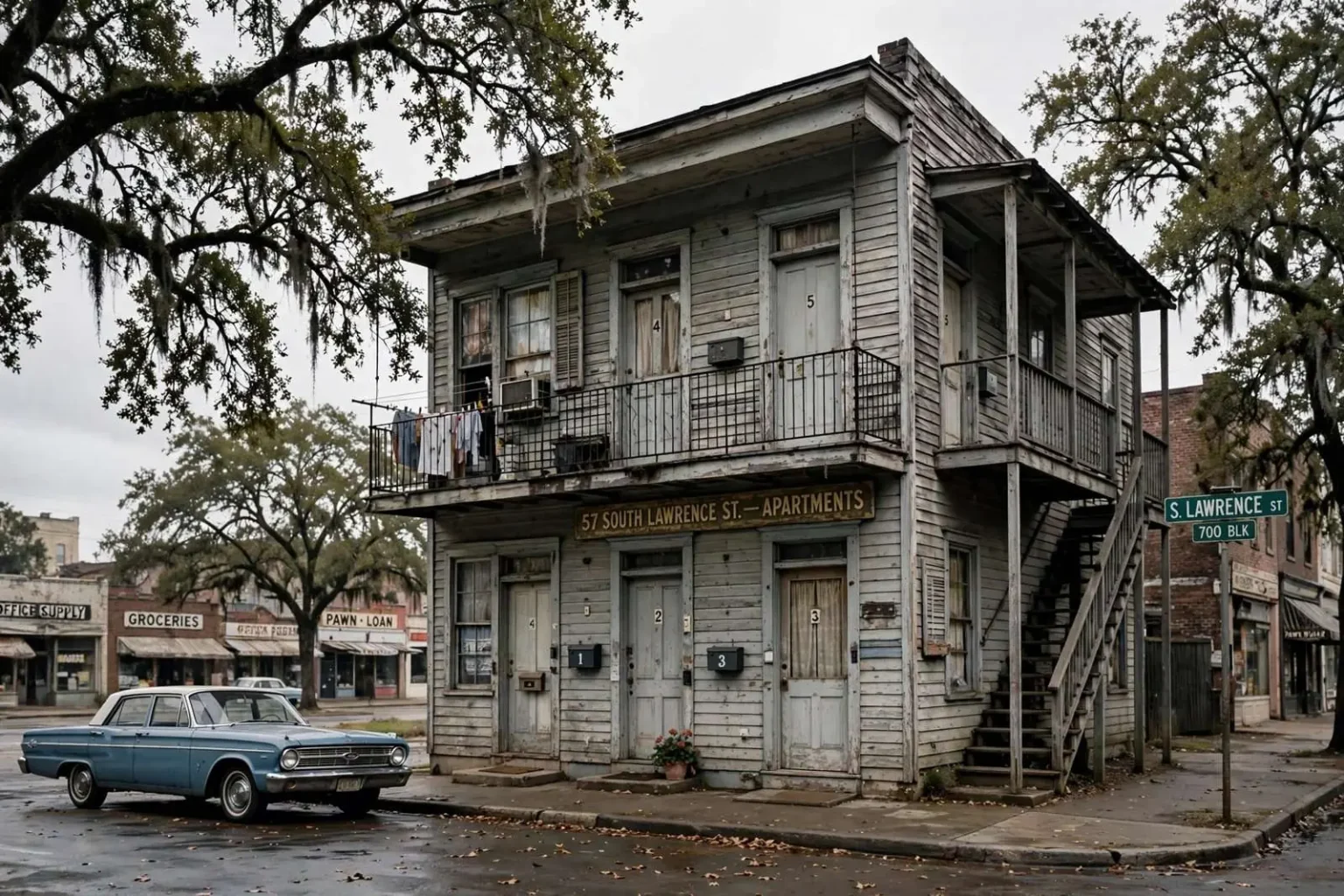
The seventh installment of a serialized memoir of a bygone Mobile turns from the brokerage office to a subject the author had no training for whatever: the management of an old downtown apartment house. It is, in the telling, less a career chapter than an inheritance problem — the story of a man who wanted to sell a building and instead became, by necessity and for four years, its reluctant landlord.
His mother’s will named him executor of her estate and trustee of a fund she had established for her eleven grandchildren, a number that would eventually grow to fourteen. Despite a top salary of $325 a month, and years in which she had worked for as little as $35, she had raised three children by herself and accumulated assets worth more than $60,000. It now fell to him to manage and distribute them. The figures tell their own story about the Mobile she worked in: a career that began at Depression-era wages and ended in a comfortable six-figure estate, built without a spouse’s income and without the financial instruments later generations of working women would take for granted. What she left was modest by any absolute standard and remarkable by the standards of a single mother’s wages in mid-century Mobile.
Her law firm probated the will promptly and without charge. Over the next few years he distributed nearly everything except the trust fund, the house, and a couple of small lots that, as of his writing, he had never managed even to locate, much less sell. That last admission — parcels owned but unlocatable — is a small window into how property records worked in an era before digitized courthouse indexes: a lot purchased decades earlier, described in an old deed, could simply vanish from an heir’s practical reach, an artifact of paper titles and shifting street addresses that anyone who has probated an old Mobile estate will recognize.
A house on the wrong side of the trend
The house at 57 South Lawrence Street was the obstacle. The flight to the suburbs was well under way by the late 1950s and early 1960s, and an aging apartment house a half mile from the business center was not a choice piece of property. The same current was reshaping every American downtown in those years, and Mobile was no exception: families were moving to brand-new subdivisions out west Mobile way and across the bay, retailers were following them, and the older residential blocks nearest the central business district began a decline that would define the city’s core for decades. A working apartment house a short walk from the office towers had gone, in a few years, from convenient to marginal.
With his mother in it, however, the house had real value. She chose her tenants carefully, made friends of them, kept most of them a long time, and kept the building up. She was, he writes, an outstanding landlady. The distinction matters, and it recurs in every account of older urban rental housing: a building’s decline tracks its management more than its paint. Under a careful owner, an aging apartment house near downtown held steady tenants and steady income; under an indifferent one, it emptied. His mother had run hers the first way — as a small business with a personal touch, the kind of operation that shows up in no economic statistics but keeps a neighborhood’s blocks occupied.
He was hardly fitted for the role of landlord, particularly as he did not live on the premises. He counts the nearly four years that followed among the more interesting business experiences of his life. They came to a merciful end on Sept. 1, 1964.
The tenants
Through 1959 he held on to only two of his mother’s five tenants: two elderly widows living out their lives in what he calls genteel poverty. They were the residue of her careful selection — women who had paid on time for years, kept their rooms in order and treated the building as a home rather than a way station. Their presence in the house through the transition was both a blessing and a liability: they kept units occupied that a stranger would have had to be placed in, but their rents, fixed by old habits and old friendship, barely covered the cost of keeping the building standing.
The vacancies filled with a very different clientele. Into the lower northeast apartment came a red-haired woman whose appearance, he concedes in hindsight, should have warned him that her rooms would host more than one gentleman caller. The arrangement ended when one of her visitors discharged a firearm inside the apartment — whether at her, or at another caller who had gotten his appointment time confused, the landlord never established.
Rent collection there had its own etiquette. He would knock; she would come to the door in a negligee and invite him in; he would take exactly one step and stop. He never had to explain that the house operated on a cash basis, though he is fairly certain she was prepared to offer an alternative. The exchange, retold decades later, carries the deadpan of a man narrating a situation he had no idea how to manage: a new landlord, a tenant with a trade he understood and did not want to name, and a monthly ritual that both parties conducted with complete mutual comprehension and not one word of negotiation.
He was about as glad to see her go as he was to see the departure of any tenant, including the ones who set fire to a mattress in an upstairs apartment. An upstairs mattress fire in an old wooden-frame apartment house is not a minor incident; it is the nightmare scenario of every absentee landlord, a fire burning floors above sleeping tenants while the owner sits miles away in a brokerage office. The episode — and his relief at the tenants’ departure — captures the specific anxiety of owning rental property he could not watch: every phone call might be a fire, a shooting or a vacancy, and all three were expenses.
All told, in that first year as a landlord, sixteen tenants passed through five apartments. It goes without saying, he writes, that he did not demand long leases.
The arithmetic of that turnover describes a building in transition. Sixteen tenancies across five units in a single year means the population of the house changed three times over — the signature of a property that had moved from a stable rooming house under a resident owner to a revolving-door operation under an absentee one. Each new tenant meant screening he did not know how to do, leases he did not know how to write and repairs he did not know how to price. The mother who had made friends of her tenants had, unknowingly, left her son a business that depended entirely on the friendships she was no longer there to maintain.
The buyer in waiting
All of it was a holding operation, and he knew it. He could not run the house indefinitely, and he had one plausible buyer: a man named Albert Schock, who owned the corner property on Government Street bordering his mother’s lot. Schock had converted an old stone home into a large business office and needed more parking. The apartment house covered virtually its whole lot and offered space for perhaps a dozen cars — not much value to anyone but Schock, who wanted it badly and had nowhere else to expand.
The negotiation, as the memoirist sets it up, was a study in asymmetric need. A downtown building worth little as housing could be worth a great deal as a parking lot — but only to one particular neighbor, whose business had outgrown its lot and whose options for expansion were bounded by the streets around him. In a city where downtown land was becoming valuable precisely as the older uses on it declined, that kind of adjacency was money waiting to change hands. The seller’s problem was patience: he could not hold the building for years while waiting for a better buyer to appear, because no better buyer existed.
He was, the memoirist writes, an exasperating man to deal with. He would appear at the office or telephone at home, announce that he was nearly ready to make an offer, name an attractive price, and then stay — at length — wandering off the subject to explain what a fine man he was, how he trusted in the Lord and the Lord in him, and so forth. With other prospects, the landlord writes, he would have cut him off. Schock was virtually the only hope, so he played along.
That accommodation — enduring a monologue he would never have tolerated from any other prospect — is the installment’s quiet lesson in small-town commerce. Downtown Mobile in that era was a marketplace of personal relationships, where a banker, a broker and a property owner all knew one another’s reputations and where a deal could rise or fall on how a man conducted himself in a waiting room. The memoirist’s patience with Schock was not weakness; it was the rational strategy of a seller with exactly one buyer and no alternative market. The old stone office on Government Street and the tired apartment house on South Lawrence faced each other across the property line for years in exactly that posture: one side desperate to buy, the other unable to leave.
The installment ends, as the series does, on a hinge — the sale still ahead, the landlord’s endurance still unspent, the question of price still hanging between a man who trusted in the Lord and the Lord in him and a broker who trusted in little else.
Next in the series: Business and sentiment share quarters uneasily.