Cold Feet on the Coast: A Mobile Broker’s Conscience Nearly Sinks the Plot
The fourteenth installment of a bygone-Mobile memoir finds the conspirators summoned to a financier's beach house, an office secured in the Waterman Building, and one man losing his nerve.
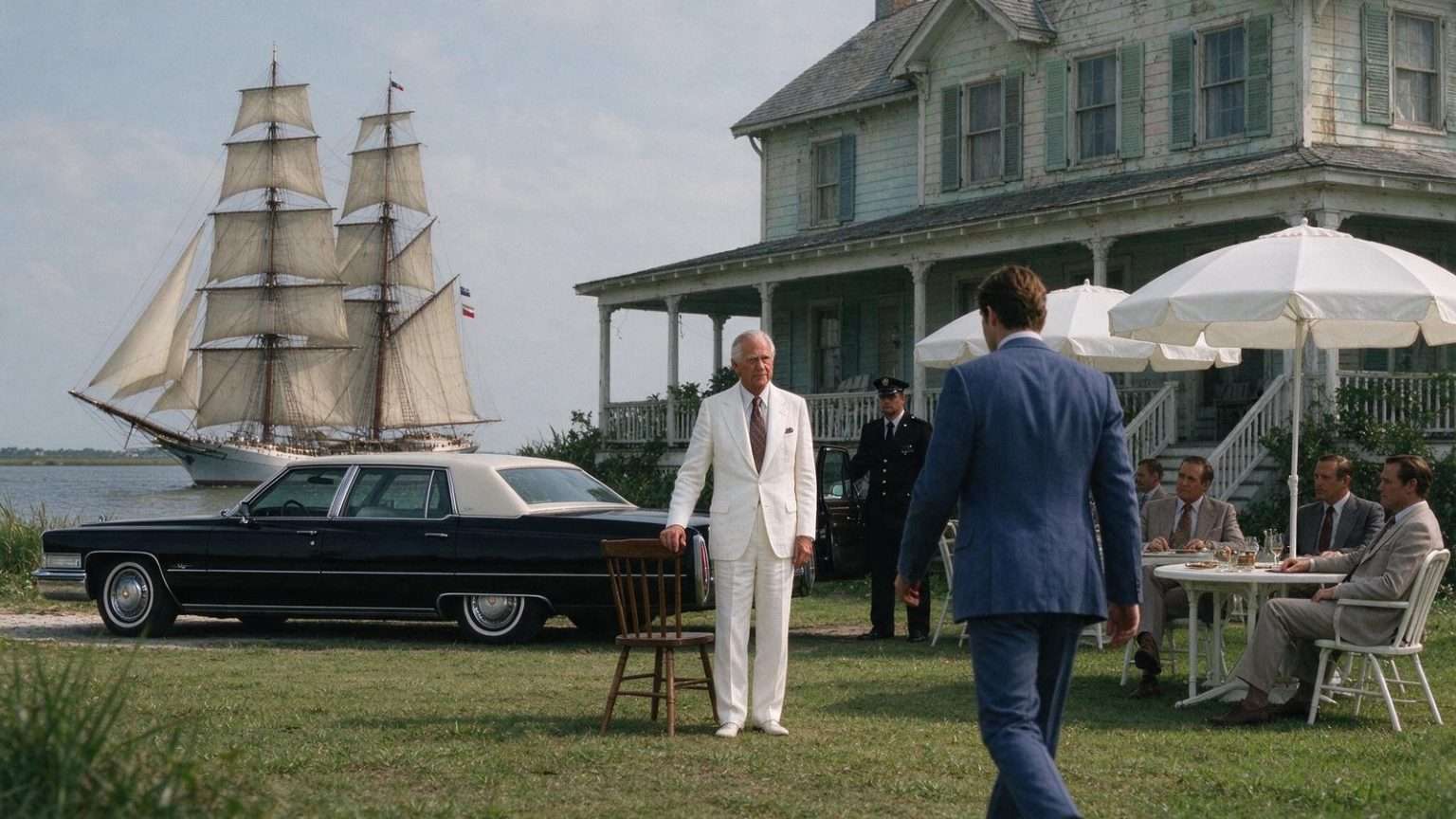
MOBILE — The fourteenth installment of Vita Sua, the serialized memoir of a bygone Mobile published anonymously under the byline “A,” moved the story from whispered telephone calls to face-to-face negotiation — and then, at the last moment, to the brink of collapse. The plot, for readers joining late, involved a group of Mobile stockbrokers determined to leave the branch office of a firm the memoirist calls SR, and the branch manager he calls X, whose petty tyranny had made their working lives intolerable. Their escape route ran through E.F. Hutton’s New Orleans office and its senior partner, a courtly and immensely wealthy financier identified only as G.T. The Cadillac and the conference room The Hutton principals came to Mobile in G.T.’s chauffeured Cadillac and set up headquarters at the Battle House, where they arranged for a conference room. The five conspirators trooped over one by one, after the market’s close, to avoid suspicion. The visitors were sufficiently impressed with their prospective recruits to set a second meeting — this one on a Saturday morning at G.T.’s summer home on the beach near Biloxi.
A Pirate’s Soul
The old man, the memoirist observed, had a bit of the pirate in his soul. He was one of the country’s foremost sailors, and owned a magnificent square-rigged vessel called the Windjammer — one of perhaps a dozen then in active service in the United States. It was an expensive hobby: G.T. kept a four-man crew on duty year-round to man her. The memoirist was convinced this explained the whole enterprise. Adding a small office in Mobile was, given G.T.’s resources, of almost no financial consequence, particularly with the market in a sour stretch. Had dollars and cents been his sole motivation, the writer believed, he would never have bothered. He was in it because he relished the plotting.
The Mobile men were received warmly on the coast and seated at umbrella-shaded tables on a spacious lawn. G.T. introduced his son, E, a man of about thirty who had the look of someone who had never wanted for anything. The conversation turned to the terms of the move: capital requirements, profit-sharing, the transition of client accounts. The SR brokers had built a book of business worth several million dollars in annual commissions — not Wall Street scale, but substantial for a regional office. G.T. listened, asked sharp questions, and signaled agreement in principle. The deal seemed done.
Cold Feet on the Coast
Then came the moment the memoirist calls “the hesitation.” As the parties moved toward the final handshake, one of the SR brokers — the youngest, the one with the most to lose and the least seniority — pulled back. He had spoken to his wife the night before, the memoirist writes, and she had reminded him of the mortgage, the children’s tuition, the car payments, the sheer terror of walking away from a guaranteed draw against commissions into the uncertainty of a startup venture backed by a man who might lose interest tomorrow. The broker asked for a guarantee — a minimum draw for twelve months, regardless of production. G.T. refused. He had not built his fortune by guaranteeing other men’s mortgages.
The negotiation unraveled in the space of an hour. The other four brokers, sensing the fracture, hedged. G.T. watched them with the same calm he brought to the quarterdeck of the Windjammer. He did not cajole, did not threaten, did not sweeten the offer. He simply let the silence stretch until the youngest broker — the one with the cold feet — announced he was staying at SR. The others, one by one, followed. By the time the Cadillac pulled away from the beach house, the deal was dead. The memoirist concludes the installment with a reflection on the nature of risk: “We are not pirates,” he writes. “We are men who watch pirates from the shore and wonder what it would be like to sail with them.”
Vita Sua and the Lost Mobile
Vita Sua — Latin for “his own life” — ran as a serialized column in a Mobile publication during the late 1970s and early 1980s, though the exact venue has been lost to the imperfect archives of the city’s newspaper history. The byline “A” was an open secret among the city’s professional class; the memoirist was widely believed to be a senior partner at one of Mobile’s established brokerage firms, writing under a veil of anonymity that allowed a candor about names, salaries, and office politics that a signed column could not. The series chronicled the transformation of Mobile’s financial district from a sleepy backwater of cotton factors and ship chandlers into a modern outpost of the national securities industry — a transformation the writer witnessed from the inside.
The fourteenth installment, from which the excerpt above is drawn, captures a pivotal moment: the attempted defection of a broker team from SR (widely understood to be Stern, Agee & Leach, Mobile’s oldest and most prestigious investment firm) to E.F. Hutton, the New York-based house that was aggressively expanding in the Sun Belt. The episode illuminates the cultural fault lines of Mobile’s business community in the 1970s — the tension between the old guard, represented by X (the tyrannical branch manager, a composite of several real figures), and the aspirants who saw their future in alignment with national firms rather than local institutions.
E.F. Hutton and the Sun Belt Expansion
E.F. Hutton & Co., founded in 1904, was in the 1970s one of the nation’s premier brokerage houses, famous for its “When E.F. Hutton talks, people listen” advertising campaign. The firm’s expansion into the Gulf South was part of a broader strategy to capture the wealth generated by the region’s energy boom, port traffic, and emerging defense contracting. New Orleans was the natural hub — its financial district on Carondelet Street hosted the regional offices of every major Wall Street firm. Mobile, 140 miles east, was a spoke: important enough to warrant attention, small enough to be managed from New Orleans.
G.T., the Hutton senior partner who orchestrated the recruitment, cuts a figure recognizable to anyone who knew the New Orleans financial world of that era: patrician, wealthy, passionate about sailing, and operating at the intersection of finance and social capital. The Windjammer, his square-rigger, was a fixture at Southern Yacht Club regattas and Gulf Coast regattas. His son E, the heir apparent, represented the next generation of the firm’s leadership — polished, privileged, and ultimately destined for a different world than the one his father inhabited. E.F. Hutton would not survive the 1980s intact; the firm was acquired by Shearson Lehman/American Express in 1987 after a check-kiting scandal and mounting losses. The Mobile office, if the deal had gone through, would have been swept up in that tumult.
Stern, Agee & Leach: The Local Institution
SR — Stern, Agee & Leach — represented the alternative path. Founded in 1901 as a cotton brokerage, the firm evolved with Mobile: from cotton to municipal bonds to corporate securities to investment banking. By the 1970s, it was the dominant local brokerage, with deep ties to the city’s founding families, the port authority, the shipyards, and the emerging chemical industry. Its culture was paternalistic: brokers were expected to build careers within the firm, not use it as a stepping stone. The branch manager X, in the memoirist’s portrayal, enforced this culture through intimidation and control — the “petty tyranny” that drove the five brokers to consider leaving.
The five conspirators represent a cross-section of the firm’s rising generation: the rainmaker with the million-dollar book, the technician who understood the new options market, the relationship manager who held the institutional accounts, the researcher who produced the morning commentary, and the youngest — the one who ultimately balked. Their collective book of “several million dollars in annual commissions” would have been a significant acquisition for Hutton’s New Orleans office, but not transformative. The real prize was the foothold: a team of Mobile natives with Mobile relationships, planted in a competitor’s office.
The Psychology of the Deal
The beach house negotiation scene is a masterclass in the unwritten rules of Southern business culture. G.T.’s refusal to guarantee the youngest broker’s draw — “He had not built his fortune by guaranteeing other men’s mortgages” — is both a statement of principle and a power move. In the world G.T. inhabits, risk is the currency of status. To ask for a guarantee is to admit you don’t belong at the table. The youngest broker’s wife, invoking the mortgage and the tuition, speaks the language of the middle class — security, predictability, the social contract that exchanges loyalty for stability. G.T. speaks the language of the capitalist — opportunity, leverage, the freedom to win or lose on your own terms.
The other four brokers’ collapse — “The others, one by one, followed” — reveals the fragility of collective action when the stakes are personal. Each man calculates his own exposure: the rainmaker knows he can rebuild anywhere; the technician knows his skills are portable; the relationship manager knows his clients follow him; the researcher knows his intellect is his asset. Only the youngest, with the least equity and the most obligations, voices the fear they all feel. Once he breaks, the coalition dissolves because its cohesion depended on the illusion that they were all in it together — an illusion the youngest broker’s honesty shattered.
Mobile’s Financial District: Then and Now
The Mobile financial district of the 1970s — centered on Dauphin Street between Royal and Water — was a dense cluster of brokerage offices, bank headquarters, insurance agencies, and the lawyers and accountants who serviced them. The Battle House hotel, where G.T. set up the conference room, was the district’s social anchor: its lobby, its bar, its dining room were where deals were hatched, rumors spread, and reputations made. The hotel declined in the 1980s, closed in 1974, and was magnificently restored in 2007 as the Battle House Renaissance, a Marriott Autograph Collection property. The financial district itself has dispersed: Stern, Agee & Leach was acquired by Stifel Financial in 2015; the regional banks were consolidated into national giants; the brokerage offices moved to suburban office parks along Airport Boulevard and I-65.
The Serialized Form and Its Legacy
Vita Sua’s serialized format — installments published at irregular intervals, each ending on a cliffhanger or a meditation — mimicked the rhythm of the life it described. The memoirist wrote when he had something to say, not on a schedule. The gaps between installments became part of the reading experience: the city speculated, debated, and waited. The anonymity of “A” allowed the writer to name real people thinly disguised (X, G.T., E) and real firms transparently (SR, Hutton) without fear of libel or professional retaliation. The column was gossip elevated to literature — or literature disguised as gossip.
When the series ended (the exact number of installments is uncertain; references suggest between 20 and 30), the memoirist simply stopped writing. No farewell column, no revelation of identity. The city’s professional class moved on. The brokers who stayed at SR built the careers X promised; the one who balked eventually left anyway, joining a different firm in a different city. G.T. died in the early 1980s; his son E took over the Hutton office briefly before the acquisition. The Windjammer was sold. The Battle House closed, then rose again. Mobile changed, as cities do. Vita Sua remains, in the fragments that survive, a portrait of a city at a moment of transition — caught between the old Southern paternalism and the new national capitalism, between the safety of the shore and the lure of the open water.