The Contract, the Confrontation and the Green-Faced Boss: A Mobile Walkout Remembered
The fifteenth installment of a bygone-Mobile memoir delivers the payoff: a suspiciously generous contract, a coordinated resignation, and a boss confronted at his club.
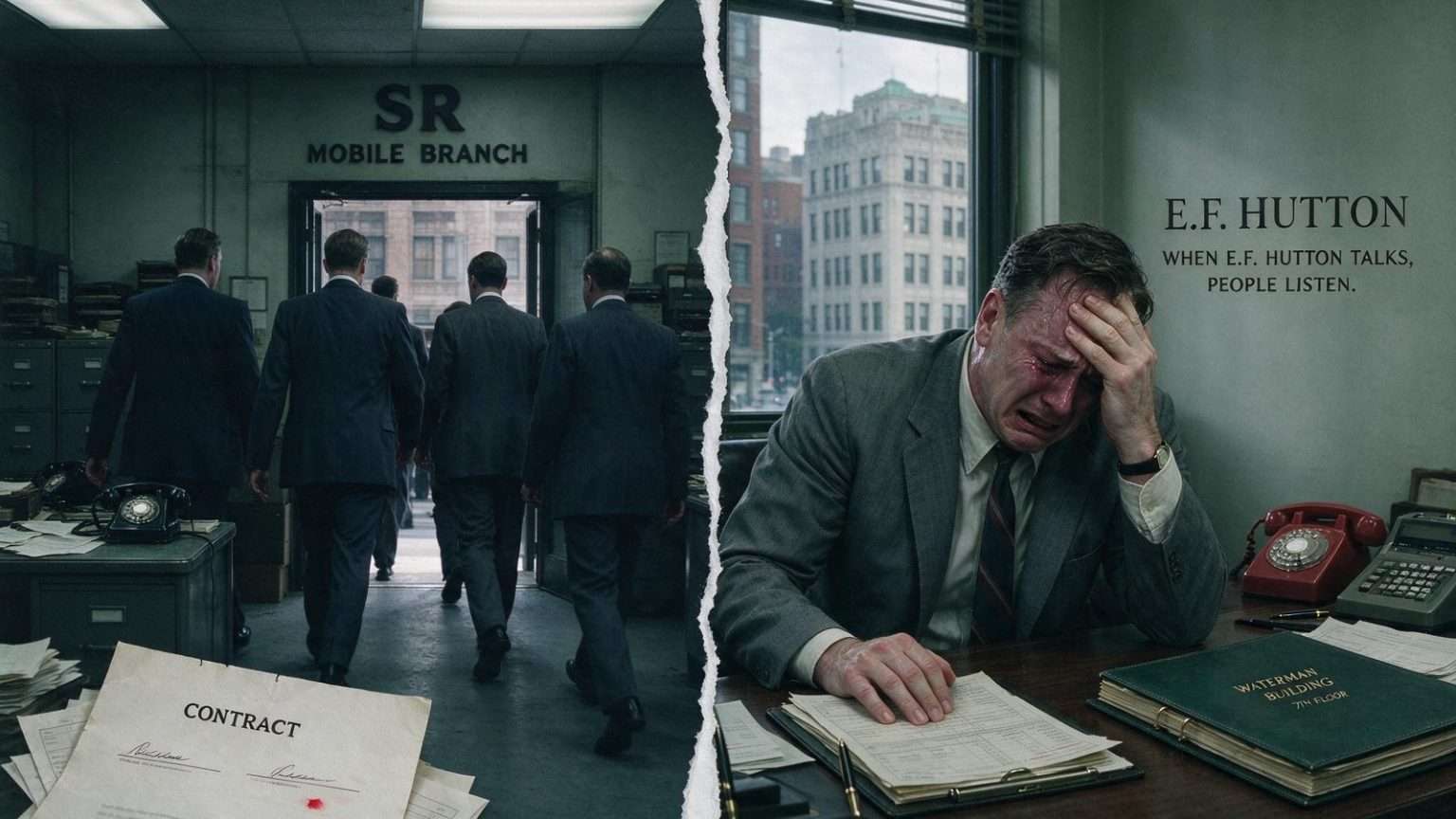
MOBILE — The fifteenth installment of Vita Sua, the anonymous serialized memoir of a bygone Mobile written under the byline “A,” delivered the moment the entire series had been building toward: the day five stockbrokers walked out of one firm and into another, and the day their tormentor learned about it.
The setup, for those coming to the story late: a group of brokers at the Mobile branch of a firm the memoirist calls SR had spent years under a branch manager identified only as X. Working in secret, they had negotiated a mass move to E.F. Hutton, arranged office space on the seventh floor of the Waterman Building, and set a date.
The migration the memoirists planned was the classic move of the brokerage era: a team departing as a unit, carrying its client relationships, its book of accounts and its working chemistry to a competitor that valued it more. In that world, a broker’s true asset was never the desk or the firm’s name — it was the trust of the clients who followed him across the street. A five-broker exodus in a city the size of Mobile was a tectonic event for the local branch, and everyone involved understood that once it happened, there was no walking it back.
Arranging it in secret was a necessity of the trade. Branch managers controlled the flow of information, the firm’s compliance machinery and — as this memoir describes at length — the day-to-day treatment of the men and women who worked under them. A defection that leaked early could be sabotaged: accounts frozen in transfer, paperwork delayed, and the departing brokers’ reputations worked over with clients before they could make their case. The Waterman Building office space, secured on the seventh floor, gave the move a destination before anyone inside the old firm could react.
An offer too good to be honest
Returning to Mobile from a covert trip to New Orleans, the memoirist found the atmosphere at the office markedly changed. X had evidently learned that something was in the wind. What it was, the writer was sure, he did not know. Given the man’s character, his reaction was strange indeed. He turned on his considerable charm, and aimed it squarely at the memoirist and his colleague BH.
“I’ve talked to Mr. M. and he has agreed that you boys should be promoted to assistant managers,” X told them. “And I’ve worked up a contract for you both that I’m sure will make you happy.”
He produced the document, and it was, by the standards of everything that had come before, a magnificent offer: A term of one year, renewable annually at the option of both parties. A fixed salary regardless of production. For the first time, a guaranteed 33 percent of their production.
Thirty-three percent was not overly generous, the memoirist conceded, but it represented a vast improvement over their existing terms — terms under which, he noted elsewhere, he had never been paid the full amount he earned. X pressed him to sign. He offered the flimsy excuse that he wanted to discuss it with his wife and would give an answer in a few days. Even as he said it, he knew how strange it sounded. No man who had been treated as they had been for years asks his wife’s permission to accept a contract that fixes his grievances; he asks her opinion of the moving company.
The offer’s structure told its own story. A one-year term, renewable at the option of both parties, was not security — it was a leash with a yearly knot. A fixed salary regardless of production inverted the brokerage’s fundamental deal, in which a broker eats what he kills; in the old arrangement the manager had skimmed the top and docked the rest, and now the memoirist was being offered a salary that would make the skimming formal. The 33 percent guarantee, meanwhile, was the number the departing brokers had negotiated across the street — arriving at the old firm’s table exactly as the move was being planned. Coincidence, the memoirist suggested, was not among the available explanations.
The green-faced boss
The installment’s climax — the moment the title remembers — comes when X learns the truth. The manager who had ruled the branch through charm, favoritism and financial squeeze discovers that five of his brokers are leaving, and his composure collapses. The memoirist’s portrait of the reaction — the face turning a color he describes as green — is the series’ accounting of what happens when a man who has spent years taking advantage of colleagues discovers they have priced him exactly right.
Nothing in the scene is stated as grievance; it is rendered as theater. The manager who had cultivated dependence — who decided who got the good accounts, who paid fully and who did not, who advanced and who stalled — meets the one result he cannot manage: his subordinates’ unanimous departure. The memoirist’s account lingers on the transformation of X from the office’s source of favors to its most conspicuous loser, because that transformation is the series’ central claim about the man: that his power had always rested on his brokers’ willingness to stay, and that the moment they priced their alternatives, the power evaporated.
The walkout itself the memoirist renders as procedure rather than drama. Five resignation letters, five sets of transfer papers for client accounts, and a migration up the street to the seventh floor of the Waterman Building — the mechanics of a defection that had been planned in New Orleans trips, after-hours meetings and careful, untraceable conversations. The drama was never in the paperwork. It was in the years of accumulated resentment that the paperwork finally spent.
The world the memoir describes
Vita Sua’s brokerage chapters preserve a world that has largely vanished: the branch offices of the great full-service firms, when stockbrokers worked on commission alone, cold-called from printed lead sheets, and lived or died by the loyalty of a client book they carried in their heads. The memoirist’s descriptions of the trade’s economics — gross production, the payout grid, the manager’s discretion over the split — document a compensation culture in which the firm’s promise and the broker’s paycheck were separated by a layer of men whose interest ran the other way.
E.F. Hutton, the destination firm, was in that era one of the recognized names of American brokerage, famous in the public mind for its advertising slogan about when E.F. Hutton talks, people listen. For Mobile’s brokers, moving to Hutton meant trading the local branch of one house for the local branch of another — same city, same clients, different table — which is precisely why the move was possible at all. The big houses competed for productive teams, and a five-broker block with a book of Mobile clients was a prize worth a guaranteed split and new offices.
The Waterman Building, the destination address, sits in the heart of downtown Mobile, and its upper floors housed exactly the kind of professional offices — lawyers, investment men, brokers — that gave the city’s business district its texture in the era the memoir recalls. A brokerage branch on the seventh floor was a claim of standing: the firm had arrived in a suite worthy of the clients it hoped to serve.
Why the installment matters
The fifteenth installment is the series’ hinge. Everything before it — the portrait of X, the accounting of unpaid earnings, the accumulating humiliations — exists to set up the day the brokers leave and the manager’s face goes green. Everything after it flows from the consequences: what the five men built in their new offices, what the old branch became without them, and what the memoirist learned about power once he was finally on the other side of a fair contract.
As social history, the installment records something larger than one office. It documents how working men in a mid-century Southern city actually fought back — not with unions or lawsuits, in a trade that offered neither, but with a coordinated market exit that converted their collective skill into leverage. The memoirist’s tone carries no triumph; he describes the victory with the wariness of a man who knows what it cost and who paid. But the scene it delivers — the contract refused, the truth revealed, the boss’s face turning color — is the payoff the series promised from its first installment, and it closes the story’s long accounting of a Mobile branch office with the only currency that office ever really traded in: who stayed, who left, and who got paid.
The installment also gives readers the clearest window yet into the memoirist’s own transformation. A man who had spent years accepting terms he never bargained for — and never being paid the full amount he earned — had learned, by the end of this chapter, to read a contract the way the man across the desk hoped he would not: term by term, clause by clause, asking what each promise costs and who holds the option. That education, purchased over years of shorted paychecks, is what the memoir frames as the real prize of the walkout — more durable than the new offices, the guaranteed split, or the sight of a green-faced manager learning that his brokers had done the arithmetic he assumed they never would.