Wawa Could Be Coming to Pensacola and Mobile
Wawa says it is scouting sites for new stores in Pensacola, Mobile and across the Florida Panhandle, with the first Gulf Coast locations expected to open.
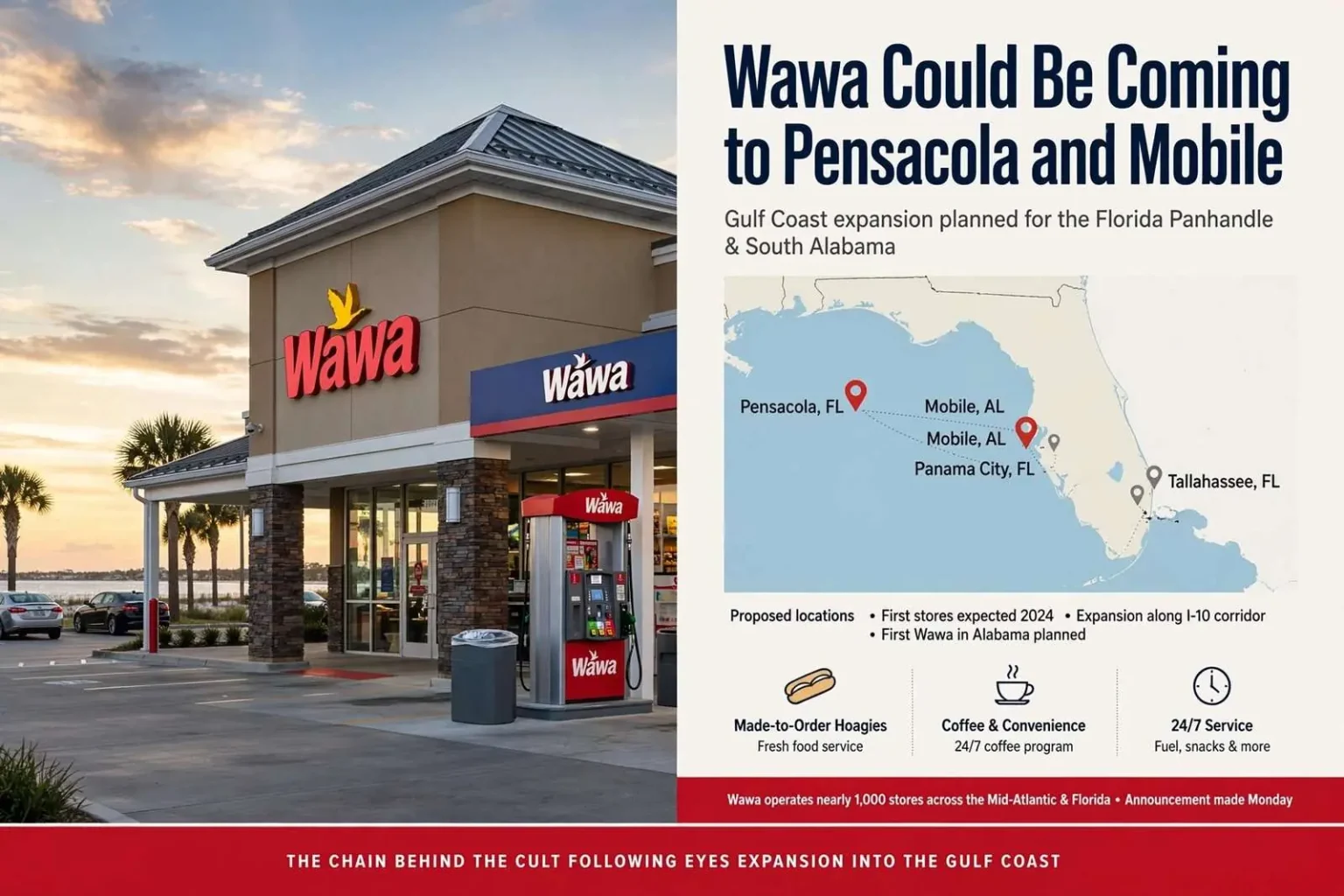
Wawa fans in the Gulf Coast may soon have a new place to grab a hoagie and a cup of coffee. The convenience store and gas station chain announced Monday that it intends to expand into the Florida Panhandle and adjacent markets in South Alabama over the next few years.
Wawa said it is “actively looking into potential sites for new stores” in Pensacola, Panama City and Tallahassee, Florida, along with Mobile, Alabama. “Over the years, we’ve been delighted to hear from so many people from so many areas who are interested in having a Wawa closer to home,” said John Poplawski, Wawa’s vice president of real estate.
There is no firm timeline yet for the Gulf Coast’s first Wawa, but the company said the initial Panhandle stores should open in 2024. Wawa operates nearly 1,000 locations across the Mid-Atlantic and Florida.
For a chain with a fan base that borders on devotion, the announcement lands as more than a real estate update. Wawa has built a national reputation out of all proportion to its footprint, drawing crowds at new-store openings and inspiring a loyalty most convenience retailers can only envy — and the prospect of stores along the Gulf Coast gives Mobile and Panhandle residents a taste of what Mid-Atlantic transplants have been describing for years.
The Chain Behind the Cult Following
Wawa’s story begins long before convenience stores. The company traces its roots to an iron foundry in Pennsylvania in the early 1800s, which later pivoted into milk processing and home delivery under the Wawa name — a word borrowed from the Lenni Lenape language for the Canada goose. The first Wawa food market opened in 1964, and the chain grew steadily through southeastern Pennsylvania, New Jersey, Delaware, Maryland and Virginia before pushing south.
The Florida expansion, launched in the 2010s, became the template for what the company now proposes in the Panhandle: entering a new region with a cluster of stores, building distribution capacity and watching demand compound. Wawa’s entry into Central Florida drew lines around the block at openings, and the chain has since spread across the peninsula, validating its reputation as a destination retailer rather than a fuel stop.
The stores’ draw rests on a combination of freshness and scale. Made-to-order hoagies built on the chain’s proprietary rolls, touchscreen ordering, a food service program that competes with fast-casual restaurants, and the coffee program that anchors its morning traffic give Wawa a food identity that most fuel-and-convenience competitors lack. The stores are large by convenience standards, open around the clock at many locations, and staffed at levels that support the food operation.
What the Expansion Means for the Gulf Coast
The markets named in the announcement — Pensacola, Panama City, Tallahassee and Mobile — form a natural cluster along the Interstate 10 corridor that ties the Panhandle to South Alabama. Entering them together lets the company build the supply chain that makes its food program work, and it means the first stores could open in more than one state as the rollout proceeds.
For Mobile, the announcement fits a pattern of national retail chains discovering the city’s growing market. The metro area’s population growth, its expanding healthcare and aerospace employment base, and its position as the Gulf Coast’s second-largest port have made it a more frequent stop on national retailers’ expansion maps in recent years. A Wawa in Mobile would mark the chain’s first Alabama presence, extending its Florida beachhead across the state line.
Site selection is the phase where local dynamics matter most. Convenience retail is a real estate business, and Wawa’s real estate team — the office Poplawski leads — will evaluate traffic counts, corner visibility, fuel demand and competition along the corridors where Gulf Coast drivers already buy their gas and their lunches. The company’s “actively looking” language signals that work is underway, though no specific sites have been named.
The Competition Braces
The Gulf Coast convenience market Wawa is entering is already competitive. Established regional and national players — from Florida’s own gate stations to national fuel brands with large travel-center formats — line the interstates and commercial corridors of Mobile, Pensacola and Panama City. Wawa’s model competes less on fuel price than on food, and its arrival typically pushes incumbents to upgrade their own food service offerings, a pattern playing out in market after market as the chain expands.
Convenience stores have become dining destinations as much as fuel stops, a shift Wawa helped drive. The company’s made-to-order menu and grab-and-go assortment capture breakfast, lunch and late-night dayparts that once belonged to fast food, and its stores generate a large share of revenue from items that have nothing to do with gasoline. In markets where Wawa opens, the effect is visible quickly: better food cases, remodeled stores and longer hours across the competitive set.
The economic footprint of the expansion extends beyond retail. Each new Wawa store represents a construction project and a staff of dozens, and the supply chain that feeds its food program — bakeries, distribution centers, local sourcing where possible — adds jobs at each stage. The company has historically built distribution infrastructure ahead of store clusters, meaning the Panhandle and Alabama rollout could eventually include regional support facilities as the store count grows.
Timeline and Expectations
The company’s own guidance is measured: initial Panhandle stores are expected in 2024, with no firm date for the first Alabama location. Convenience store development is a multiyear process — site acquisition, permitting, utility work and construction each take months, and companies of Wawa’s scale typically announce market entries well before the first cornerstone is poured.
The “next few years” framing of the announcement tells residents how to calibrate expectations. Fans should not expect a store down the street next quarter; the realistic picture is a gradual build-out along the named corridors, with early sites chosen for visibility and traffic so the brand establishes itself as it expands. Wawa’s history in new markets follows exactly that arc — a handful of anchor stores first, then steady additions as demand proves out.
For now, the announcement gives the Gulf Coast something it has rarely had in retail: advance notice of a cult brand’s arrival. Social media reaction to Wawa expansions in other regions has run from enthusiasm to attempts to lure the company to specific neighborhoods, and the chain has occasionally acknowledged that public demand influences where it looks. Poplawski’s statement — noting how many people have asked for a Wawa closer to home — suggests the company is listening to exactly that kind of feedback as it scouts the Panhandle and Mobile.
Why Wawa Inspires the Loyalty It Does
The devotion is not marketing fiction. Wawa routinely ranks among America’s favorite convenience retailers in consumer surveys, and its openings in new states have produced traffic jams, midnight lines and local news coverage usually reserved for stadium concerts. Part of the answer is food quality at a price point fast food can’t match for freshness; part of it is the company’s employee culture, which emphasizes service in an industry not known for it; and part of it is nostalgia — generations of Mid-Atlantic commuters grew up on Wawa coffee and hoagies and carry the habit with them when they move.
That migration pattern matters for the Gulf Coast specifically. The region has absorbed steady population growth from the Northeast and Mid-Atlantic for decades — retirees, remote workers and transfers drawn by lower costs and the coastal lifestyle — and each arriving Wawa devotee has asked the same question locals now get to stop asking: where’s the nearest Wawa? The answer, for now, remains Florida’s Atlantic side, with the Panhandle build-out to come.
The hoagie itself deserves its reputation’s explanation. Built to order on rolls the company bakes for the purpose, the sandwiches follow a regional grammar — shorti and classic sizes, oil and vinegar, the works — that translates poorly but tastes instantly. Combined with the coffee program and the touchscreen ordering system that lets customers customize everything, the food is the product, and the fuel pumps are the excuse.
Mobile’s Moment in Retail Expansion
Mobile’s inclusion on the initial site list reflects the city’s rising profile in regional retail. The metro’s growth along the I-10 and U.S. 98 corridors, the expansion of its western suburbs and the ongoing redevelopment of its downtown and midtown commercial districts have collectively made the market attractive to chains that once skipped Alabama’s Gulf Coast. National retailers now routinely include Mobile in the same planning tier as Panhandle markets — a grouping this announcement makes explicit.
The timing also intersects with major infrastructure investment in the region. The Mobile River bridge and bayway project, wherever its final funding stands, anchors a broader conversation about mobility and commercial development across the metro area, and convenience retailers position themselves along the corridors such projects reshape. Traffic patterns matter enormously in this business, and the sites Wawa selects in Mobile will say as much about the region’s future roads as its present ones.
For consumers, the near-term effect of the announcement is anticipation rather than change. Nearly 1,000 stores across the Mid-Atlantic and Florida give the company deep experience in new-market entries, and its track record suggests the Gulf Coast rollout will arrive with the same formula — big stores, fresh food, around-the-clock hours — that built the following. The first 2024 openings in the Panhandle will show Mobile residents what to expect, and the hunt for Alabama sites will determine when, and where, the first Wawa finally opens in the state.