West Fern Avenue Closes Weekdays in Foley Through Sept. 19 for Drainage Work
West Fern Avenue between Highway 59 and North Alston Street in Foley is closed weekdays from 6 a.m. to 6 p.m. through Sept. 19 for storm drainage work and a new right turn lane.
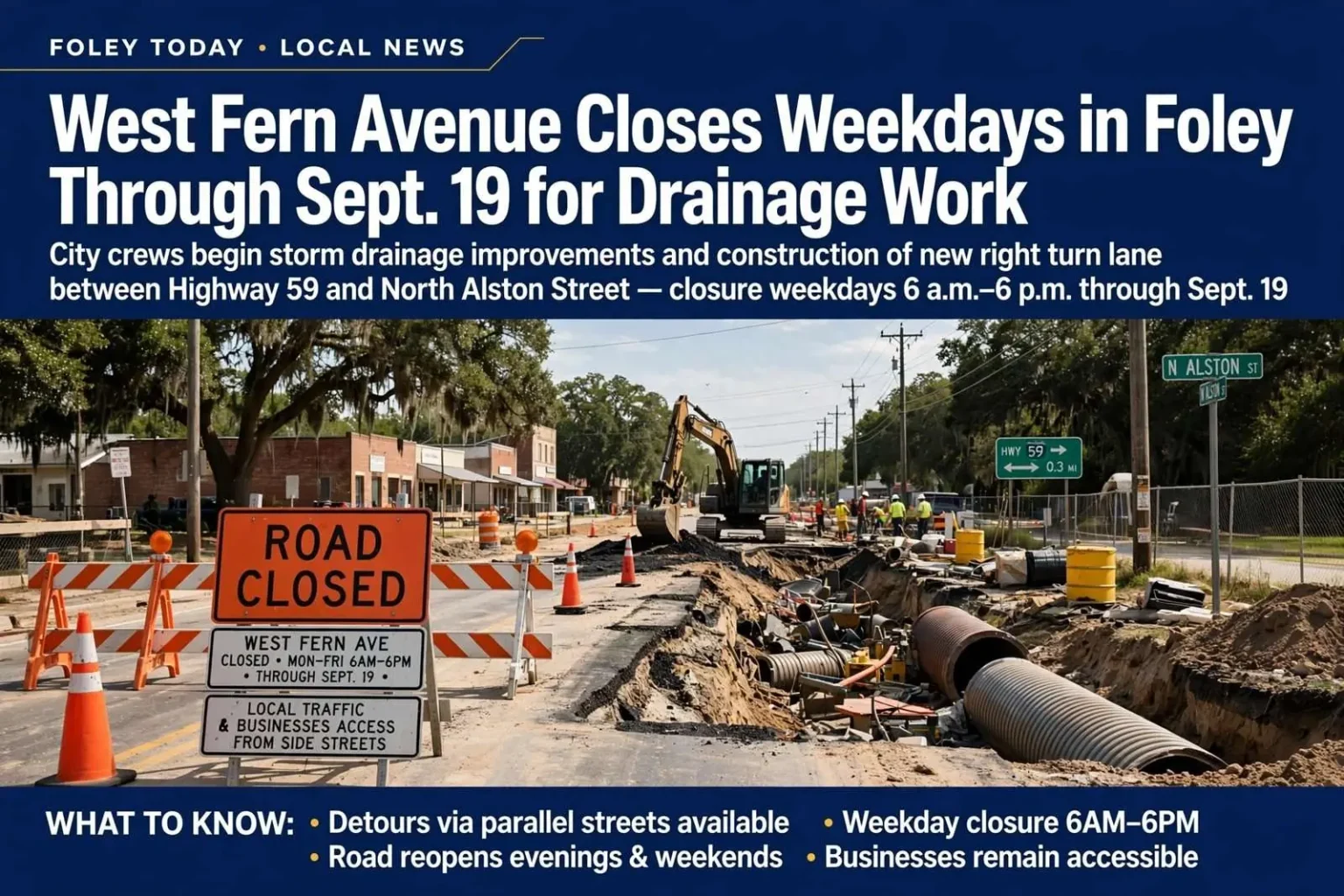
FOLEY, Ala. — West Fern Avenue between Highway 59 and North Alston Street is closed to traffic, with the restriction running Mondays through Fridays from 6 a.m. to 6 p.m. through Sept. 19. The city said crews will be completing storm drainage improvements and constructing a new right turn lane during the closure.
What the Work Involves
Two distinct projects are being handled in a single closure window. Storm drainage improvements typically involve excavating and replacing or upsizing underground pipe, adjusting inlets and restoring the roadway above — work that cannot be done under traffic. The new right turn lane requires widening the roadbed, which likewise demands full access to the corridor. Bundling both into one closure is the more disruptive option on any given day but the less disruptive option overall, since it avoids returning to the same stretch of road twice.
Drainage upgrades of this kind usually begin below ground. Crews saw-cut and remove the existing pavement, dig out and replace aging culverts and cross-drains, reset drainage inlets to grade, and then rebuild the roadbed in layers before the final surface is laid. A right turn lane adds its own requirements, from adjusting the road’s width and striping to relocating any utilities or driveways that fall in the new lane’s path. Completing both scopes side by side means the street is torn up once rather than twice, and residents get a finished corridor instead of a second round of closures next season.
The stretch between Highway 59 and North Alston Street carries a steady mix of local traffic and drivers cutting between the highway and Foley’s interior streets. West Fern Avenue is part of the older grid that grew up around the city’s historic downtown, where the blocks are short and drivers can pivot between parallel streets when a closure forces the issue. That grid gives commuters options, but it also pushes cut-through traffic onto residential blocks, which is why cities in Baldwin County now routinely pair announcements of road work with explicit guidance on alternate routes.
Planning Around It
The weekday-only schedule is a meaningful accommodation. West Fern Avenue reopens each evening at 6 p.m. and stays open through the weekend, which preserves access for weekend errands and evening traffic while giving crews full daytime working hours. Drivers who normally use West Fern between Highway 59 and North Alston should plan alternate routes during business hours through Sept. 19. Motorists are advised to watch for signage, reduce speed near the work zone and give crews room to operate.
The pattern is worth noting for anyone who lives or works in the area: a commuter who leaves early can beat the 6 a.m. closure, and anyone with business along the corridor can shift that trip to an evening or a Saturday rather than rerouting entirely. Businesses along the affected block remain reachable throughout the project, and cities generally encourage drivers to remember during closures like this that access to shops and restaurants stays open even when the through-route does not.
Work-zone safety is the other half of the arrangement. Narrowed lanes, heavy equipment backing in and out of the work area, and workers on foot within feet of live traffic make construction corridors among the most dangerous environments on public roads for both crews and drivers. The advisory to slow down and give crews room is not boilerplate: most work-zone injuries nationally are suffered by drivers and passengers, not workers, and speeds through the closed stretch will be enforced under the posted restrictions.
Part of a Broader Pattern
Drainage work has become a recurring feature of construction schedules across Baldwin County, where rapid development and intense rainfall events have put pressure on stormwater systems that were sized for a considerably smaller population. Projects like this one address capacity before the failures become visible in the form of flooded intersections.
Foley’s situation illustrates the dynamic well. The city sits in south Baldwin County a short drive north of the Gulf beaches, and it has grown from a small agricultural and railroad town into one of the county’s retail and tourism hubs, with attractions along the Highway 59 corridor drawing heavy seasonal traffic. Growth of that kind covers farmland and woodland with roofs and pavement, and every acre that stops absorbing rainfall sends its runoff into the nearest ditch, culvert, or storm drain instead. Systems designed decades ago for a quieter town now handle storm flows from a much larger developed area, and cities across the county have responded with standing programs of pipe replacement, ditch improvement, and inlet upgrades.
Rainfall is the other half of the pressure. The Gulf Coast receives some of the heaviest annual precipitation in the country, and south Alabama storms routinely drop several inches of rain in a few hours. When drainage infrastructure cannot keep pace with a burst of that intensity, water backs up into intersections and yards, sometimes closing roads outright. Cities have learned that the cheapest time to fix an undersized pipe is before the storm that proves it undersized, which is why drainage work appears on municipal schedules with such regularity even in years without a headline flood.
Compared to the scale of that problem, a single block’s worth of pipe and a turn lane is a modest project, but the strategy behind it is the same one governing the larger programs: match the system to the population the city actually has, not the one it used to have. Bundling the drainage scope with the turn lane also reflects how modern public works departments sequence work, combining related projects so that a business district or residential street absorbs one disruption instead of two.
What Drivers Should Do
Through Sept. 19, the practical guidance is straightforward. Drivers who normally use West Fern Avenue between Highway 59 and North Alston Street should treat the block as closed from 6 a.m. to 6 p.m. on weekdays and build extra time into trips that cross the area. The city’s signed detours and the surrounding grid of parallel streets offer workable alternatives, but those routes will carry heavier traffic during the closure hours, and drivers on them should expect slower movement at peak times.
Residents can also expect the usual rhythms of road construction: heavy equipment arriving at the 6 a.m. start, occasional noise from saws and excavators, and temporary piles of dirt and pipe staged along the corridor. The evening and weekend reopenings mean the street returns to normal use at the end of each workday, though drivers should use caution even when the closure is lifted, since fresh pavement, uneven patches, and stored materials can remain along the margins until the project is fully complete.
The closure remains in effect through Sept. 19, weather permitting, as construction schedules generally are. Foley’s stormwater infrastructure improvements reflect the city’s response to recurring flooding challenges, and the short-term inconvenience of a closed block is the trade for a street that drains better and turns traffic more safely once crews are finished. Drainage work is essential for protecting residences, businesses, and the public roads that connect them, and cities that invest in it consistently rank it among the least glamorous and most valuable work they do.
For businesses and residents along the corridor, the city’s decision to publish the full closure schedule in advance — the specific dates, the daily hours, and the reopening windows — is itself part of modern construction management. Municipalities have learned that a closure announced with precise parameters generates far fewer complaints and far fewer stranded trips than one announced vaguely, and drivers are more willing to accept disruption when they can see the end date on the calendar.
How to Reach Businesses During the Closure
Access management is the detail most likely to matter day to day. Even when a block is closed to through traffic, individual driveways and side streets generally remain reachable from the open ends of the corridor or from parallel streets, and contractors stage their work to keep those connections available wherever the excavation allows. Drivers heading to a specific destination on West Fern Avenue should approach from whichever side of the closure their destination sits on, rather than assuming the whole street is off limits to them.
The same logic applies to deliveries and service calls, which continue throughout projects of this length. Mail, trash collection, and utility crews work around construction closures as a routine matter, adjusting routes as needed. Anyone with a scheduled appointment along the block during weekday work hours should build in a few extra minutes and follow posted signage rather than moving barricades or entering the work zone from an unsigned direction.
The new turn lane at the Highway 59 end of the project should deliver the most visible daily benefit once the work is done. Right-turn lanes exist to separate slowing vehicles from through traffic, and adding one at a busy intersection approach reduces the rear-end collisions and the bunching that occur when a turning driver holds up a line of cars behind them. Combined with the rebuilt drainage underneath, the project aims to leave the corridor handling both its water and its traffic better than it did before the barricades went up — which is, in the end, the entire point of closing it now.