
West Mobile Crash Required Firefighters to Cut a Driver Free, Mobile Fire-Rescue Says
Mobile Fire-Rescue says a West Mobile crash near Airport Blvd required vehicular extrication Thursday morning, with state troopers investigating.
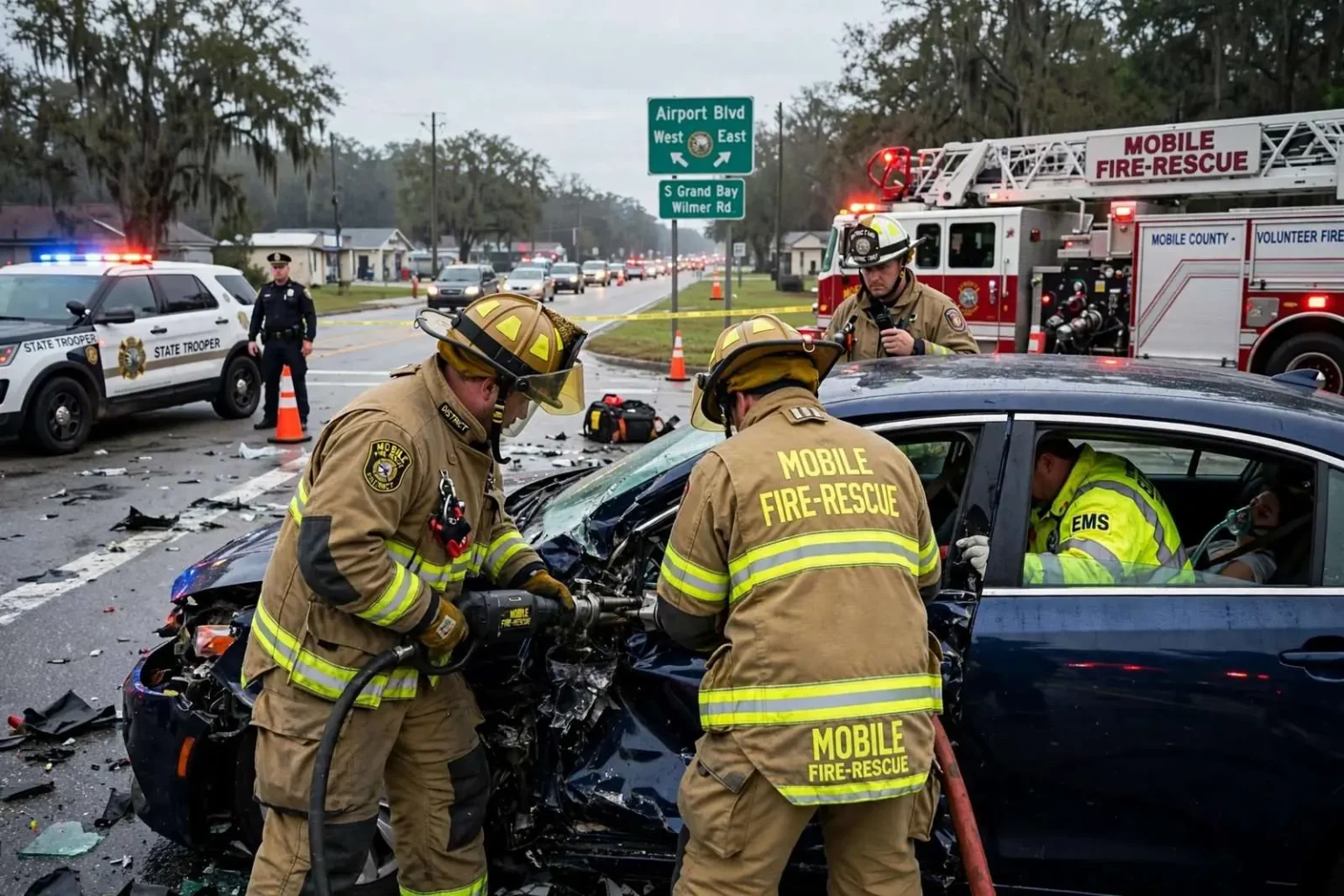
Mobile Fire-Rescue Department crews were called out to a morning crash in West Mobile that left at least one person trapped in their vehicle and forced firefighters to perform a vehicular extrication.
According to the department, around 8:10 a.m. Mobile County EMS and volunteer firefighters requested assistance for a motor vehicle collision near South Grand Bay Wilmer Road and Airport Boulevard. Alabama State Troopers also responded to investigate the crash.
The morning timing placed the response squarely in the commuter rush, when the corridors of West Mobile carry their heaviest traffic. A crash that closes or constrains a junction during those hours ripples outward quickly, as drivers seeking alternate routes load onto parallel streets and delay multiplies across the network. The 8:10 a.m. call meant crews were working while the morning’s traffic was at or near its peak.
The request for mutual aid tells its own story about how serious crashes are handled in West Mobile. Mobile County EMS and volunteer fire units arrived first and recognized that the trapped occupant required resources beyond their equipment — the heavy hydraulic tools, additional personnel, and command structure that a career fire department brings to an extrication. The call to Mobile Fire-Rescue brought a ladder crew and a district chief to the scene, layering urban-grade rescue capability onto the initial response.
What Vehicular Extrication Involves
Vehicular extrication is the delicate process of cutting or removing a crash victim from a vehicle they have become entrapped in, done carefully to avoid worsening injuries during removal. A Mobile fire ladder crew and a district chief were dispatched to support the operation.
Extrication work ranks among the most technically demanding tasks in fire service. Modern vehicles are engineered with high-strength steel, airbags, and structural designs that protect occupants in a crash — but those same features make a wrecked car difficult to dismantle. Firefighters must know where to cut, which components are hazardous, and how to support the vehicle’s frame as they remove parts of it, all while paramedics work to stabilize the patient inside.
The medical dimension runs parallel to the mechanical one. A trapped patient may have spinal injuries, internal bleeding, or other conditions that movement could worsen, so rescue crews coordinate with EMS personnel who begin treatment through the wreckage while others cut. The process can take anywhere from minutes to the better part of an hour depending on the entrapment, and every decision balances speed against the risk of aggravating injuries. It is careful, methodical work performed under pressure, with a patient’s condition setting the tempo.
The dispatch of a district chief signals the scale of the operation. A chief on scene assumes command, coordinates the multiple agencies now working the incident — career firefighters, volunteer crews, EMS, and law enforcement — and manages the scene’s safety for both victims and responders. On a busy commuter corridor, that command role also extends to traffic control and scene security, protecting the work zone from passing vehicles.
At the time of the initial report, authorities said it was possible the crash had turned fatal, but that had not been confirmed by Mobile Fire-Rescue. The Alabama Law Enforcement Agency handles investigations of serious injury and fatal crashes in Mobile County.
That division of responsibility matters for how information emerges from a crash scene. Fire and EMS crews handle rescue and treatment, but the determination of what caused the collision — speed, impairment, distraction, or something else — belongs to state troopers, whose investigation may take days or weeks to reach official conclusions. In the hours after a serious crash, the agencies’ public statements are therefore cautious by design: rescue facts are confirmed quickly, but questions of fault and fatality wait on the investigation.
Crashes on the Airport Boulevard Corridor
The stretch of West Mobile where the collision occurred carries steady commuter traffic between western Mobile County and the city core, and intersections along the Airport Boulevard corridor have seen repeated serious collisions over the years. Airport Boulevard functions as one of the principal east-west arteries of the metropolitan area, running from the near-downtown districts deep into the county’s western communities, and its junction with South Grand Bay Wilmer Road sits in a zone where residential growth has steadily added vehicles to roads built for lighter loads.
The corridor’s crash history reflects that growth. As subdivisions have spread across western Mobile County, commuter volumes on Airport Boulevard and its crossing roads have risen year after year, and morning and evening peaks now produce the kind of congestion that raises crash risk — closely spaced vehicles, turning conflicts, and drivers diverting onto neighborhood streets to bypass delays. Serious collisions at corridor intersections have prompted ongoing discussions about signal timing, turn lanes, and long-term widening plans.
For first responders, that growth has changed the daily rhythm of their work. Mobile Fire-Rescue’s stations across West Mobile handle a steady flow of crash calls during rush hours, and mutual aid arrangements with volunteer departments in the county’s fringe areas have become an operational necessity. Wednesday morning’s response — volunteer units first on scene, the career department’s ladder crew and district chief arriving to complete the extrication — shows that layered system functioning as designed.
Officials have not identified those involved or described the extent of injuries beyond confirming that extrication equipment and personnel were needed. That reticence is standard practice: names of crash victims are typically released only after families are notified, and injury details beyond the general are withheld pending the troopers’ investigation. The confirmation that will eventually emerge — from the Alabama Law Enforcement Agency’s report — will supply the facts that initial scanner traffic and rumor cannot.
What the Response Shows About West Mobile’s Safety Net
Beyond the immediate incident, the morning’s events illustrate how the region’s emergency response network fits together. Mobile County EMS provides ambulance coverage across the county, volunteer fire departments protect the unincorporated and fringe communities, and Mobile Fire-Rescue backs them up with the heavy rescue capability that only a career department maintains. A crash at the seam between jurisdictions draws on all three at once, and the system worked: within minutes of the 8:10 a.m. call, the trapped occupant had both the medical care and the rescue expertise the situation demanded.
The Alabama State Troopers’ role completes the picture. Because the crash occurred outside Mobile city limits proper, the investigation falls to the state rather than municipal police, ensuring a neutral, standardized inquiry into a collision that may involve life-threatening injuries. Troopers’ reports from such crashes feed the data that transportation planners later use when they evaluate corridors like Airport Boulevard for safety improvements.
For the commuters who passed the scene Wednesday morning, the crash was a delay; for the crews working it, it was a coordinated rescue; and for at least one family, it was the beginning of an anxious wait for news. The corridor will carry its traffic again by mid-morning, but the episode leaves behind the recurring questions that follow every serious collision on West Mobile’s arteries — questions about congestion, growth, and the price the region pays, in risk and in response, for the roads its development has outpaced. The answers will come from the troopers’ investigation, and the community will be watching for them.
Training and Tools Behind an Extrication
The firefighters who performed Wednesday’s extrication trained extensively for exactly that scenario. Extrication certification involves hours of practice on real vehicles — cutting roof pillars, removing doors, folding dashboards away from patients — using hydraulic spreaders, cutters, and rams collectively known as the “jaws of life.” Departments refresh that training constantly because vehicle construction changes with every model year: high-strength steel alloys, reinforced battery compartments, airbag cylinders, and hybrid drive components each demand updated techniques and updated cautions.
The ladder company’s role in such operations extends beyond the ladder itself. Ladder crews carry much of a department’s heavy rescue equipment, and their personnel are typically among the most experienced in vehicle extrication and structural rescue. When a trapped-patient call comes in, dispatching a ladder company alongside an engine is standard practice precisely because the tools and the trained hands ride together.
Volunteer departments, meanwhile, form the first line across much of unincorporated Mobile County. Their crews arrive fastest because their stations sit within the communities they serve, and their quick initial actions — scene control, hazard mitigation, first medical contact, and an accurate assessment of what the trapped patient needs — set up everything that follows. Wednesday’s request for career-department assistance reflects the system’s division of labor rather than any shortfall: volunteers stabilize, specialists extract, and the patient’s care never pauses between them.
After the Wreckage Is Cleared
Once the extrication is complete and the injured are transported, the scene shifts from rescue to investigation and recovery. Troopers document the roadway, photograph the vehicles, and begin canvassing for witnesses while tow operators clear the wreckage. Traffic resumes in stages, and the incident drops from scanner chatter to a case file — one that will eventually produce an official determination of cause, and possibly charges, weeks down the road.
For the residents of the neighborhoods around South Grand Bay Wilmer Road and Airport Boulevard, the episode serves as a familiar reminder of the corridor’s risks. Local drivers know which intersections back up, where turning traffic stacks, and which stretches have seen serious crashes before. As western Mobile County continues to grow, those local observations accumulate into the pressure that eventually shapes road improvements — and until they arrive, the region’s firefighters, volunteer crews, and EMS personnel will keep answering the calls the corridor produces, morning after morning.


