
What ‘ACE’ Tells Us About the 2022 Hurricane Season
Accumulated Cyclone Energy, or ACE, measures a hurricane season's strength by factoring in storm intensity and duration, not just the number of named.
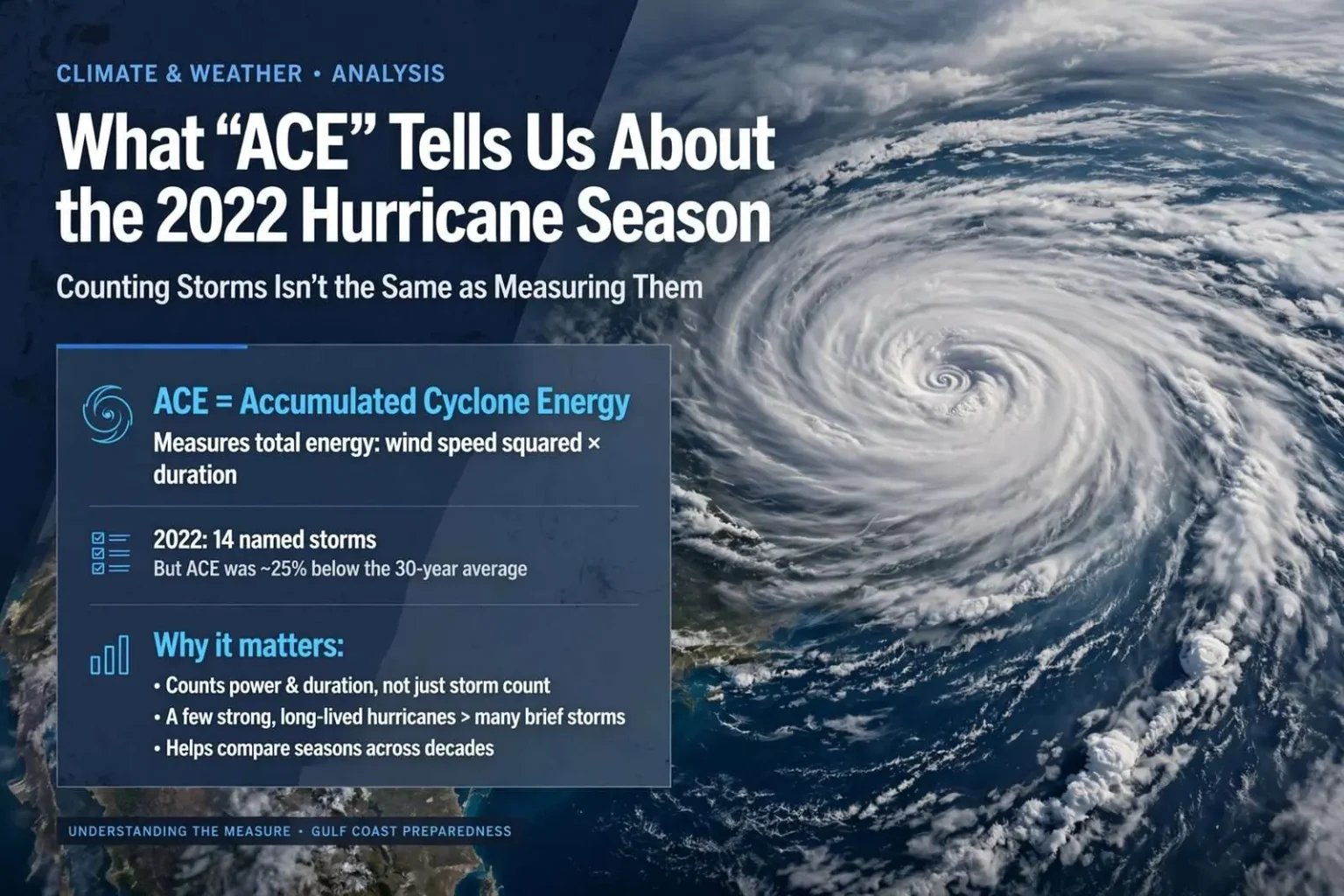
Counting Storms Isn’t the Same as Measuring Them
When hurricane forecasters talk about how busy a season really was, they lean on more than a simple head count of named storms. One of the tools they use is a measure called ACE — Accumulated Cyclone Energy — a single number that attempts to capture the overall power of a season rather than just its length.
ACE is the total energy a tropical storm or hurricane expends over its life. Rather than just tallying how many storms formed, it accounts for how long they lasted and how intense they became. The calculation squares a named storm’s wind speed every six hours and adds those values together, producing a single number that captures the season’s overall power.
The 2021 Atlantic season produced 21 named storms, seven of which became hurricanes and four of those major hurricanes. That above-average tally made it an active year, following a run of five similarly busy seasons. On paper, the stretch from 2016 through 2021 read like one of the most demanding eras Atlantic forecasting has recorded, and residents of the Gulf Coast lived much of it under one watch or another.
Yet four of 2021’s named storms lived less than 48 hours and never struck land — brief, weak systems that can inflate the raw storm count. That is where ACE helps. A minimal tropical storm that lingers for a week before briefly reaching hurricane strength, then fades, contributes far more to ACE than a quick-developing major hurricane that peaks for only a few hours. Shorter-lived, weaker storms add little.
The index gives a fairer way to compare recent seasons with those from decades before satellites and computers. In earlier eras, a ship report or a coastal observation might be the only evidence that a storm ever existed, and short-lived systems at sea often went entirely uncounted. Modern satellite coverage spots nearly every spin-up the moment it organizes, which means today’s storm counts include systems that would never have made an older season’s ledger.
The Limits of the Number
Even so, ACE has limits. It says nothing about landfalls and offers no clue whether a tropical depression will stall and flood a region. A depression that never reaches named status adds nothing to ACE, yet can still prove deadly and costly, as Gulf Coast communities learned from slow-moving rain events that never earned a name.
Like the simple named-storm count, ACE cannot answer the question every Gulf Coast resident asks each spring: What will actually happen here? A season can rack up enormous accumulated energy while every storm stays harmlessly at sea, or produce a modest number of systems while a single one makes a catastrophic landfall. The index measures the ocean’s output, not the risk to any particular street in Mobile or Baldwin County.
The past six seasons would rank as more active or energetic than average by ACE as well. But the record shows that raw numbers can mislead — the 30 named storms of 2020, researchers note, rank only 13th busiest by ACE. That season churned out names at a record pace, forcing forecasters deep into the Greek alphabet, yet many of its systems were compact and short-lived, contributing less energy than their number suggested.
Alan Sealls, chief meteorologist and an adjunct meteorology professor at the University of South Alabama, has explained the measure to Gulf Coast audiences as a way of putting seasons in context. For a viewing area that sits at the mercy of both the Gulf and the Atlantic, understanding the difference between a season that sounds busy and one that actually is busy helps separate the years that demand attention from the ones that merely fill the name list.
The distinction matters for how residents prepare, too. If a quiet-sounding season can hide a single devastating storm, then preparation cannot wait for a headline number to justify it. Emergency managers along the northern Gulf Coast have long made the same point: it takes only one system to make a season historic for the people who live through it.
What the Measure Reveals About Recent Seasons
Looking across the recent run of active years, ACE helps explain a pattern residents have noticed without being able to name it: more storms on the map does not always mean more damage on the coast. The technologies that let forecasters detect a tropical depression within hours of its formation have padded the storm counts of every modern season, while the older measure of sustained, powerful cyclones tells a more nuanced story about whether the atmosphere has genuinely been working harder.
It also reframes the way seasonal outlooks should be read. When a forecast calls for an above-average number of named storms, the number alone does not say whether the extra systems will be fleeting spin-ups far from land or long-lived hurricanes churning for weeks. The energy accumulated over a season — not the count of names — is what tracks more closely with the kind of widespread, sustained impact that stresses response resources along the coast.
For Southwest Alabama specifically, the lessons of the ACE era are familiar ones. Mobile Bay’s geography makes the region vulnerable to storm surge funneled northward, and communities from Dauphin Island to eastern shore neighborhoods have learned that a storm’s wind speed at landfall tells only part of the story. Water, not wind, has historically been the region’s deadliest hazard, and no index of cyclone energy predicts where a rain band will stall or how high a surge will push.
That is why forecasters and local meteorologists urge residents to treat seasonal summaries as context rather than prediction. Knowing that a season was energetic tells a community something about the atmosphere it lived through; it tells the individual household nothing about whether the next name on the list will find its way into the Gulf. Preparation, from hurricane kits to evacuation planning, is calibrated to the worst storm a family might face, not to the average of twenty.
The deeper value of ACE, then, is honesty about uncertainty. By showing that a record 30-storm season can rank only 13th in actual energy, the measure keeps both forecasters and the public from over-reading the calendar. The ocean’s power is real and measurable, but its path — and the harm it chooses to deliver to any single stretch of coastline — remains the one thing no index can foretell.
The mechanics of the index are worth understanding for anyone who follows seasonal outlooks. Because wind speed is squared before it is summed, a hurricane blowing at twice the speed of a tropical storm contributes roughly four times the energy per six-hour interval — and a major hurricane that holds its strength for days can single-handedly outweigh a handful of disorganized systems. Duration matters just as much: a storm that survives two weeks over open water accumulates energy around the clock, whether or not it ever approaches land.
Forecast agencies compute the index across entire basins, allowing climatologists to compare the Atlantic against the Pacific, and to look back over decades for signs of quieter and busier eras. Those long records show multi-decadal swings in overall activity, driven by broad ocean and atmospheric patterns that unfold over generations rather than single summers. A single season, busy or quiet, says little on its own; the value comes from placing it on that longer curve.
The measure also helps explain why a season’s first month can feel misleading. Early spin-ups that last a day or two pad the name list without adding meaningful energy, while the systems that define a season — long-track hurricanes that organize in the deep tropics and survive the whole journey west — often arrive in the heart of the season and dominate the final tally. Residents who judge a season by its August headline can be caught unprepared by what September delivers.
For local newsrooms and emergency management offices along the Gulf, translating these distinctions into plain language has become part of the job of hurricane communication. Explaining why 21 names does not mean 21 disasters — and why a below-average name count offers no comfort to a coastal county — is the kind of context that turns a statistic into something a family can actually use when deciding how seriously to take a forecast.
That practical framing is where measures like ACE earn their place. Used carefully, they keep the conversation anchored to the atmosphere’s real behavior rather than to the drama of a name list. Used carelessly, any single number can mislead — which is why the forecasters who understand the index best are the first to say that the only number that ultimately matters for a coastal household is the distance between the next storm and home.


