Who Is the King of Mobile Bay? A Reader Debate Over the City’s Real Power Brokers
From Abraham Mitchell to Trey Lane: readers debate who really holds sway over Mobile, from RSA towers and festivals to weather forecasts and the arts.
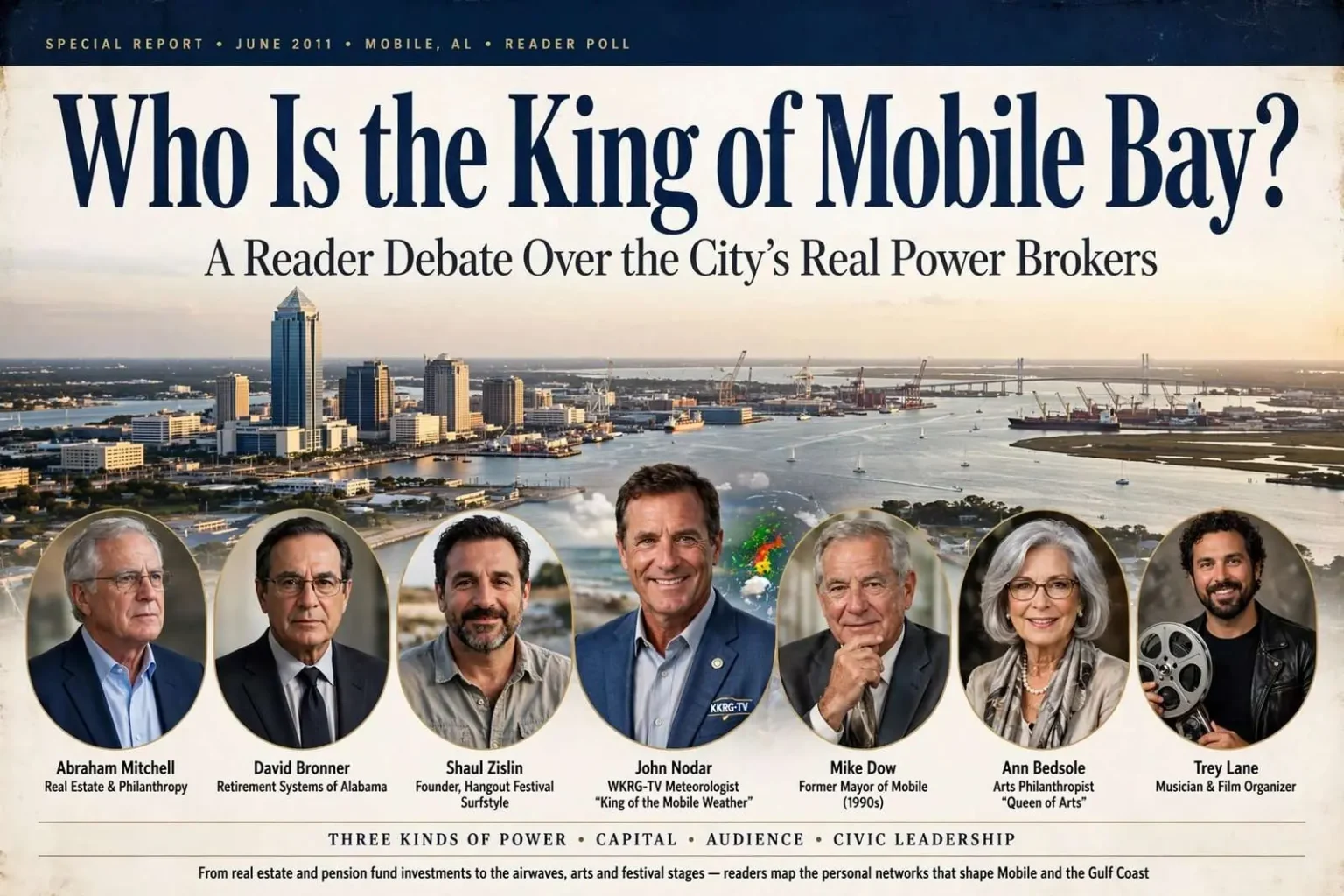
Plenty of names have been floated over the years for the title of “King of Mobile” — shorthand for whoever can make things happen in this city, or stop them, on a whim. In June 2011, a lighthearted local reader poll put the question to the public, and early voting produced some eyebrow-raising matchups, including a tongue-in-cheek rivalry between local personality Trey Lane and WKRG meteorologist John Nodar. None of the candidates had any knowledge of, or consent to, their nominations.
Strip away the fun, though, and the ballot doubles as a decent map of who actually shapes Mobile and the broader Gulf Coast. The names readers attached to the crown came from every corner of the city’s power structure — real estate, state finance, entertainment, broadcasting, city hall and the arts — and each one tells a story about how things get done in a port city that has never quite decided whether its future belongs to the old families, the state pension fund or the festival promoters.
The Contenders
Abraham Mitchell. The well-known real estate executive and philanthropist, whose family lent its name to the Mitchell Center and the Mitchell Cancer Institute, has played an outsized role in modernizing Mobile. The Mitchell name on the city’s arenas and research buildings is a reminder that some of the city’s biggest civic leaps begin with family money and a handshake.
David Bronner. Head of the Retirement Systems of Alabama, Bronner’s investments — most visibly the RSA Tower — have left a permanent mark on the downtown skyline and the city’s growth. From his office in Montgomery, Bronner has used the pension fund’s billions to bankroll projects across the state, and Mobile’s riverfront skyline is the most visible evidence of how much a single state official’s investment decisions can reshape a city hundreds of miles from the capital.
Shaul Zislin. Founder of the Surfstyle chain, Zislin conceived the Hangout Festival in Gulf Shores, an event credited with roughly a $30 million economic impact and a boost to the area’s progressive image. The festival’s rise from an ambitious idea on the public beach to one of the Gulf Coast’s signature music events made its founder the closest thing the beach towns have to a visionary developer.
John Nodar. “King of the Mobile Weather,” the morning and noon anchor has delivered forecasts at WKRG-TV for 25 years — a daily presence in more households than any politician. In a hurricane town, the weathercaster occupies a peculiar throne: on the days that matter, the entire coast hangs on his word, and no elected official commands that kind of attention twice a day, every day.
Mike Dow. Mobile’s mayor through much of the 1990s, Dow drove the String of Pearls neighborhood renewal effort and remains a behind-the-scenes force. His decade in office reshaped how the city thought about its own neighborhoods — restoring parks, libraries and civic buildings street by street — and his successors inherited both the projects and the habit of thinking of the city as a collection of communities worth investing in one by one.
Ann Bedsole. A former mayoral candidate known as the “Queen of Arts,” Bedsole’s donations seeded much of downtown’s arts renaissance. The theaters, galleries and cultural institutions that anchor downtown’s revival trace back to a champion who spent decades arguing that a city’s artistic life is not decoration but infrastructure — an argument that the Lower Dauphin entertainment district has since proven on every Friday night.
Trey Lane. Mobile’s self-styled Renaissance Man: musician (The Port Wine Stain, Seduction Bomb), artist, filmmaker, entrepreneur and organizer of the Mobile Bay Film Scrambles, with fame from his years as call-screener on the Uncle Henry Show. His nomination was the poll’s inside joke and its unexpected truth at once — proof that in a city this size, a personality with a radio following, a band and a film series can stand, half seriously, beside billionaires.
What the Ballot Reveals About Power
Looked at as a map, the poll’s field sorts into three kinds of power. There is capital: Mitchell and Bronner, whose buildings and investments change the physical city regardless of who holds elected office. There is audience: Nodar and Lane, whose influence runs through screens and airwaves rather than bank accounts. And there is civic leadership: Dow, Bedsole and Zislin, who used office, philanthropy or entrepreneurship to redirect the city’s attention and money toward something new.
The blend is Mobile’s own. In larger metros, a “who runs this town” list would be dominated by executives and elected officials, with a token culture figure. Mobile’s version gives a weatherman top billing against a pension fund director and counts a film scrambler among the heavyweights — because in a city of under 200,000, one determined person with a reputation can genuinely move an institution, and everyone voting knows it.
The poll also captured a transition moment. The names on the ballot were, mostly, builders of the 1990s and 2000s: the downtown renewal, the RSA skyline, the arts district, the Hangout Fest. The decade that followed would test which of those bets held, and would add new contenders — tech, aerospace and the shipbuilding boom among them — to any future version of the question.
The Port City’s Peculiar Throne
Why does a city of Mobile’s size argue about kings at all? The habit says something about the place. Mobile is old by Southern standards — three centuries of French, Spanish, British and American rule layered into its institutions — and its power structure has always been personal rather than procedural. Deals happen over lunch at the country club or a phone call between old friends; the newspaper’s society page and the business section have never fully been separate documents. In that environment, the question of who can make things happen “on a whim” is not idle. The city has watched whims become convention centers, museums and festivals.
The poll’s tongue-in-cheek framing was also a small act of democratic leveling. Naming the kingmakers in public — even in jest — tugs at the curtain of a power structure that usually operates without being named. The candidates had no say in their nominations, which was the point: the exercise measured the city’s perception of influence, not the influencers’ self-image.
The Lane-Nodar rivalry, the poll’s early headliner, captured its spirit perfectly. A call-screener turned multimedia personality against the man who tells half the city whether to evacuate — no candidate would have chosen the matchup, and that was the fun of it. Behind the joke sat a real observation: that in Gulf Coast life, the weatherman’s authority during hurricane season rivals any mayor’s, and that local celebrity, carefully built, is a form of power the city takes half-seriously.
How the Coast Gets Made
Read together, the contenders describe a region built by parallel efforts that rarely share a single institution. Bronner’s RSA money arrives from Montgomery; Zislin’s festival economy rises on the Baldwin County beaches; Mitchell’s philanthropy and Dow’s city hall operate in Mobile proper; Nodar’s forecast reaches every living room from Pascagoula to Pensacola. No mayor controls all of that, and no single vote elects it. The Gulf Coast’s development story is the sum of people acting from different seats of power at the same time.
That is the quiet insight of the 2011 poll. The “King of Mobile” framing assumes a single throne, but the ballot itself listed seven, spread across two counties and several industries. The city’s history of fits and starts — booms the old families saw coming, ones they did not — tracks with the periods when those thrones aligned and when they did not.
Every few years, Mobile returns to the question, in polls, bar arguments and editorials: who is actually in charge here? The honest answer, as the ballot showed, is that the crown has several wearers and no fixed address. The city that ran America’s first Mardi Gras has always understood that better than most — influence here, like Carnival, is seasonal, layered and claimed by whoever earns the crowd. The poll’s winner mattered less than the roster it produced: a map, drawn by readers themselves, of who moves this city and who the city trusts to move it next.
The Old Families and the New Money
The poll’s field also traced a generational handoff that Mobile has been negotiating for decades. Mitchell’s family fortune belongs to the old civic establishment — name-on-the-building philanthropy that has shaped the city since the port booms of the last century. Bronner and Zislin represent the newer engines: a state institution with billions to deploy and an entrepreneur who saw that a beach, a stage and a marketing budget could rival a factory as an economic engine. Dow and Bedsole stand for the elected-and-advocating middle, the public servants whose leverage came from office and persistence rather than capital.
Mobile’s development debates since then have replayed the same lineup. When a downtown project needs anchor funding, the establishment’s names surface; when the beaches need a new signature event, the entrepreneurs surface; when neighborhoods need renewal, the String of Pearls playbook gets dusted off. The poll’s readers, asked to crown one king, had in effect listed the city’s whole court — and every subsequent big decision has involved some combination of the same seats.
The cultural thread deserves its own note. Bedsole’s arts philanthropy and Lane’s do-it-yourself film scene represent two very different models of the same conviction: that a city without an active cultural life cannot keep its young people, let alone attract new ones. Downtown’s revival along Dauphin Street — galleries and venues where vacant storefronts stood — is the shared evidence behind both models, and it may be the poll’s most durable exhibit.
The Verdict That Matters
Reader polls keep no formal score, and this one was never meant to. Its value, a decade on, is archival: a snapshot of whom Mobilians credited with influence at the start of the 2010s, before the decade’s development wave confirmed or forgot the predictions embedded in the ballot. Some names have grown only larger; others remain beloved figures whose influence was always personal rather than institutional.
The enduring lesson is the one the poll stated without meaning to. Power in Mobile is real, personal, and traceable — to a pension fund’s investment committee, a family’s foundation, a sheriff of the airwaves, a mayor’s neighborhood list. Strip away the crown and the contest was simply the city introducing itself to itself, in the only voice Mobile fully trusts: its own.