Why Mobile and the I-10 Corridor Punch Above Their Weight in GOP Primaries
Presidential campaigns have increasingly targeted Mobile, Daphne and other stops along the I-10 corridor during GOP primary season, drawn by large, energized crowds in a reliably Republican but culturally distinct stretch of the Gulf Coast.
Every presidential election cycle brings talk of the handful of “swing” precincts that candidates chase relentlessly in the campaign’s final stretch — places like the Philadelphia suburbs of Bucks County, Pennsylvania, the counties ringing Cleveland, Columbus and Cincinnati in Ohio, or Florida’s famed “I-4 corridor” stretching from Tampa through Orlando to the Atlantic coast. Campaign staffs study turnout histories block by block in those places, and candidates burn scarce days of the calendar holding rallies there because everyone understands the same underlying idea: as those bellwether areas go, so goes the state, and sometimes the nation. In a general election, the map of truly competitive ground has shrunk so far that a few dozen counties and neighborhoods effectively decide which candidate reaches 270 electoral votes.
Alabama has never really been one of those places. The state has voted reliably Republican in presidential elections since Barry Goldwater carried it over Lyndon Johnson in 1964, with only two exceptions in the decades since — George Wallace’s home-state win in 1968 and Jimmy Carter’s victory over Gerald Ford in 1976. Wallace’s American Party candidacy split the state three ways and captured its electoral votes on the strength of Deep South loyalty, while Carter, a Georgia peanut farmer and former governor, rode regional affinity and a still-fragile two-party system to narrowly claim Alabama in 1976. Neither result reflected a competitive, two-party statewide electorate in the modern sense, and in every cycle since, national campaigns have written Alabama off early as a foregone conclusion on the Republican side of the ledger.
There’s no serious debate about which party will carry Alabama’s electoral votes in a general election. Down-ballot races occasionally produce genuine suspense — a contested Senate seat, a hard-fought legislative primary, a county courthouse battle — but the top of the ticket has been functionally locked for half a century. That reality shapes everything about how presidential campaigns allocate money, staff and candidate time: a state that cannot be lost is also a state that cannot be won over, so its voters rarely see the candidates in person during the fall campaign.
But that doesn’t mean South Alabama is irrelevant to presidential politics — particularly during the Republican primary season, when the math changes entirely. A primary is not about flipping a state; it is about dividing delegates within a party, and in a party where one candidate may carry the state while three others split the remainder, every county matters. Delegates in many states are awarded by congressional district as well as statewide, which turns Mobile County and Baldwin County into distinct pieces of the puzzle rather than footnotes to it. A campaign that can bank delegates in districts it loses statewide can still shape the convention’s outcome, and that gives second-tier markets like Mobile a weight they never carry in November.
The SEC Primary Changed the Calendar
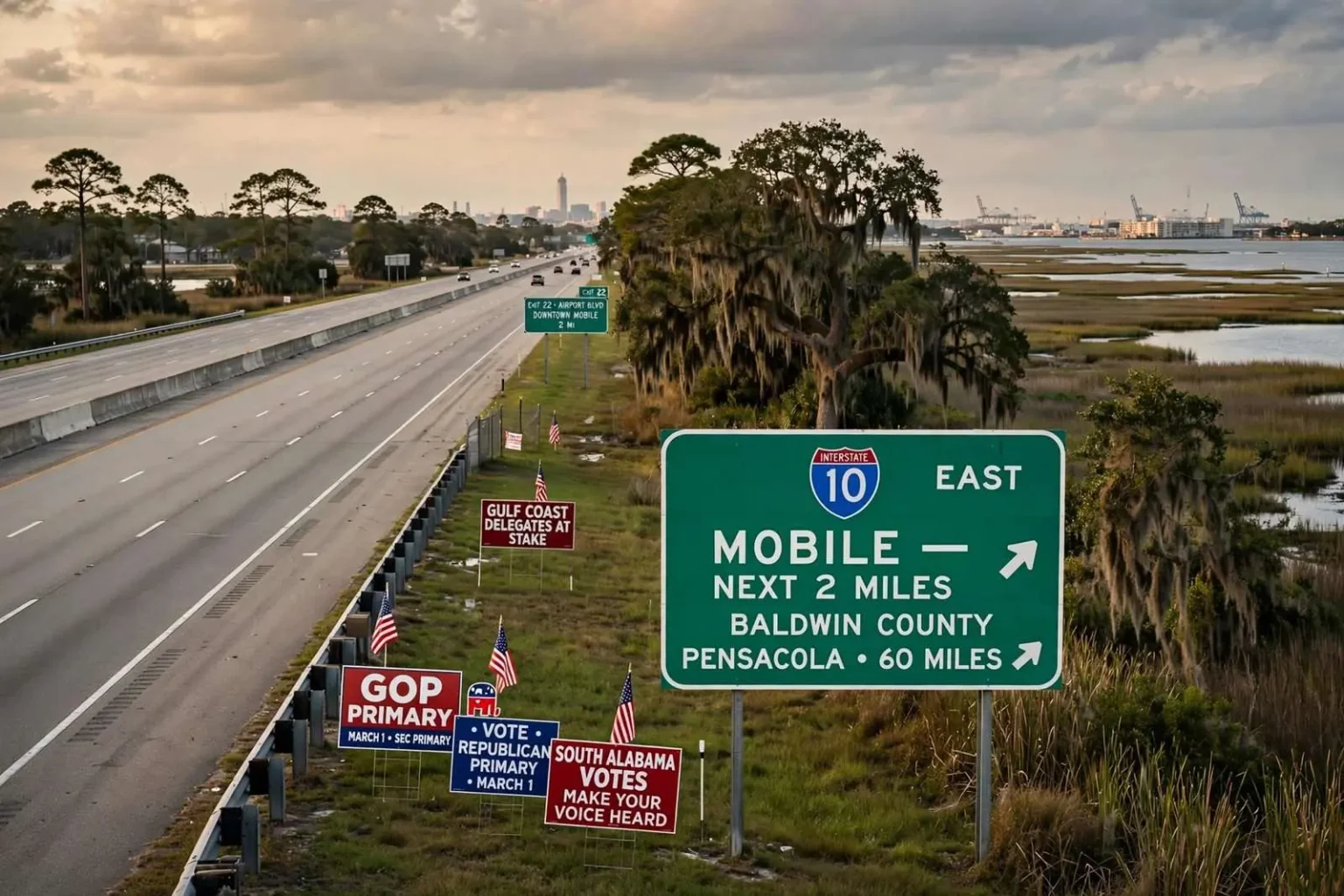
The Mobile and Baldwin County area saw a steady stream of candidate visits over recent months, including a stop by Hillary Clinton, the former secretary of state, on the Democratic side, and appearances from former Florida Gov. Jeb Bush, retired neurosurgeon Ben Carson, Texas Sen. Ted Cruz, former Arkansas Gov. Mike Huckabee, Ohio Gov. John Kasich, Kentucky Sen. Rand Paul, Florida Sen. Marco Rubio and businessman Donald Trump on the Republican side — all jockeying for delegates ahead of the so-called SEC primary, when Alabama and several neighboring Southern states vote on the same day. The nickname borrows from college football’s Southeastern Conference, and it captures how Southern states, tired of watching early voting states like Iowa and New Hampshire filter the field through sensibilities far removed from their own, coordinated their primary calendars to vote together and force candidates to compete for Southern delegates in a single sweep.
The regional primary is a deliberate act of leverage. By holding their contests on the same day, Southern states pool their delegate hauls into a prize large enough that no candidate can afford to skip the region, no matter how much Iowa and New Hampshire have already shaped the field. For Alabama, that means the state’s voters see candidates in person months before the ballots are printed — something that simply never happens in a general election cycle. Campaigns open field offices in Mobile and Huntsville, hire state-based chairs, and schedule town halls in venues that would otherwise never appear on a national itinerary.
South Alabama’s string of visits reflected that new arithmetic. Bush, Carson, Cruz, Huckabee, Kasich, Paul, Rubio and Trump each had distinct reasons to court the Gulf Coast: Rubio’s Florida ties made neighboring Baldwin County feel like an extension of his home-state operation; Cruz and Huckabee leaned on evangelical networks that run deep through South Alabama’s churches; Kasich pitched his Ohio record to suburban voters in Mobile’s growing western neighborhoods; and Trump’s rally-style events drew crowds large enough to fill arenas in a market national media often ignores entirely. Each visit generated local coverage, volunteer sign-ups and donor lists that campaigns could not have bought any other way.
Why Candidates Keep Landing at the Coast
Geography explains part of it. Mobile sits within a day’s drive of several Southern primary states, and Mobile Regional Airport connects directly to hub cities that campaigns use as staging points. A candidate flying from Florida to Louisiana or Texas can stop in South Alabama without spending an extra travel day, and a rally on the Gulf Coast earns coverage not just in Mobile and Baldwin counties but across the Pensacola and Biloxi media markets — three states’ worth of voters reached from one appearance. Pensacola’s television stations routinely carry Mobile-area events to Northwest Florida viewers, and New Orleans media follow Gulf Coast politics closely on the Louisiana side.
Demographics and party structure explain the rest. Baldwin County ranks among the most reliably Republican counties in Alabama, delivering some of the party’s strongest margins cycle after cycle, while Mobile County mixes a large Republican base with contested local races that keep the party machinery active year-round. Campaigns that build county organizations in places like these create the ground game — yard signs, phone banks, church-network contacts — that converts a primary win into delegates on the convention floor. The visits were not symbolic gestures; they were investments in a delegate map that pays off only if the local organization shows up on election day.
A Corridor That Cuts Across State Lines
Closer to home, a different kind of regional pattern has been taking shape — one that cuts across state lines rather than following them. Stretching along Interstate 10 from the New Orleans suburb of Slidell, Louisiana, through the Mississippi and Alabama Gulf Coast and on toward Jacksonville, Florida, sits a corridor of reliably Republican territory that behaves, in political terms, almost like a single region. The interstate binds together coastal cities that share a tourism-driven economy, a military and aerospace presence, hurricane-prone geography, and a socially conservative voting culture that predates the modern realignment. In general elections the corridor is safe for Republicans everywhere it runs, but in primaries it functions as a genuine swing zone — contested ground where competing Republican factions fight for the delegates and the narrative.
The corridor’s shared character is no accident. Interstate 10 was completed across the Gulf Coast in stages through the 1960s and 1970s, knitting together metropolitan areas that had previously been separated by hours of two-lane driving. Commerce followed: casinos in Mississippi, beaches and retirement communities in Baldwin County, petrochemical and shipping employment around Lake Charles and Baton Rouge, military installations from Pensacola Naval Air Station to Jacksonville’s naval complexes. The population along the route grew steadily, much of it composed of retirees and relocated military families — two of the most consistent Republican voting blocs in the country.
What makes the corridor politically interesting is that its Republicanism is not uniform. The New Orleans metro area on the corridor’s western end includes substantial Democratic and independent populations alongside its conservative suburbs; Mobile County’s city precincts have historically produced stronger Democratic margins than its outskirts; and Jacksonville anchors a Florida congressional district map where partisan competition concentrates sharply. In a Republican primary, those differences matter, because establishment-aligned and insurgent candidates draw their strongest support from different slices of the same region. A candidate strong in Baldwin County’s retirement communities may run weaker in Mobile’s working-class neighborhoods, and both may trail a rival along the Mississippi casino coast, where the economy itself shapes what voters want from government.
What It Means for Local Voters
For residents of South Alabama, the practical meaning is straightforward: in presidential primary years, the Gulf Coast becomes a place candidates must visit rather than a place they fly over. Local party organizations get direct access to national campaigns, volunteers get training and field experience that carries into later state and local races, and voters get to evaluate candidates face to face instead of through thirty-second advertisements cut for other states. County chairmen in Mobile and Baldwin counties have used the surge of visits to grow their volunteer lists and donor networks, assets that pay dividends in the municipal and legislative elections that follow.
The visits also carry economic ripples that residents notice even when they pay no attention to politics. A candidate rally booked into the Mobile Civic Center or a Baldwin County venue fills hotels, restaurants and parking structures on an otherwise ordinary weeknight, and the traveling press corps that follows national campaigns files stories from the region that introduce Mobile to audiences who rarely encounter it in national coverage. Convention and visitors bureaus in Gulf Coast cities have long understood that political events function as showcase opportunities, and they court campaign advance teams accordingly.
There is a longer-term dimension as well. Every cycle in which candidates compete seriously for Alabama delegates strengthens the argument for keeping the state inside the early primary calendar, rather than seeing it pushed back to a late slot where its votes merely ratify a race already decided. Southern states that coordinated their calendars did so precisely because they were tired of irrelevance, and the steady traffic of candidates through Mobile and Baldwin counties in the most recent cycle demonstrated that the strategy worked. The Gulf Coast’s delegates mattered, and the candidates behaved accordingly.
The Corridor’s Future Weight
Whether the I-10 corridor matures into a recognized political region the way Florida’s I-4 corridor has remains an open question. Corridors earn that status when analysts begin tracking them as units — when campaign memoranda speak of the Gulf Coast the way they speak of the Orlando suburbs — and that recognition tends to follow observable patterns: turnout differentials, media-market overlap, and the habit of candidates scheduling multi-stop itineraries along a single route. All three markers were visible in the most recent primary season, when campaign itineraries repeatedly jumped between Mobile, the Mississippi Gulf Coast and Pensacola within single days.
Alabama’s general-election irrelevance is unlikely to change, and nobody in either party expects it to. But the primary-season importance of the Mobile area is now established practice rather than an anomaly, and as long as Southern states hold their primaries together, the Gulf Coast will keep its seat at the table. The stretch of I-10 from Slidell to Jacksonville has become, in effect, a lane of its own in national politics — a corridor of dependable Republican votes that nevertheless hosts some of the party’s most consequential internal battles. For the residents of Mobile and Baldwin counties, that means the candidates keep coming back, and their primary votes carry a weight that their November ballots never will.