Wilmer Crash on U.S. 98 Blocked Both Lanes and Left Nearly 900 Without Power
A single-vehicle crash closed U.S. 98 near Avenue B in Wilmer and left nearly 900 Alabama Power customers without electricity.
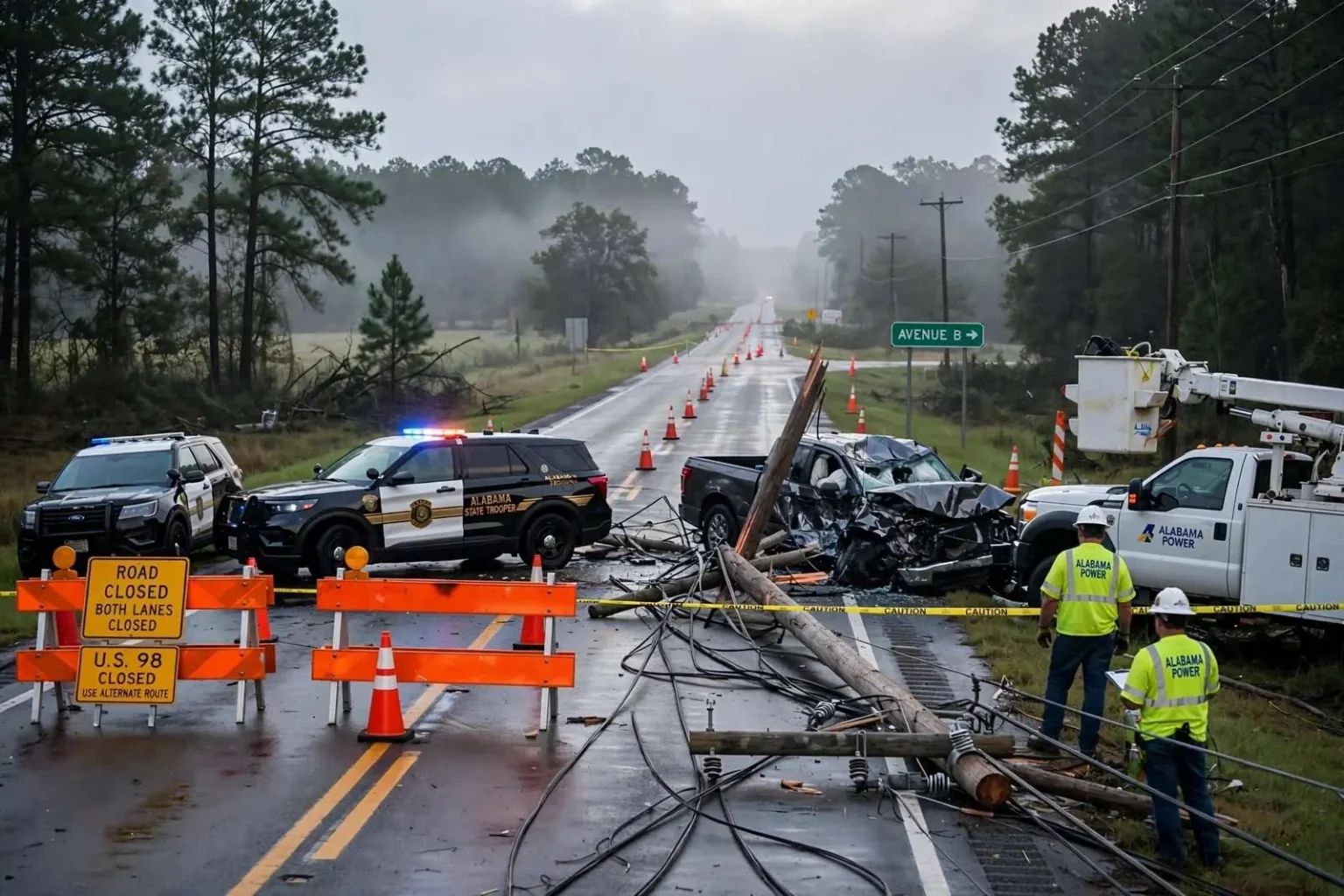
A single-vehicle crash in Wilmer shut down both lanes of U.S. 98 near Avenue B and knocked out electricity to hundreds of customers in western Mobile County, according to the Alabama Law Enforcement Agency. The early-morning wreck turned one of the region’s main rural highways into a closed scene and left a wide band of the county dark while utility crews worked to repair what the collision damaged.
The crash happened around 7 a.m., the hour when U.S. 98 through Wilmer carries its heaviest mix of traffic — commuters heading toward Mobile, school buses on their routes, and local drivers running morning errands. ALEA Highway Patrol troopers responded to the scene and investigated, and officials said at the time that both lanes would remain closed for an undetermined amount of time. With no side roads able to absorb a highway’s worth of diverted traffic, drivers who use U.S. 98 daily had to find alternate routes or wait out the closure.
Wilmer sits in the far western corner of Mobile County, close to the Mississippi state line, a rural community where U.S. 98 functions as the main street and the only direct artery toward the population centers to the east. When both lanes close near Avenue B, there is no convenient parallel road — the network around Wilmer is a lattice of narrow county roads that were never designed for highway volumes, and a closure funnels disruption across an entire morning’s traffic.
Widespread outage tied to the wreck
Alabama Power’s outage map showed nearly 900 customers without power in the wake of the crash, in a band stretching from Old Moffett Road to the Alabama-Mississippi state line. The affected area also reached homes along Howells Ferry Road over to Grant Road. That footprint — hundreds of homes across multiple roads, all losing power at once — is the signature of damage to main distribution lines rather than an isolated service drop.
The outage footprint suggested the collision damaged utility infrastructure along the U.S. 98 corridor, where lines run alongside the highway through rural Wilmer. In rural stretches of Mobile County, overhead power lines follow the highway because that is where the right-of-way already exists, which puts them directly in the path of any vehicle that leaves the road at speed. A single pole snapped at the base can drop span after span of wire across the roadway, and each fallen span takes every customer downstream of the break out of service until repairs are made.
Utility repair work of that kind is measured in hours, not minutes. Crews have to reach the site, assess what broke, set new poles if needed, re-string and tension wire, and then restore power in stages while checking for damage further along the line. Meanwhile the highway remains closed over the work zone, because heavy buckets and pole trucks cannot safely operate with traffic squeezing past.
The road was later cleared and reopened to traffic once crews finished working the scene and utility repairs were made. No details were released about injuries or potential charges connected to the crash, and ALEA’s investigation remained the authoritative account of what happened in the moments before the impact.
When a wreck takes out the grid
Vehicle-versus-pole crashes are a recurring hazard along rural Alabama highways, and the Wilmer case shows why they cascade the way they do. Distribution lines along U.S. 98 serve not just homes but the everyday infrastructure of a rural community — wells and pumps, small businesses, and the communication equipment that depends on local power. A pole knocked out at 7 a.m. interrupts all of it simultaneously, and restoration priority generally runs through whatever repairs the physical damage requires rather than through the list of who lost power first.
Alabama Power crews worked the outage across the affected band, and the utility’s public outage map — which residents in the area follow closely during any interruption — gave the clearest real-time picture of the crash’s reach. Mapping tools like that one bucket customers by feeder line, which is why the affected area showed up as a band along Old Moffett Road to the state line and across Howells Ferry Road to Grant Road: those were the neighborhoods served by the damaged segment of the system.
For drivers on U.S. 98 that morning, the closure was a lesson in rural geography. Detours in Wilmer mean county roads that loop for miles between crossings, and many morning travelers simply waited for the reopening rather than guessing at a route. Local officials generally advise drivers in that corridor to expect long delays any time U.S. 98 closes, because the alternatives add distance and are easy to congest.
The timing compounded the disruption. A 7 a.m. crash lands at the start of the school day and the work commute, so the closed highway affected buses, shift workers, and anyone whose route ran through the Wilmer stretch of U.S. 98. Storms knock out power without closing roads; a crash closes the road and the power together, which is what made this morning particularly disruptive for the community.
Investigators with the ALEA Highway Patrol handled the scene the way they handle serious rural crashes: documenting the vehicle’s path, the point of impact with the pole, and the factors — speed, restraint use, road conditions, possible impairment — that determine what, if anything, leads to charges. Until that work concludes, agencies typically decline to release details about injuries or potential violations, which is why the public account of the crash centered on the road closure and the outage rather than on the driver.
Living along the corridor
Wilmer’s morning routine runs through U.S. 98 in a way that residents of larger cities rarely think about. The highway carries the community’s traffic toward Mobile, connects its churches and stores, and doubles as the address line for businesses that depend on drive-by customers. A closure near Avenue B does not just delay drivers; it interrupts the commercial rhythm of the whole corridor until the road reopens.
That dependence is also why utility and road crews coordinate so closely on scenes like this one. The pole that came down sat in the state’s right-of-way, on a highway the Alabama Department of Transportation maintains, carrying lines owned by the utility, closed by state troopers, and traveled by a county’s commuters. Getting all of those agencies working the same piece of pavement is itself a task, and the fact that the road reopened the same day reflects how routine that coordination has become.
Power restoration in the affected band also illustrates how the rural grid is built. Out west in Mobile County, customers are spread along miles of line per feeder, so there is no way to reroute power around a break the way denser areas sometimes can. The customers downstream of the damage wait for the physical repair. That is why the outage map showed a solid band from Old Moffett Road to the state line — everyone on the damaged segment, regardless of how close their house was to U.S. 98 itself.
For the nearly 900 households affected, the outage was more than an inconvenience logged on a map. Food in refrigerators, well pumps that supply water outside municipal service areas, medical equipment that runs on household power, and the simple mechanics of getting ready for work and school all stopped at once. Outages that begin with a crash also carry an uncertainty that storm outages do not: no one knows the restoration time until the crews arrive and see what broke, which is why the initial response from the utility carried no estimate at all.
By the time the road reopened, the episode had run its familiar course: troopers working the investigation, utility crews rebuilding the line, and a rural community absorbing a morning without its main highway and, for several hours, without its electricity. The crash served as another reminder for drivers along the U.S. 98 corridor — the same lines that bring power to the homes and businesses of western Mobile County run within feet of the highway, and a vehicle leaving the road anywhere along that stretch can darken a community for miles in either direction.
Residents who lose power in circumstances like this are generally advised to report the outage directly to the utility rather than assuming the damage is already known, to stay clear of any downed lines they encounter — especially around a crash scene, where energized wire can lie across the roadway — and to check the utility’s outage map for restoration updates. Those guidelines held in Wilmer as crews worked through the repair, and the eventual reopening of both lanes closed out a morning that demonstrated, once again, how interconnected a rural highway and its utility corridor really are.