Wilsonville mayor keeps up fight against Alabama Power’s plan to cap coal ash in place
Wilsonville Mayor Lee McCarty is pressing Alabama Power to excavate, not cap in place, coal ash after arsenic was found leaching into groundwater.
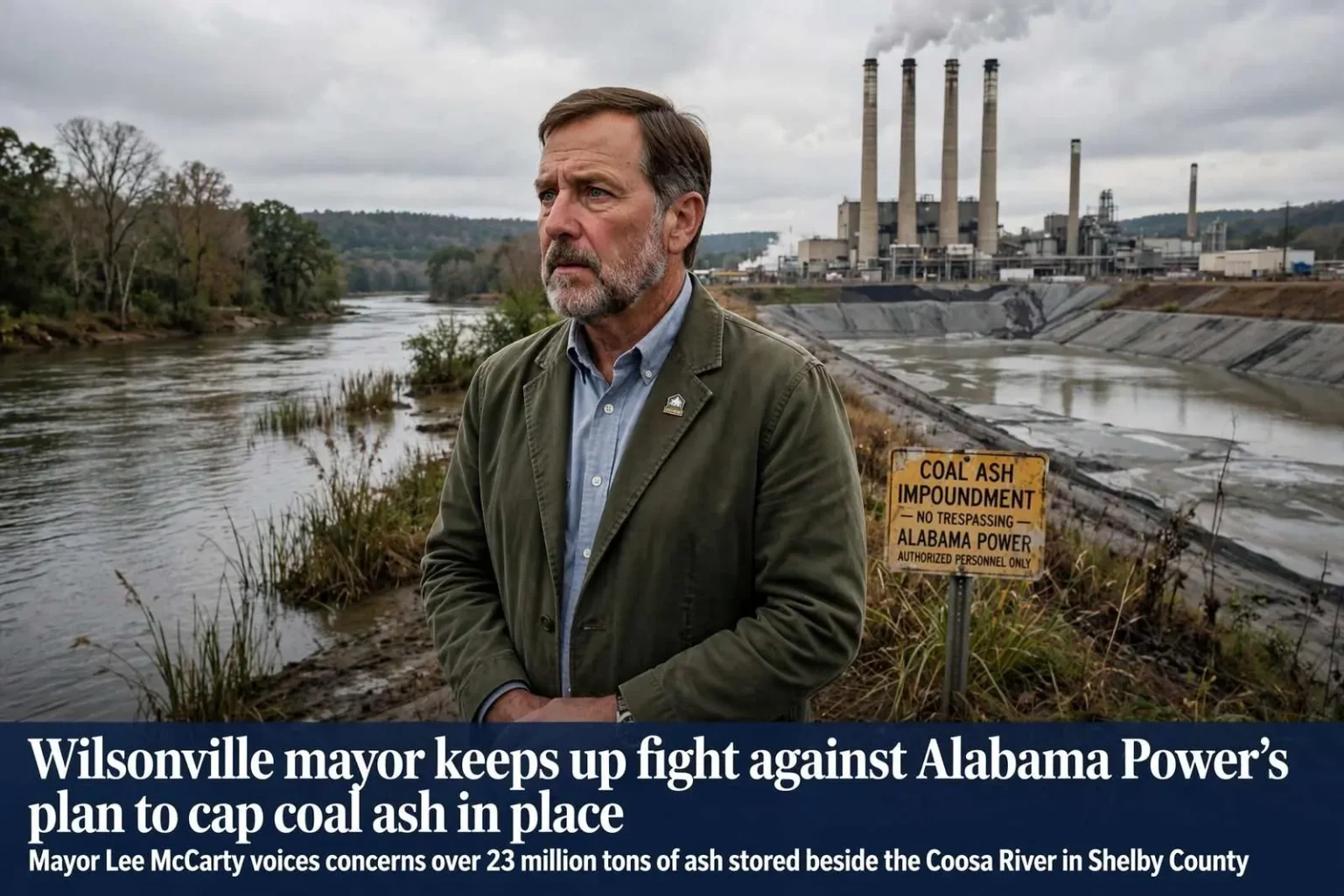
The mayor of a small Shelby County town has become an unlikely central voice in a statewide debate over how Alabama Power should handle decades of coal ash stored at its plants. Wilsonville Mayor Lee McCarty has spent the past couple of years publicly criticizing the utility’s plan to de-water and “cap in place” roughly 23 million tons of coal ash at its E.C. Gaston Plant on the Coosa River, arguing that the approach leaves a permanent hazard beside a river that thousands of Alabamians rely on.
Coal ash is the residue left after coal is burned to generate electricity, and it contains concentrated amounts of arsenic, radium, mercury, lead and other contaminants. For decades, utilities across the country mixed the ash with water and stored it in large surface ponds — essentially engineered lagoons — next to their power plants. Alabama Power’s plants, built along the state’s rivers for cooling water, accumulated some of the largest such ponds in the Southeast, and what to do with the ash now that those plants are retiring or converting to gas has become one of the state’s most persistent environmental disputes.
Wilsonville, home to about 2,000 people, sits near the plant, and McCarty argues the ash pond directly abuts the river and lies close to residents. “Plant Barry sits in an awful location for an ash pond, but Wilsonville is not much better,” McCarty said. “The ash pond here directly abuts the Coosa River, and in some ways it’s even worse than Barry’s because we’ve got people living much closer to the plant itself.”
The same dispute at Plant Barry
The same dispute surrounds Plant Barry in Mobile County, where Alabama Power proposes to cap in place about 21 million tons of ash in an unlined pond. Monitoring at both sites has detected arsenic leaching into groundwater. The Barry pond sits in the Mobile-Tensaw Delta’s watershed north of Mobile, a landscape of wetlands and channels that feed the drinking water and seafood economy of the entire coast — which is why the Mobile County site has drawn its own cohort of opponents, from environmental groups to downstream governments.
Several Alabama Power plants received $250,000 fines from the Alabama Department of Environmental Management in 2018, the first day new federal rules required utilities to disclose groundwater monitoring results. Those disclosures transformed the debate: data that utilities had collected for years became public, and at site after site, the monitoring wells showed contaminants moving in the groundwater beneath the ponds. Regulators and utilities cautioned that exceedances at a monitoring well do not necessarily mean contamination of drinking water, but for residents living near the ponds, the disclosures confirmed long-held suspicions.
Both ADEM and the U.S. Environmental Protection Agency permit closing the ponds in place. McCarty, however, contends the material “will pollute in perpetuity if it’s not moved.”
Two ways to close a pond
The debate McCarty has joined comes down to two competing closure methods. Capping in place leaves the ash where it lies, removes the pond water, covers the mass with a liner and soil cap, and relies on that engineered barrier — plus groundwater monitoring — for the coming decades. Excavation, by contrast, digs the ash out and hauls it to a modern lined landfill engineered to isolate it from groundwater permanently. Federal rules adopted in 2015 allow both approaches, and utilities across the country have split between them, with costs often the deciding factor.
Environmentalists point out that the only Alabama Power pond fully capped in place so far is still leaking arsenic and radium into groundwater and drew a $250,000 ADEM fine in May. For closure opponents, that record is the argument in miniature: a cap, however well built, does not remove the source of contamination, and monitoring wells at closed ponds keep telling the same story. The utility and its regulators respond that exceedances at wells can occur during and after closure and that the systems are designed to detect and correct problems.
Alabama Power says its closure plans “go above and beyond” state and federal requirements. At Gaston, the company proposes treating and removing pond water, building a 330-yard buffer between the ash and the river, and adding a redundant dike system. The utility maintains that excavating the ash would be far more costly, take years, and create major logistical challenges on the scale of moving an entire mountain of industrial waste by truck and rail through communities that never agreed to become thoroughfares.
The cost argument is not trivial. Moving tens of millions of tons of ash means thousands of truck trips a day for years, rail spur construction, and landfill capacity at the receiving end, with the bill ultimately recovered from the utility’s customers through rates. Capping in place is dramatically cheaper, which is why utilities favor it and why opponents describe it as choosing the utility’s balance sheet over the river’s future.
The view from Wilsonville
For the people of Wilsonville, the issue is not abstract policy but proximity. The town sits in the shadow of the Gaston plant, whose four exhaust stacks have marked the Coosa River horizon for decades, and generations of residents have fished, boated and swum in the river that the ash pond touches. McCarty’s argument — that ash sitting beside a river, behind dikes, over groundwater, is a risk no cap can fully retire — has made the mayor of 2,000 people a fixture at regulatory hearings and in news coverage across the state.
Small towns, McCarty has suggested, have the most to lose and the least leverage. Wilsonville has no industrial tax base to compensate for a damaged aquifer, no legal team the size of the utility’s, and no ability to move its wells or its waterfront. What it has is a mayor willing to keep showing up, and a dispute that has outlasted two years of hearings.
Why the Coosa River matters
The Coosa is one of Alabama’s great river systems, flowing southwest from Georgia through a chain of lakes and dams before joining the Tallapoosa to form the Alabama River. It supplies drinking water to riverside towns, supports a sport fishery that draws anglers from across the Southeast, and carries recreational traffic that anchors the economies of communities all along its banks. It is also, biologists note, one of the most species-rich river systems in North America — a distinction that makes the water quality of every mile a matter of more than local interest.
Ash ponds are placed beside rivers because plants need cooling water, but the same geography that made the siting convenient makes closure contentious. Groundwater along a river valley moves toward the river; anything the groundwater picks up tends to end up in the current. Opponents of cap-in-place argue that this hydrology makes riverside ponds fundamentally different from ponds in dry, isolated terrain, and that the federal rules’ flexibility should not be read as permission to leave 23 million tons of ash leaning against a riverbank.
A debate that reaches statewide
The Wilsonville fight and the Plant Barry fight have become the two poles of Alabama’s coal ash argument, and they have drawn in parties well beyond the utility and the towns. Environmental organizations have pressed for excavation at both sites; downstream governments in Mobile County have raised concerns about the Barry pond’s location in the delta’s watershed; and legislators periodically introduce bills that would require utilities to move ash away from waterways. The utility, for its part, has consistently defended its closure plans as compliant, engineered, and monitored.
The federal rules at the center of the dispute require utilities to stop using unlined ponds, install monitoring systems, and close the ponds either by retrofitting with a liner or removing the ash — with deadlines that utilities have sometimes sought to extend. How strictly those rules are enforced, and whether future revisions tighten or loosen them, will shape what happens at Gaston and Barry as much as any local hearing.
For residents near either plant, the practical questions are immediate: the safety of private wells, the long-term value of riverfront property, and whether the fish from the river are safe to eat at rates the state advisories contemplate. Those questions are why McCarty keeps repeating his central claim — that the material will pollute in perpetuity if it is not moved — and why the utility keeps repeating its own: that the engineered closures, monitored for decades, protect the rivers and the ratepayers alike.
The dispute remains unresolved at both sites, and both sides appear prepared for a long contest. What has changed is that a mayor from a town of 2,000 has forced the question into statewide view, pairing a concrete argument — people live closer to the Gaston pond than to almost any other in Alabama — with a broader one about who bears the risk of the cheapest available closure. As the federal deadlines approach, that argument will be made not just in Wilsonville and Mobile County, but in Washington, where the rules that govern the ash will ultimately be decided.