New Window Depot Civil Complaint Filed in Mobile County as Owners Still Face No Charges
Homeowners who say they paid $12,500 for windows that never arrived have filed a new civil complaint against the owners of Window Depot USA of Mobile and All Weather Roofing and Construction, while a criminal review remains without charges.
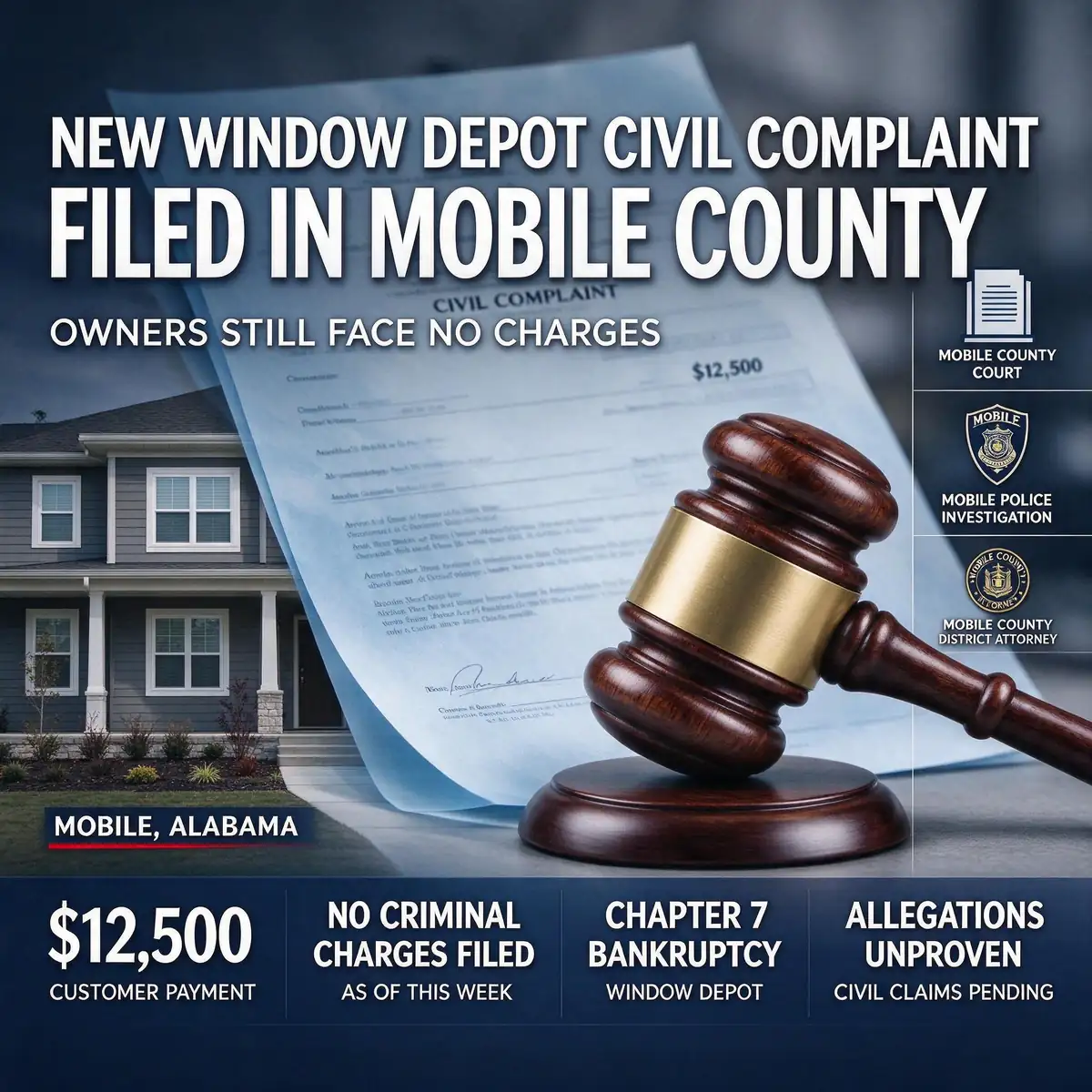
MOBILE, Ala. — Homeowners who paid a Mobile window company $12,500 last winter for replacement windows they say never came have taken the dispute to court. Their new Window Depot civil complaint adds to a growing stack of civil claims against the couple who own Window Depot USA of Mobile and All Weather Roofing and Construction. No criminal charges have been filed against the owners, and the allegations in the civil filings have not been proven in court.
The latest lawsuit landed in Mobile County court on Tuesday. It is the latest legal action tied to the two companies, which have been the subject of a Mobile police investigation and are now the focus of a review by the Mobile County District Attorney’s Office.
At a Glance
- New lawsuit: A lawsuit lodged in Mobile County on Tuesday by Window Depot customers who say they paid for windows that were never delivered.
- Payment: The filing includes an image of a $12,500 check dated Jan. 30.
- Supplier claim: ABC Supply filed its own civil complaint in June alleging All Weather Roofing and Construction left a bill of more than $632,000 unpaid for supplies and labor.
- Criminal review: City public safety officials said in July that Mobile police were looking into more than 100 criminal cases involving the two businesses. The matter went to the district attorney’s office in September.
- Charges: None filed as of this week. Prosecutors report nothing new in the case.
- Bankruptcy: Window Depot sought Chapter 7 protection in September, reporting liabilities of nearly $2 million and zero assets.
What the Newest Complaint Alleges
The customers behind Tuesday’s filing say they wrote a check to Window Depot on Jan. 30 to cover a set of replacement windows. A copy of that $12,500 check is attached to the complaint as evidence of the payment.
According to the complaint, a company representative told the homeowners in March that the windows had been ordered and should be delivered in June. The customers say June came and went without any windows, and that their later calls to the owners went unanswered.
The filing states the customers were told their order had been placed through ABC Supply, a building materials distributor. That detail connects the homeowners’ case to a much larger claim the supplier brought earlier this year.
The same customers also appear in Window Depot’s bankruptcy paperwork, where they are listed among the parties the company owes. That overlap is common when a business enters bankruptcy while lawsuits are pending, and it can affect how, or whether, a civil claim moves forward.
A Supplier’s Six-Figure Claim
In June, ABC Supply filed a civil complaint against one of the owners. The supplier alleges that All Weather Roofing and Construction did not pay for more than $632,000 worth of materials and work.
Like the homeowners’ complaint, the supplier’s lawsuit contains allegations that the defendants have the opportunity to answer and contest. A civil complaint is the document that starts a lawsuit; it lays out one side’s version of events, and a judge or jury has not ruled on the claims simply because they were filed.
Where the Criminal Investigation Stands
The civil cases are running alongside a separate criminal inquiry. About six months ago, dozens of customers came forward publicly to say they had paid the companies for roofing and window services and received nothing in return.
By July, city public safety officials said Mobile police had upward of 100 criminal cases open connected to All Weather Roofing and Construction and Window Depot. In September, police turned the case over to the Mobile County District Attorney’s Office, which decides whether the evidence supports criminal charges.
As of this week, no charges have been filed against the couple who own the companies, and prosecutors have reported no new developments. Being the subject of an investigation is not the same as being charged with a crime, and anyone who is charged is presumed innocent unless proven guilty in court.
Window Depot’s Chapter 7 Filing
Court records show Window Depot USA of Mobile entered Chapter 7 bankruptcy in September. In its filing, the company listed nearly $2 million in debts and reported no assets.
How Chapter 7 Bankruptcy Works
Chapter 7 of the U.S. Bankruptcy Code is often called liquidation bankruptcy. Instead of reorganizing and continuing to operate, the debtor’s case is handed to a court-appointed trustee, whose job is to gather any property that can be sold and distribute the proceeds to creditors according to the priorities set out in federal law.
A few general points help explain what a filing like this can mean for customers who are owed money:
- The automatic stay. Once a bankruptcy petition is filed, an automatic stay generally takes effect, pausing most collection efforts and many lawsuits against the debtor while the bankruptcy case proceeds.
- Proofs of claim. Creditors may be asked to file a proof of claim with the bankruptcy court describing what they are owed. Notices from the court explain whether and when to do so.
- No-asset cases. When a debtor reports no assets, there may be little or nothing for the trustee to distribute, which means unsecured creditors, including many customers, may recover little or none of what they paid.
- Businesses and discharge. Under federal law, a corporation or similar business entity that goes through Chapter 7 does not receive a discharge of its debts the way an individual can. The business is typically wound down.
- Separate from criminal matters. A bankruptcy filing addresses debts. It does not end a criminal investigation, and it does not resolve whether anyone broke the law.
Customers who receive bankruptcy notices and have questions about their rights may want to speak with an attorney, because the rules that apply can depend on the details of each case.
A Separate Case Across the Bay
In Baldwin County, an unrelated contractor case has reached a different stage. A Baldwin County couple who own a business there now face a grand jury indictment listing several financial crime counts. Prosecutors have not publicly described the specific allegations behind the indictment.
That couple also faces civil claims. Two of the alleged victims named in the indictment have already won civil judgments against them in Baldwin County. Those customers say they paid deposits totaling thousands of dollars for boat lifts that were never constructed, and that none of it came back to them.
An indictment is a formal accusation issued by a grand jury after it finds probable cause to believe a crime was committed. It is not a finding of guilt. The Baldwin County defendants are presumed innocent, and the criminal charges must be proven beyond a reasonable doubt. The Baldwin case and the Mobile case involve different businesses and different people.
Civil Court and Criminal Court: Two Different Tracks
Situations like these often play out in two court systems at once, and the difference matters for customers trying to understand what comes next.
Civil cases
A civil lawsuit is filed by a private party, such as a homeowner or a supplier, who says they were harmed and wants a remedy, usually money. The person bringing the case must generally prove their claim by a preponderance of the evidence, meaning it is more likely true than not. If they win, the court can enter a judgment ordering payment, but collecting that money is a separate step and can be difficult if the defendant has few assets.
Criminal cases
A criminal case is brought by the government, not by the victim. Police investigate, and prosecutors, such as a district attorney’s office, decide whether to seek charges, sometimes by presenting evidence to a grand jury. To convict, prosecutors must prove guilt beyond a reasonable doubt, the highest standard in the legal system. A criminal conviction can bring penalties such as jail time, fines or court-ordered restitution to victims.
Because the standards and goals differ, a person can lose a civil case without ever being charged with a crime, and a civil judgment does not by itself mean a crime occurred. In the Mobile matter, the allegations in both the customers’ and the supplier’s complaints remain unproven, and no criminal charges have been filed.
Protecting Yourself When Hiring a Contractor in Alabama
Home improvement disputes are among the most common consumer complaints nationwide. While nothing can remove every risk, a few practical steps can make it easier to choose a reliable contractor and to recover if something goes wrong.
Before you hire
- Check licensing. The Alabama Home Builders Licensure Board licenses residential home builders and remodelers in the state and offers a way to look up whether a contractor holds a current license. Ask for the license number and verify it yourself.
- Confirm insurance. Ask for proof of liability insurance and, where applicable, workers’ compensation coverage.
- Get several bids. Comparing written estimates from more than one company can help you spot prices or terms that seem out of line.
- Ask for references. Talk with recent customers and, if possible, look at completed work.
- Research complaints. Search for the company’s name along with words like complaint or lawsuit, and consider checking court records in your county.
When you sign
- Put it in writing. A written contract should spell out the scope of work, materials, total price, payment schedule, start and completion dates, and warranty terms.
- Limit upfront payments. Avoid paying a large share of the total before work begins or materials arrive. Tying payments to completed stages of the job gives you more leverage.
- Pay traceably. Use a check or credit card rather than cash so there is a record of every payment. Credit cards may also offer dispute options.
- Be wary of pressure. High-pressure sales tactics, demands for immediate decisions, or offers that are valid only today are warning signs.
If something goes wrong
- Keep records. Save contracts, receipts, canceled checks, texts, emails and photos, and keep notes of every conversation with dates.
- Put concerns in writing. Send the contractor a written description of the problem and what you want done.
- File a complaint. The Alabama Attorney General’s Office accepts consumer complaints through its Consumer Interest Division. Complaints about licensed residential builders can also be directed to the Alabama Home Builders Licensure Board.
- Report possible crimes. If you believe you were the victim of fraud or theft, contact your local police department or sheriff’s office.
- Consider legal options. Depending on the amount involved, small claims court or a consultation with an attorney may be appropriate.
What Happens Next
The customers’ civil complaint will move through Mobile County’s court system, where the defendants can respond, though Window Depot’s bankruptcy filing may affect how claims against that company proceed. The ABC Supply lawsuit remains pending as well.
On the criminal side, the decision rests with the Mobile County District Attorney’s Office, which has reported no new developments. Until prosecutors act, the couple who own All Weather Roofing and Construction and Window Depot USA of Mobile face civil allegations only, none of which have been proven.