2020 National Shrimp Festival in Gulf Shores Canceled Over Pandemic Concerns
Organizers have canceled the 2020 National Shrimp Festival in Gulf Shores, citing the impossibility of meeting COVID-19 safety guidelines at the free, ungated event.
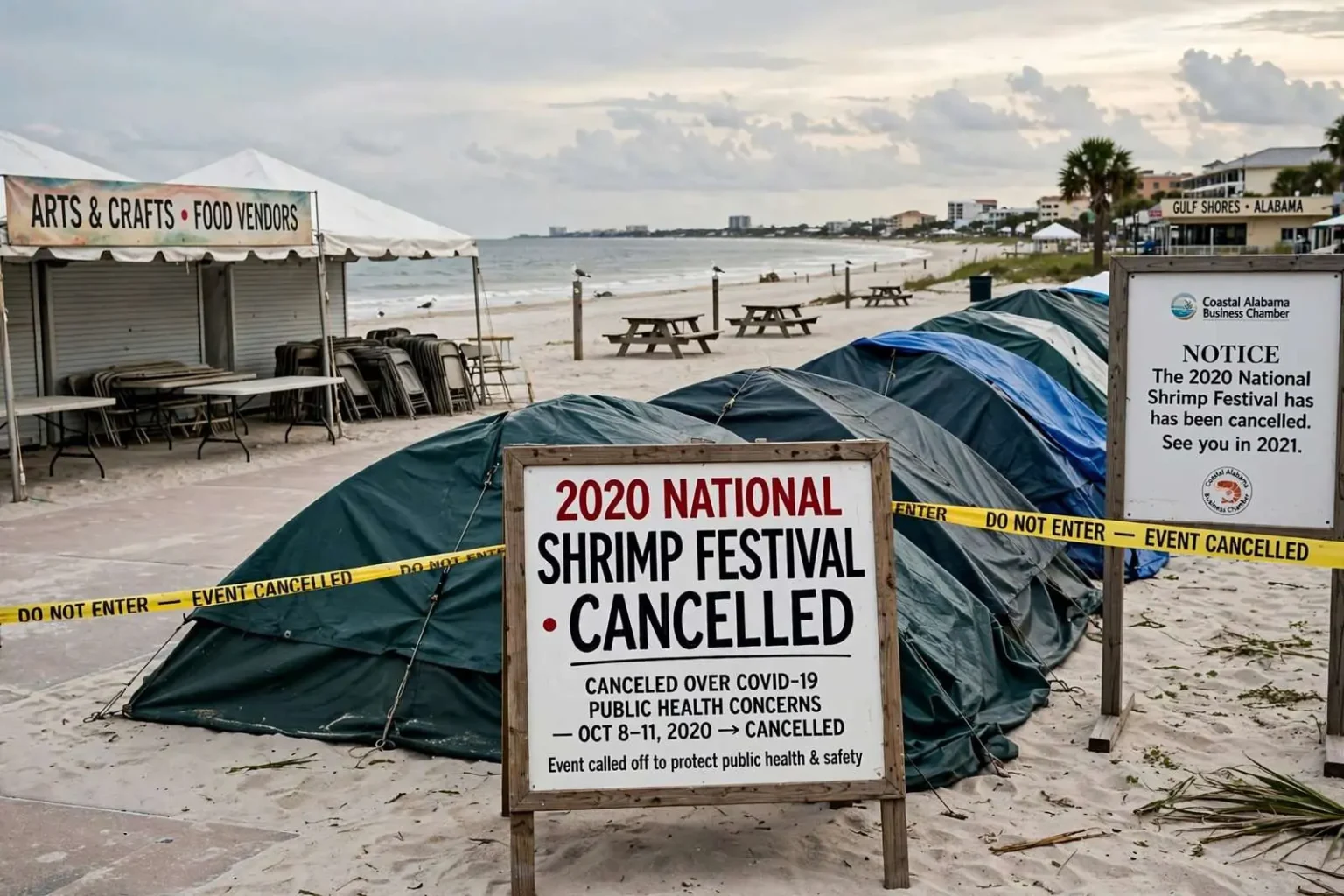
The 2020 National Shrimp Festival, originally set to bring crowds to the Gulf Shores beachfront Oct. 8-11, has been called off. Organizers announced the cancellation in a news release, citing the difficulty of meeting social distancing and public health guidelines at an event of that scale during the COVID-19 pandemic.
The decision followed a series of meetings between festival organizers, state and local permitting agencies and other stakeholders. For an event that draws tens of thousands of visitors to a single stretch of public beach over four days, the logistics of pandemic-era compliance — spacing, sanitation, crowd management — would have had to be negotiated with every agency that touches the festival, from the city’s permitting office to state health authorities.
Coastal Alabama Business Chamber President and CEO Greg Alexander said the timing of the announcement was intended to give the festival’s many partners time to adjust their own plans.
“This determination is being made now in fairness to the many volunteers, sponsors, vendors, contractors, our local municipalities, and local businesses so they are not put at the disadvantage of a last minute announcement,” Alexander said.
The early call mattered well beyond the festival’s own committee. Vendors book inventory and staffing for the fall season months in advance; sponsors budget their giving by the quarter; and the hotels, restaurants and shops that surround the festival footprint plan their October around the crowds it brings. Announcing months ahead of the gates would have opened, in a normal year, gave each of those partners a season to rework their plans instead of absorbing losses in the festival’s final days.
A free, open event built on volume
Part of what made the decision difficult is the very structure that has made the National Shrimp Festival successful for nearly five decades. The festival is free, non-ticketed and ungated, drawing crowds to a family-friendly footprint of food vendors, arts and crafts booths, retail displays, sponsor exhibits and entertainment stages. Anyone can walk onto the site from the public beach access points, and that openness is central to the event’s identity as a community gathering rather than a commercial production.
Because there is no ticketing system, organizers have no practical way to cap attendance or enforce capacity limits — a problem that made compliance with pandemic-era health protocols effectively unworkable. Festivals that sell tickets can count their crowd, control entry and stagger arrival; an ungated beachfront festival cannot. There is no gate to count through and no turnstile to slow down.
The festival’s financial model compounds the challenge. Organizers rely on drawing large numbers of attendees who spend money with vendors, in turn supporting the event’s costs. Scaling back the festival’s footprint, trimming concerts or other offerings, or attempting to limit crowds would have both undercut the health rationale for changes and left the festival short of the revenue needed to cover its costs.
In other words, there was no half-measure available. A smaller, spaced-out festival would have been both harder to keep safe and harder to fund, while the full-scale version was impossible to run within public health guidelines. The arithmetic pointed in one direction, and the organizers followed it.
Looking ahead to 2021
Shrimp Festival Chairman Spencer Cade said organizers spent weeks weighing alternatives before settling on cancellation as the only workable path.
“There have been many people involved in the collective process of avenues and alternatives to organize and adapt the Festival around the COVID-19 pandemic, but the one thing we’ve always been able to rely on in making an informed calculated decision is ‘the known,'” Cade said. “With COVID-19 and the restrictions and limitations that may or may not exist in October, it would be challenging if not impossible to produce a healthy, profitable, fun, and of course successful Festival for all participants.”
Organizers said planning has already begun for a return in 2021, with an eye toward making next year’s National Shrimp Festival the biggest yet. The commitment to return — rather than simply cancel and regroup — reflected the festival’s role in the Gulf Shores calendar, where the October weekend has become a fixture for vendors and visitors alike.
The Coastal Alabama Business Chamber is also working with The Wharf and the city of Orange Beach on a new event planned for 2021, an effort aimed partly at filling the hole left in the coastal events calendar and partly at spreading festival activity across the two beach cities.
“Our goal is to begin preparing now for the 2021 National Shrimp Festival and work toward making it the best yet here in Gulf Shores,” Alexander said. “We are also working with the Wharf and the City of Orange Beach to bring a new and exciting event there in 2021. We thank everyone for your understanding during these unprecedented times and we look forward to the possibility of coming back bigger and stronger next year.”
A staple of the Alabama coast
The National Shrimp Festival has run in Gulf Shores for 49 years, growing from a local celebration into one of the largest annual events on the Alabama Gulf Coast. What began as a modest community shrimp boil has grown into a four-day festival spanning multiple music stages, hundreds of vendor booths and an arts and crafts show juried for quality — an evolution that mirrors the growth of Gulf Shores itself from a quiet fishing town into one of the region’s busiest resort destinations.
The festival’s October slot has long made it a bridge between the summer tourist season and the quieter fall shoulder season, keeping hotel rooms filled and restaurant tables occupied after Labor Day. That economic role is why the cancellation rippled through the local business community: the festival is not just a party on the beach but a pillar of the fall economy in a town whose year rises and falls with tourism.
Its history also spans the coast’s hardest moments. Gulf Shores has rebuilt from hurricanes and weathered the Deepwater Horizon oil spill’s bruising 2010 summer, and the festival has returned each time — a symbol, for locals, of the town’s habit of coming back. The pandemic year marked a different kind of disruption: not a storm to clean up after, but a public health emergency that made gathering itself the hazard. Organizers concluded that the only way to guarantee a healthy 49th festival would have been not to hold one at all.
What the cancellation cost — and what it protected
The losses were real. Vendors who count on the festival’s four-day crowds lost their largest autumn sales window; charities and church groups that staff booths as fundraisers lost their biggest single payout; and the city lost a weekend of sales tax revenue that funds services year-round. Local officials had spent the summer navigating closures and capacity limits, and the festival’s absence extended the pandemic’s economic drag into the fall season.
Yet the cancellation also protected the things that make the festival worth saving. A crowded, ungated beach festival held amid a pandemic risked becoming a superspreading event — and with it, a public health and reputational disaster for a beach town whose brand is built on safe, family-friendly tourism. Ending the event early, months in advance, spared vendors the cost of stocking inventory for a festival that might have been shut down at the last minute and spared the community the risk of an outbreak traceable to its signature event.
For organizers, the calculation came down to the point Cade made about “the known.” With October restrictions unknowable in the spring and summer of 2020, no plan — however careful — could promise a festival that was simultaneously safe, solvent and fun. Canceling preserved the festival’s future by surrendering its present, and by the time the announcement was made, the committee had already turned its attention to the 50th year ahead.
The week the calendar emptied
The 2020 cancellation fit into a broader pattern along the Alabama coast, where nearly every major gathering of the year was rethought in turn. Mardi Gras seasons, parades, sporting events and seafood celebrations across the Gulf had already been trimmed or scrapped, leaving businesses that live on event traffic to improvise through the fall. For a tourism economy, an empty calendar is more than an inconvenience: the festivals and tournaments scheduled across a year function as an infrastructure of demand, and removing them strips the season down to weather and word of mouth.
The festival’s food vendors felt that shift most directly. Many of the operations that set up along the beachfront each October are small, family-run businesses that follow a circuit of Southern festivals from spring to fall, and the Gulf Shores event is one of the circuit’s anchor stops. Without it, the 2020 season closed early for vendors who had already survived a spring of canceled events, and some used the unexpected off-season to rework menus, repair equipment and apply for federal relief programs designed for pandemic-hit small businesses.
The chamber’s parallel work with The Wharf and Orange Beach was, in part, an answer to that gap — a way to give the coast’s event economy a foothold in 2021 rather than a single comeback weekend. Spreading new activity across venues and cities also reflected a lesson of the pandemic year: events that concentrate enormous crowds in one footprint are fragile in ways that smaller, distributed gatherings are not.
Why the shrimp festival endures
Through nearly five decades, the festival has survived on a simple proposition: put an abundance of Gulf shrimp, live music and local crafts within walking distance of a public beach, and crowds will come. The event’s committee has kept admission free by funding operations through vendor fees, sponsorships and the volume of sales the crowds generate — a model that has made the festival accessible to every family on the coast while tying its fortunes directly to attendance.
That same model is what made 2020 unworkable, and it is also why organizers moved so quickly to secure the next year. A festival with no tickets, no gates and no reserved seats cannot pivot to a drive-in or a livestream; its product is the crowd itself. The only durable response was to protect the brand — the reputation for a well-run, family-friendly October weekend — by sitting out one year and returning with full force.
By the time the announcement reached the public, the committee’s attention had already shifted to 2021: booking entertainment, renewing vendor commitments and planning the logistics of a comeback. Alexander’s message to vendors, sponsors and volunteers was built around that horizon — a promise that the festival’s absence was a pause, not an ending, and that the work of the next October would begin long before the current one arrived.