39th Annual Alabama Coastal Cleanup Set for September, Organizers Seek Volunteers
Volunteers are needed for the 39th Annual Alabama Coastal Cleanup on Sept. 19, part of the global International Coastal Cleanup protecting Gulf Coast waterways.
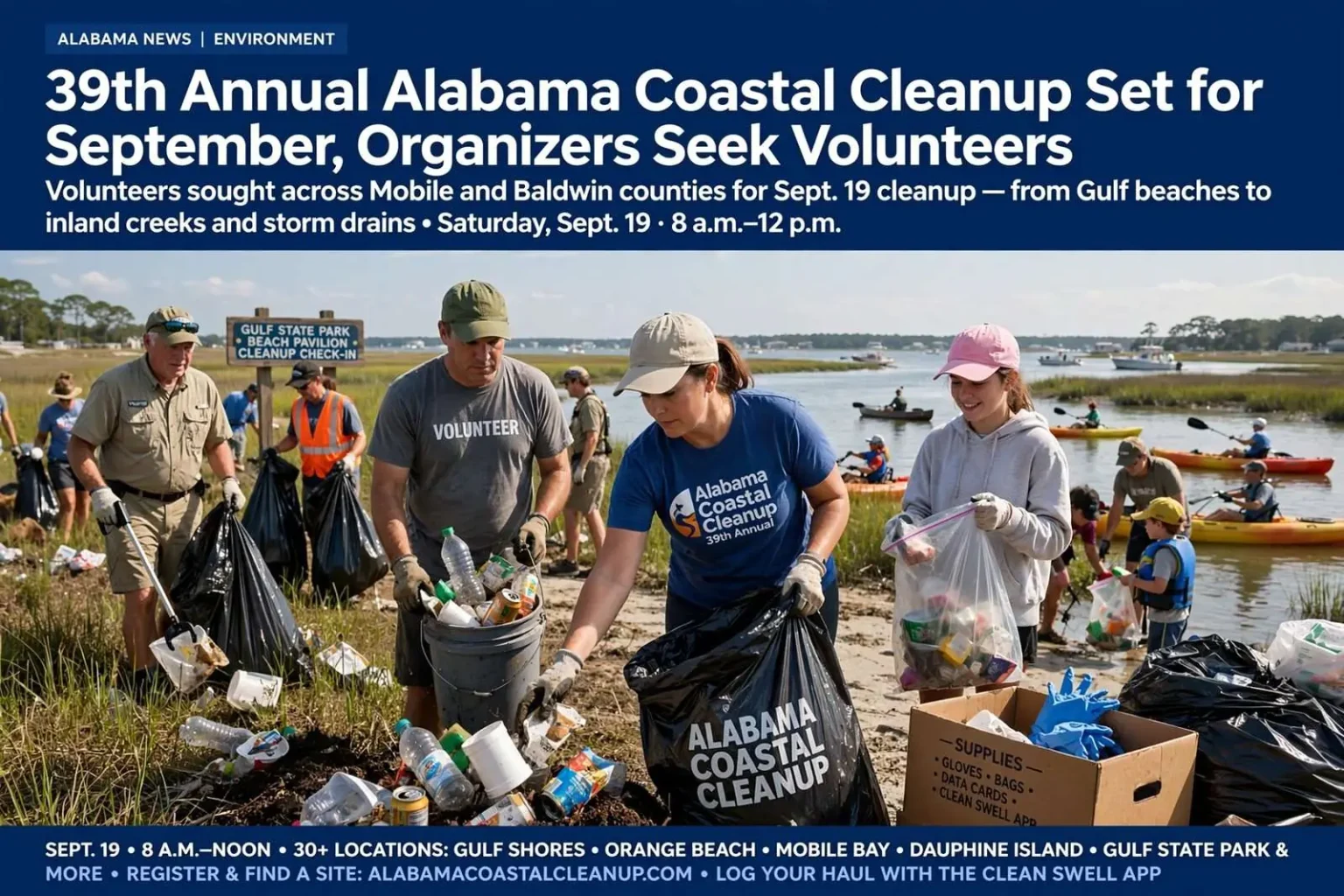
Volunteers across coastal Alabama are being asked to donate a few hours to help protect the beaches, bays and waterways that draw millions of visitors each year during the 39th Annual Alabama Coastal Cleanup. This year’s cleanup is scheduled for Saturday, Sept. 19, running from 8 a.m. to noon, and includes sites ranging from neighborhoods and local parks to streets and storm drains — a reminder that the event’s mission extends far beyond the sand.
Volunteers can visit the cleanup’s website to find a site and sign up, with locations spread across Mobile and Baldwin counties and beyond: public beaches on the Gulf, bayfront parks, boat launches, creek banks, and even inland roadways that feed litter into the coast’s drainage systems. The four-hour window is deliberately short — long enough to fill bags and log data, short enough that families, scout troops, church groups, and corporate teams can all take part without committing an entire day.
The event marks the 39th year Alabama has taken part in the International Coastal Cleanup, a global initiative that began in 1987 under the Ocean Conservancy and has since grown into the world’s largest volunteer effort for ocean health. Since Alabama joined, more than 110,000 volunteers have helped collect trash from the state’s coastline and waterways — a cumulative tally built one Saturday morning at a time over nearly four decades.
How the cleanup works
The cleanup is coordinated by the Alabama Department of Conservation and Natural Resources’ State Lands Division, Coastal Section, along with Alabama People Against a Littered State, better known as Alabama PALS. The two organizations divide the work: the state agency brings the scientific and coastal-management oversight, while PALS supplies the anti-litter network of volunteers, local affiliates, and community partnerships that turn a statewide goal into thousands of individual pickups.
On cleanup morning, site captains — local volunteers who coordinate each location — distribute gloves, bags, and data cards, then send teams out to their assigned zones. Participants record what they collect: cigarette butts, plastic bottles, fishing line, foam cups, and the other items that consistently top the annual totals. That data is not just ceremonial. Collected totals feed into the international database used by researchers and policymakers to track marine debris trends, meaning an hour spent on a Mobile County creek bank contributes to a global picture of ocean pollution.
Organizers note that litter left on land doesn’t always stay there — trash travels through storm drains, streams and rivers before eventually polluting Mobile Bay and the Gulf. That hydrological reality is why the cleanup’s site map stretches inland: a foam cup dropped on a Mobile street can end up in Three Mile Creek, then the Mobile River, then Mobile Bay, then the Gulf, picking up momentum at every rainstorm along the way.
Logging what the Gulf Coast throws away
Volunteers are encouraged to use the CleanSwell app, provided by Ocean Conservancy, to log what they collect during the event. The app replaces the traditional paper data cards for smartphone users, letting teams tally items as they go and instantly contribute their totals to the international marine debris database — while giving organizers a faster, cleaner picture of what Alabama’s coastline accumulates in a single morning.
The cleanup has drawn strong sponsorship from local and regional organizations, including Coca-Cola United, the City of Orange Beach, the City of Gulf Shores, the Mobile Bay National Estuary Program, NOAA, Alabama Power, Home Depot and Alfa Insurance. The sponsor list tells the story of an event with broad constituencies: beverage and retail companies with a stake in packaging, beach cities whose economies depend on clean sand, federal and state agencies charged with coastal science, and the estuary program that coordinates restoration across the Mobile Bay watershed.
Flora-Bama and LuLu’s at Homeport are among the Gulf Coast venues supporting the annual event, with the famous state-line bar and the waterfront restaurant serving as longtime hosts and staging points for volunteers. Their involvement underscores the cleanup’s economic logic as much as its environmental one: the beaches, bays and waterways being cleared of trash on Sept. 19 are the same assets that fill restaurants, bars, and rental properties across coastal Alabama every summer.
For volunteers deciding where to spend their morning, the choice of sites is part of the appeal. Gulf-front locations such as the public beaches in Gulf Shores and Orange Beach offer the classic image of the cleanup — bags filling with plastic and cigarette butts against a backdrop of emerald water — while bay sites around Mobile Bay and the Delta put teams in kayaks and small boats in some cases, reaching debris along shorelines and marsh edges that land-based crews cannot access. Inland sites along creeks, streets, and storm drains tackle the litter at its source, before the next rain carries it seaward.
Families with young children generally gravitate to the park and beach sites, where the terrain is easy and the results are visible immediately. Experienced volunteers often seek out the storm-drain and creek sites, knowing that a morning spent there prevents months of downstream accumulation. Every site contributes to the same totals, and organizers stress that no location is more important than another — the point is coverage, from the Gulf’s edge to the headwaters of the coastal watershed.
What four decades of cleanups have accomplished
The Alabama Coastal Cleanup’s longevity is its most impressive statistic. An event that has run for 39 consecutive years has outlasted most civic initiatives, surviving hurricanes, economic downturns, and the inevitable turnover of volunteers. Generations of coastal Alabama families have made the third Saturday of September a standing appointment; many of today’s site captains first picked up trash as children alongside their parents.
The cumulative numbers — more than 110,000 volunteers since the state joined the international effort in 1987 — translate into tons of debris removed from beaches, bayous, rivers, and roadsides. Just as important is the record the event has built: nearly four decades of itemized data documenting what washes up and what gets left behind, information that has shaped everything from local plastic-bag discussions to international marine debris policy.
The event’s educational reach may be its most durable product. Schools across Mobile and Baldwin counties incorporate the cleanup into service-learning projects, teaching students that coastal stewardship begins with the simple act of not letting trash reach the water. Civic groups, real estate associations, fishing clubs, and church congregations treat the morning as an annual team event — part volunteer day, part social gathering, and part visible commitment to the place they call home.
For Sept. 19, the instructions remain simple: pick a site on the cleanup’s website, show up by 8 a.m., wear closed-toe shoes and sun protection, and bring a water bottle. Gloves and bags are provided, and the morning’s work wraps by noon. Four hours and one Saturday is a small price, organizers note, for protecting the coastline that makes coastal Alabama what it is — and with the 39th annual edition approaching, the state’s longest-running environmental volunteer tradition is ready for another turnout to match its history.
The economic stakes behind the cleanup are hard to overstate. Coastal Alabama’s tourism economy — built on Gulf Shores and Orange Beach’s beaches, Mobile Bay’s waterfront, and the fishing and boating culture that spans both counties — depends directly on the appearance and health of the water. Visitors who find litter on the sand do not return, and debris that harms fisheries, fouls boat engines, or washes into the Delta carries real costs for the businesses that line the coast. That is why the sponsor list mixes beverage companies and hardware stores with beach municipalities: everyone on it has a balance sheet tied to a clean coast.
The Mobile Bay National Estuary Program’s involvement also connects the cleanup to a larger scientific mission. The estuary program coordinates restoration and water-quality work across the entire Mobile Bay watershed — one of the largest drainage basins in the United States, fed by the Alabama, Tombigbee, and Mobile rivers. Every piece of trash intercepted on Sept. 19 is a small piece of that broader effort to keep the bay’s waters healthy for the fisheries, oyster reefs, and seagrass beds that depend on them.
Why the land-to-Gulf message matters
The cleanup’s central insight — that litter is a water-quality problem, not just an eyesore — has gradually changed how coastal communities think about waste. Cities have installed storm-drain filters and markings, neighborhoods have adopted roads, and boaters and anglers have adopted practices like stowing trash securely, all part of the same understanding the cleanup teaches: the Gulf begins at every curb, ditch, and driveway in the watershed.
Volunteers who use the CleanSwell app add to that understanding in real time. The app’s itemized tallies — down to individual cigarette filters and bottle caps — give the international database a level of detail that informs marine debris research worldwide, and Alabama’s four decades of participation have made the state one of the effort’s most consistent contributors. A team of a dozen volunteers logging their haul from a Daphne creek or a Dauphin Island shoreline becomes part of a dataset used on every coast on Earth.
With the 39th annual event set for Saturday, Sept. 19 from 8 a.m. to noon, organizers are calling on residents of Mobile, Baldwin, and the surrounding counties to keep the streak alive. Registration and site maps are on the cleanup’s website, the CleanSwell app is free to download, and — with supporters from Coca-Cola United to the Flora-Bama and LuLu’s at Homeport behind it — the infrastructure is in place for another four-hour morning that adds to a 110,000-volunteer legacy. The Gulf gives coastal Alabama its economy, its identity, and its summers; the cleanup is the one morning a year the entire coast gives back.
Update: Locations, Contacts and What to Bring
The 39th Annual Alabama Coastal Cleanup will be held Saturday, Sept. 19, at more than 30 locations in Baldwin County.
For a list of cleanup locations and zone captain contact information, call 251-621-1216 or 251-928-9792. Participants are asked to use the Clean Swell app to record data collection — the app turns each volunteer’s haul into a data point in a national marine debris database, which is what allows a single morning of cleanup to contribute to long-term tracking of what is washing up and where.
Gulf State Park Beach Pavilion
No pre-registration is required to volunteer at the cleanup around the Gulf State Park Beach Pavilion. Parking is free for all volunteers, and supplies will be available at the pavilion.
After gathering trash, volunteers return to the pavilion to weigh their trash and return equipment, and receive a T-shirt and a hotdog. For more information on that site, contact Hannah Russell at 251-948-7275 ext. 62092.
Pleasure Island Sites
Pleasure Island cleanup sites include Gulf State Park, CoastAl Restaurant, Boggy Point, Cotton Bayou Public Beach, the Wind and Water Learning Center on Wolf Bay, the Flora-Bama, Ono Island, Gulf Shores Public Beach, Fort Morgan and Little Lagoon.
Boat Zones
Zones designated as Boat Zones are areas where personal watercraft — canoes, kayaks and small boats — can assist in the cleanup.
Those zones matter more than their share of volunteers suggests. Marine debris accumulates most heavily in marsh edges, back bays and shoreline pockets that cannot be reached on foot, and a kayak volunteer can often clear stretches that would otherwise go untouched year after year.