93rd Alabama Deep Sea Fishing Rodeo Wraps Up on Dauphin Island
The 93rd Alabama Deep Sea Fishing Rodeo wrapped up on Dauphin Island with about 3,800 tickets sold, and organizers have released the full category and cash jackpot results from this year's tournament.
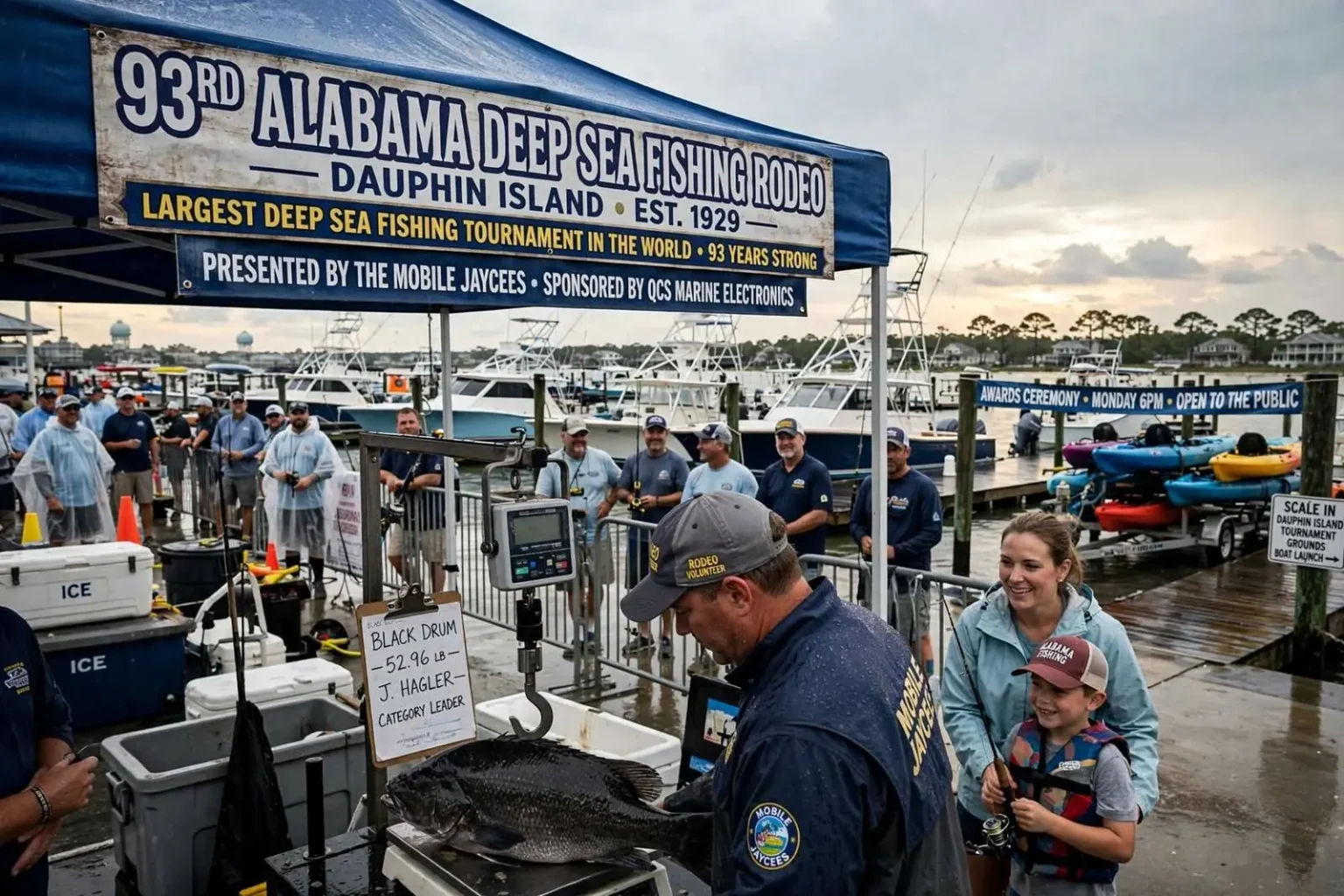
The 93rd annual Alabama Deep Sea Fishing Rodeo, billed as the largest deep sea fishing tournament in the world, came to a close Sunday evening on Dauphin Island with a cannon blast at 5 p.m.
Organizers said the weekend drew a strong crowd despite afternoon rain.
“We’ve had a great weekend, a great turnout,” said Cody Ward, the rodeo’s vice president of publicity. “93 years strong!”
Ward said roughly 3,800 tickets were sold over the course of the weekend, and the rain that moved through Sunday afternoon did little to dampen the mood at the docks.
Anglers brought in a wide range of catches, from snapper and shark to swordfish, and organizers said the size of the fish mattered less to most participants than the experience of sharing it with family.
“It does not matter how big their fish is, they always have a smile ear to ear,” Ward said. “It’s a great family event; we have all of our families out here.”
The rodeo’s full results, including the biggest catches of the weekend, were set to be announced at an awards ceremony Monday evening on the tournament grounds. The ceremony, sponsored by QCS Marine Electronics, is open to the public and caps off a weekend built around fishing, friends and family.
2026 Alabama Deep Sea Fishing Rodeo results
Organizers, hosted by the Mobile Jaycees, released the full category results following the Monday night awards ceremony. Winners by category and the weight or point totals of their catches:
Inshore and nearshore categories
Blackfish Tripletail: Hayes Cornelius, 34.69 lbs. Blackfish Tripletail (live bait): Victoria Tourne, 26.17 lbs. Bluefish: Andrew Rehwinkel, 8.17 lbs. Blue Runner (Hardtail): Grant Howell, 5.78 lbs. Crevalle: Mathew Glenn, 31.12 lbs.
Black Drum: Jackson Hagler, 52.96 lbs. Flounder: John Mitten, 6.05 lbs. Flounder (live bait): Jacon Howard, 5.21 lbs. Gafftopsail Catfish: Rick Dalton, 7.74 lbs.
Ladyfish: Trace Tingle, 2.77 lbs. Florida Pompano: Mathew Glenn, 2.45 lbs. Redfish: Kim Herrin, 7.83 lbs.
A tournament with a long history
The Alabama Deep Sea Fishing Rodeo has been a fixture on Dauphin Island since 1929, when a group of Mobile businessmen and anglers organized the first tournament as a way to showcase the Gulf’s offshore fishing. Hosted by the Mobile Jaycees, it has grown into one of the largest fishing tournaments anywhere in the world, drawing thousands of anglers each July from across Alabama and the Gulf South.
The tournament grounds at the east end of Dauphin Island transform for one weekend each summer into a working city of scales, weighmasters, vendors and spectators. Anglers run boats of every size — from large offshore sportfishers to small bay boats and kayaks — because the rodeo’s category list reaches from deep-water species to fish that can be caught from a pier.
That breadth is deliberate. Categories like gafftopsail catfish, ladyfish and flounder give families with small boats and children a real chance to win, while the offshore divisions attract serious crews chasing marlin-class fish. The result is a tournament where a first-time angler and a veteran captain can both walk away with a trophy, and where the judge’s stand weighs everything from a two-pound ladyfish to a several-hundred-pound shark.
Over more than nine decades, the rodeo has survived hurricanes, oil spills and wartime interruptions, and it has become as much a part of the island’s summer identity as the ferry landing and the public beach. Attendance figures routinely rank it among the biggest spectator events on the Alabama coast.
What the cannon blast means
The 5 p.m. Sunday cannon is the rodeo’s traditional closing signal, marking the last moment an angler can join the line at the scales. After the cannon fires, weighmaster crews finish processing the day’s fish, judges begin verifying the leading catches in each category, and attention shifts to Monday night’s awards ceremony.
The ceremony on the tournament grounds is a genuine public event rather than a private banquet. Sponsored this year by QCS Marine Electronics, it draws families who came to hear whether a neighbor’s or their own catch held up through the final hours, and it is where the Mobile Jaycees present the full slate of category awards.
The species anglers chased
The results list shows the range of fishing Dauphin Island offers. Tripletail, one of the Gulf’s most prized inshore curiosities for their fighting ability and table quality, led the inshore categories with Hayes Cornelius’s 34.69-pound blackfish tripletail, while Victoria Tourne took the live bait division at 26.17 pounds.
Black drum produced one of the heaviest catches on the list, with Jackson Hagler’s 52.96-pound fish topping the category. Mathew Glenn appears twice among the winners — a 31.12-pound crevalle and a 2.45-pound Florida pompano — a combination that shows the spread between the tournament’s heaviest inshore fish and one of its lightest categories.
Redfish, flounder and bluefish round out the inshore slate, each with its own devoted following. Redfish remain one of the Gulf Coast’s signature fish, while flounder fishing on live bait is a tradition of its own among Mobile Bay anglers, and the category results reflect both approaches with separate awards.
The offshore side of the rodeo — snapper, shark, swordfish and other blue-water species — draws the tournament’s largest crowds to the scales, where a big catch is hoisted for spectators to see before it is weighed. Those divisions are where the weekend’s biggest stories usually happen, and they are why the rodeo’s international reputation rests on more than sheer participation numbers.
Money, crowds and the local economy
Roughly 3,800 tickets sold in a single weekend represents more than a fishing tournament; it is one of Dauphin Island’s biggest economic events. Visitors fill the island’s rentals, campgrounds and restaurants, and businesses along Alabama 193 and the island itself plan their summers around the rodeo’s dates.
Proceeds from the tournament have historically been returned to the community through the Mobile Jaycees, whose charitable projects benefit from the rodeo’s success each year. The event is staffed largely by volunteers, which keeps costs down and keeps the focus on the fishing.
The crowd tolerance for Sunday’s rain — anglers and families stayed through the afternoon storms — was a point organizers emphasized. Beach weekends live and die on weather, and a rodeo that holds 3,800 anglers through a wet Sunday is one whose regulars treat it as an appointment, not an option.
How the judging works
Every fish brought to the rodeo is weighed and verified at the judge’s stand under the supervision of weighmaster crews, and each category’s leader is posted in real time through the weekend. An angler can bring a fish to the scales at any point during tournament hours, and a leading weight can change hands a dozen times before the cannon fires.
Judges confirm species, condition and the legality of each catch, and tournament rules govern everything from how fish are handled to which categories accept live bait catches. The verification process is what allows the full results — released after the Monday night ceremony — to stand as the official record of the weekend.
For the winners, the payoff is more than a trophy. Rodeo titles are earned bragging rights on the Gulf Coast, and several of this year’s category winners — an angler topping both crevalle and pompano, a tripletail over 34 pounds — posted numbers that will be hard to beat when the 94th rodeo convenes next July.
Looking ahead to the 94th
Organizers closed the 93rd rodeo with the same message they have carried for nine decades: the event belongs as much to families as to fishermen. Ward’s remark that “all of our families out here” was a description of the tournament grounds as much as of the organizers — children at the scales, grandparents in the shade, and crews spanning three generations working the same boats.
The Mobile Jaycees will take the results from this year’s ceremony, settle the standings, and turn toward next July, when the island will again fill with anglers chasing everything from a two-pound ladyfish to a Gulf monster at the scales.
Tickets for the next rodeo, category rules and tournament updates are announced by the Mobile Jaycees in the months ahead of the event, and the full 2026 results now stand as the benchmark the next field of anglers will be aiming at.
For Dauphin Island, the closing cannon on Sunday evening and the awards on Monday night closed out another chapter of what has become a Gulf Coast tradition — 93 years and counting.
Weather and the weekend rhythm
Sunday’s rain was the only wrinkle in a weekend that otherwise followed the rodeo’s familiar script. Saturday typically brings the biggest crowds and the heaviest offshore effort, with boats running to snapper banks and beyond before dawn, while Sunday shifts attention to last-chance catches and the closeout at the scales.
The fact that roughly 3,800 anglers stayed engaged through the afternoon storms says something about how the tournament is structured. Because categories extend from offshore giants to fish that can be caught in the bay or from the surf, a washed-out offshore day does not end the weekend for most participants — it just shifts effort to the nearshore and inshore divisions that make up the bulk of the results list.
That resilience is why the rodeo has outlasted nearly every other fishing event of its generation. Tournaments that depend on one species or one kind of boat rise and fall with conditions; the Alabama Deep Sea Fishing Rodeo has built a weekend broad enough that some category is always being won, rain or shine.
The volunteers behind the scales
A tournament that weighs thousands of fish across three days does not run itself. The Mobile Jaycees organize the volunteer force that staffs registration, the weighmaster stand, parking, security and the grounds, and members spend months preparing for the July weekend before the first boat leaves the dock.
The Jaycees’ stewardship is also why the rodeo’s proceeds flow back into community projects rather than private pockets, a structure that has made the event as much a civic institution as a fishing competition. Each year’s results become part of that story — a record of what the Gulf gave up, who caught it, and what the weekend raised for the work the organization does year-round.