

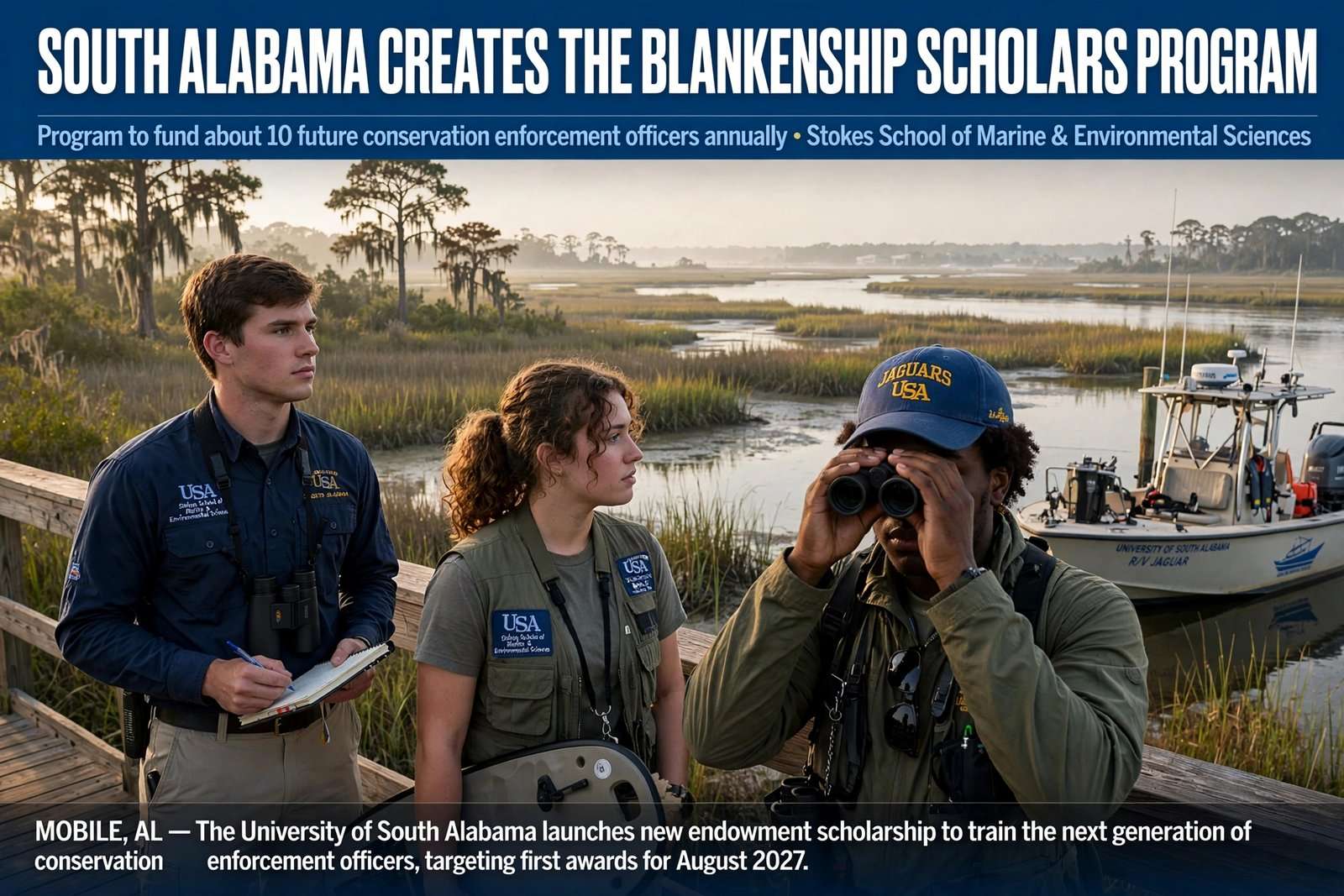
MOBILE, Ala. — For those who wish to pursue a law enforcement career in Alabama’s outdoors, an opportunity will soon be available at the University of South Alabama, where the Blankenship Scholars program will award endowments to approximately 10 students annually to further their studies and career.
The university is now in the middle of a $1 million fundraising campaign to endow the program, and it hopes to award the first Blankenship Scholars endowment in August 2027.
At a Glance
- Program: University of South Alabama Blankenship Scholars
- Purpose: Prepare students for careers in conservation law enforcement
- Awards: About 10 competitive scholarships a year, open to sophomores through seniors
- Funding goal: $1 million endowment campaign, now underway
- First award: Targeted for August 2027
- Home: Stokes School of Marine and Environmental Sciences, led by Dr. Sean Powers
Named for a Career That Started on the Water
The program is named in honor of Chris Blankenship and family. Blankenship has served as commissioner of the Alabama Department of Conservation and Natural Resources since he was appointed by Gov. Kay Ivey in 2017.
His career at ADCNR started much earlier, as a law enforcement officer with the Alabama Marine Resources Division. Those roots in enforcement are what prompted the endowment program.
Blankenship served as director of the Marine Resources Division before being promoted to commissioner.
What USA’s President Said
“Without a doubt, Chris Blankenship’s leadership in conservation and natural resources has been unrivaled,” said USA President Jo Bonner. “He has worked tirelessly to implement the governor’s vision to make sure every corner of Alabama benefits from the investments that have been made over the past decade. Clearly, no one is more indebted to Commissioner Blankenship than those of us in south Alabama, where the beautiful Gulf meets the Mobile-Tensaw River Delta.”
“Just as Chris’s stewardship of our wildlife and marine resources has been exceptional, he has done so much to upgrade and expand our state parks, which will benefit Alabamians for generations to come,” Bonner said. “It is only appropriate for the University of South Alabama to create the Blankenship Scholars so that our current and future students who want to follow in Chris’s path can do so with this endowment. We are extremely proud to count Chris Blankenship among our more than 100,000 alumni, and we salute him for his tireless and dedicated service to Alabama.”
What Blankenship Said
Blankenship said he is grateful for the recognition but also sees the scholarships creating pathways into a field that needs people.
“I’m excited the University of South Alabama would like to create a program where we can train and attract more conservation enforcement officers,” Blankenship said.
“Our current officers are wonderful, and I am also excited that these scholarships will be able to help us fill those roles with officers that come in with even better enforcement training and conservation knowledge.”
“For the university to create a scholarship program that has my name on it is extremely humbling, and I appreciate very much for them to think of me and my family and our contributions over the last 30-plus years,” he said.
“I am very thankful for the work we’ve been able to do that has made the resource and environment better over the last 30-plus years,” Blankenship added. “I’m excited to see the next generation of leaders who will follow us.”
A Job That Requires Two Skill Sets
Conservation enforcement is a distinct branch of law enforcement, and the reason a dedicated scholarship pipeline makes sense lies in what the job actually requires.
Conservation officers and marine resources enforcement officers are sworn peace officers with full arrest authority, and they perform that work largely alone, in remote locations, often on water, frequently at night, and almost always in contact with armed people — hunters and anglers legally carrying firearms. Backup is typically distant.
At the same time, the substance of the job is biological. Enforcing size and creel limits, seasons, gear restrictions, tagging requirements and habitat protections requires a working knowledge of species identification, life cycles, harvest regulation and the reasons behind the rules. An officer who cannot distinguish between similar species, or who does not understand why a size limit exists, cannot enforce the law competently or explain it to the public.
Recruiting people who arrive with both halves of that skill set — law enforcement preparation and conservation science — is the persistent staffing challenge in the field, and it is precisely what an academic scholarship program is positioned to address.
Where South Alabama Fits
The university’s location is central to the program’s logic. Mobile sits between the Gulf and the Mobile-Tensaw River Delta, one of the largest and most biologically diverse river delta systems in the United States. Students in the program will be studying within reach of estuarine, marine, riverine and coastal forest environments — the working environments of the officers the program aims to produce.
Latest: A $1 Million Campaign and a 2027 Target
South Alabama announced the program at a Sept. 21 reception honoring Blankenship at the Grand Bohemian Mountain Brook in Birmingham. The announcement came days before Blankenship’s retirement from the department at the end of September; Ben Stimpson takes over as commissioner Oct. 1.
Dr. Sean Powers, director of USA’s Stokes School of Marine and Environmental Sciences, said the university is raising $1 million to fund 10 competitive scholarships each year for sophomores, juniors and seniors.
“We wanted to create an endowment that will last forever,” Powers said. “We want really bright students to consider this as a career. The Blankenship Scholars program is inspired by Chris and designed to recognize the legacy of the Blankenship family. This will provide the training to be the next Marine Resources officer, maybe be the next Marine Resources Director or the next Conservation Commissioner.”
Powers, who worked with Bonner to develop a way to honor Blankenship and his family — his wife, Allyson Tomberlin Blankenship, and their three children — said the university hopes to award the first endowment in August 2027.
“Jo Bonner wanted a way to recognize Chris for his work for the state, particularly in the south Alabama region,” Powers said. “Chris is a South Alabama alum and represented the university so well.”
More Than Marine Resources
Although Blankenship’s own career began in marine enforcement, Powers said the scholarships are meant to feed a much wider range of conservation law enforcement jobs. He listed:
- Alabama Marine Resources Division enforcement
- Wildlife and Freshwater Fisheries enforcement
- State Lands enforcement
- Alabama State Parks rangers
- U.S. Fish and Wildlife Service officers
- The U.S. Coast Guard
“That’s the way I pitched it to the president,” Powers said. “All the best science, rules and regulations and management schemes in the world don’t mean anything unless we have conservation enforcement officers who are committed to the environment and committed to protecting it.”
He noted that competition for those jobs is increasing.
“Some of the officers have military backgrounds, and some of those positions are becoming more and more competitive,” Powers said. “So having our graduates be qualified, where they have the background in political science and criminal justice with training in either marine sciences or environmental sciences, really makes sure we have that pipeline of dedicated Conservation Enforcement Officers.”
That combination, he said, would let officers understand the science behind slot limits and other restrictions on fish and wildlife — and explain it to the public.
“If they write a violation, they can explain why they had to do these types of things,” Powers said. “Chris is really the epitome of a really smart, really committed marine conservation officer. Trying to give students a head start on all those things Chris learned to become the professional he is, that’s the idea.”
“Plus, you get to train not only in a marine environment but also land management, forestry, freshwater fishing and hunting,” he added. “We think it’s a unique program, and who wouldn’t want a job in the outdoors.”
A Ride-Along That Changed a Career
Blankenship’s own path through South Alabama is part of the program’s story. Powers said Blankenship attended on a full President’s scholarship that covered tuition through room and board. He began as a physics major before switching to political science and criminal justice.
“He went on a ride-along with Marine Resources Enforcement, and he fell in love with it,” Powers said. “He got his degree in political science and criminal justice and then started with Marine Resources Enforcement. Chris has that background. Chris has also basically helped us start the School of Marine and Environmental Sciences at South through the investments the Conservation Department has made through GoMESA and the oil spill funds.”
Blankenship said that scholarship shaped his future.
“Being able to provide scholarship money to these students is a very positive thing,” he said. “Instead of going somewhere else, where I would have had to take a loan to pay for my education, having that scholarship definitely was a deciding factor to attend South, and I was so thankful to receive it. Graduating with no student debt gave me a leg up starting out. I think getting my education at the University of South Alabama is one of the best decisions I’ve made.”
“And we’ve continued our relationship with Dr. Powers and the university and the great work they continue to do in marine sciences,” he said. “It’s exciting, and I’m glad to be a part of it.”
The Record Behind the Name
During Blankenship’s time as commissioner, the department has invested more than $525 million in outdoor recreation improvements, including more than $350 million spent building and improving Alabama State Parks facilities. More than 50 boating access projects have been completed statewide.
With more than 95% of Alabama’s land in private hands, the department and its partners have also bought more than 110,000 acres for public use, using funding sources that include the Forever Wild Land Trust, the Gulf of Mexico Energy Security Act (GoMESA) and the Deepwater Horizon oil spill settlement.