‘A Grand Amalgamation’: Three Mobile Artists Shared One Canvas of Color at the Mobile Arts Council
Josh Holland, Sol Davis and Nikki Bhakta showed vivid contemporary work as A Grand Amalgamation opened during Mobile's August 2010 Art Walk.
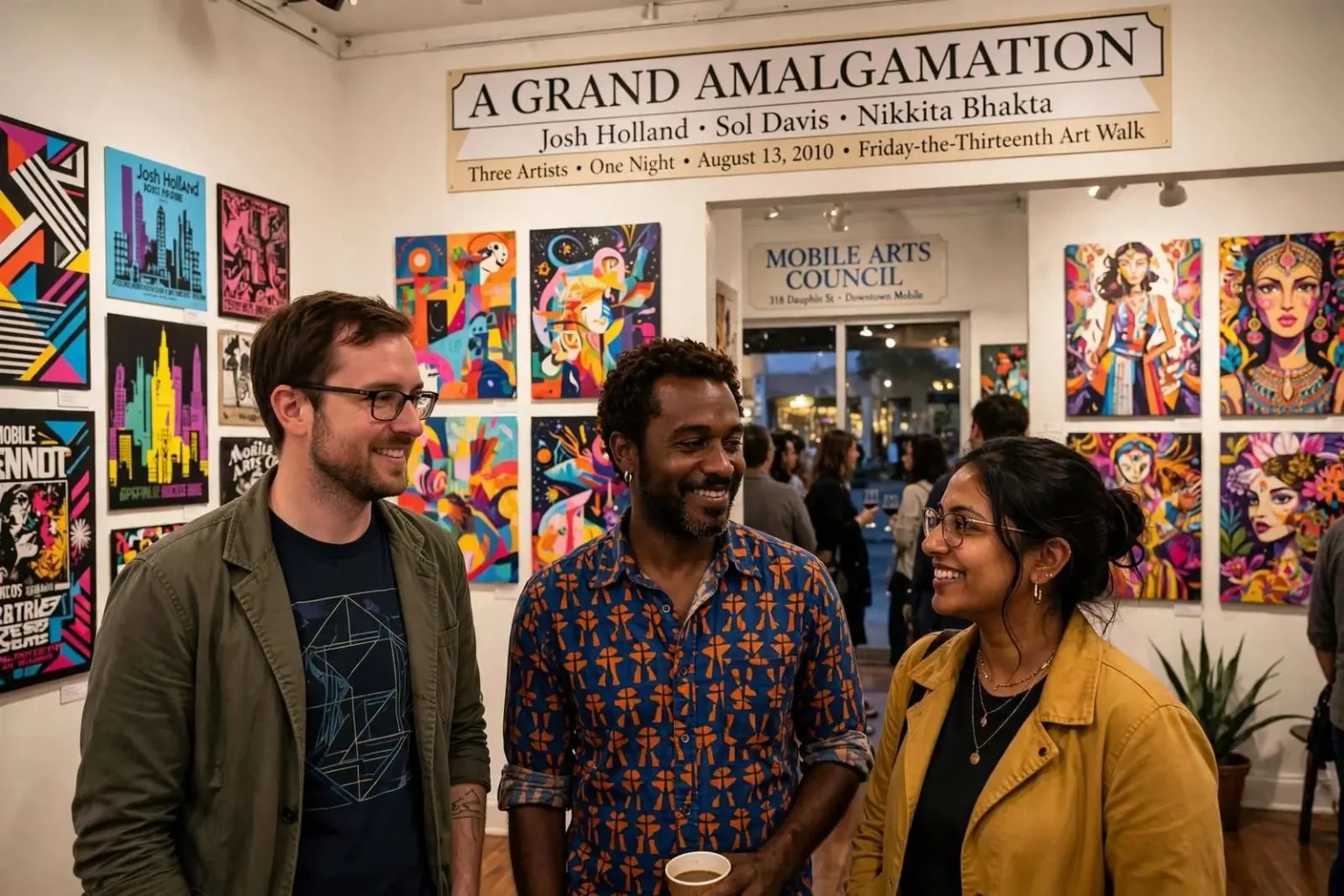
On Friday, August 13, 2010, the Mobile Arts Council hosted A Grand Amalgamation, a joint showing from three artists with sharply different styles — Josh Holland, Sol Davis and Nikkita “Nikki” Bhakta — timed to the Friday-the-Thirteenth Art Walk. The date gave the show an added spark of occasion: Mobile’s downtown art walk fell on the calendar’s unluckiest evening, and the three exhibitions under one roof turned the coincidence into a theme.
The Mobile Arts Council’s gallery space has long served as the anchor venue for the city’s art walk crowds, and a three-artist bill gave visitors to the August event the rare experience of sampling three distinct artistic sensibilities in a single stop. The timing placed the show at the height of Mobile’s summer gallery season, when art walk attendance swells and foot traffic through downtown’s venues peaks.
Three Shows Under One Roof
For Holland, a graphic designer whose work had already appeared around town at the Blind Mule, Serda’s Coffee, Soul Kitchen, Alabama Music Box, Liquid Sushi Lounge, Satori Coffee and the University of South Alabama’s Townhouse Gallery, the show was his largest yet. That circuit of venues — restaurants, coffee shops, music rooms and a university gallery — maps the geography of Mobile’s young creative scene, where local businesses double as exhibition spaces and emerging artists build audiences one wall at a time.
He recalled that gallery director Charlie Smoke approached him about exhibiting; when fellow artist Nikki’s own show landed in the same August window, the pair invited Sol Davis to make it three separate exhibitions under one roof. The arrangement grew organically rather than by institutional design — two artists discovering they shared a month and deciding to turn scheduling coincidence into a joint occasion, then adding a third to complete the bill.
None of the three had shown together on this scale before. Past group shows had limited each of them to a few pieces, the usual format for juried exhibitions and themed group events where many artists split the available wall space. A Grand Amalgamation flipped that structure, giving each artist room to present a full body of work and letting visitors experience the range of a complete artistic practice rather than a two- or three-piece sample.
The show’s title captured the experiment. An amalgamation implies distinct elements fused into something new, and the evening’s layout asked visitors to move between three individual visions and consider what they made together. For the artists, the format also functioned as a mutual introduction: each exhibition contextualized the others, drawing comparisons and contrasts that a solo show could never generate.
The Common Thread: Color
What connected the three distinct bodies of work was range and intensity of color. In a gallery season often dominated by muted palettes and restrained presentation, three exhibitions committed to bold, saturated hues gave the August art walk a jolt of energy that visitors could register from the doorway.
All three artists came up with formal training, moved in the same circles, and shared what Holland called a healthy obsession with music, design, fashion and animation — an outlook he said aimed at stimulating not just the eye but the mind and spirit. That shared vocabulary mattered to the show’s coherence: although the three styles differed sharply, they emerged from a common generational culture in which the boundaries between graphic design, illustration, album art, and fine art had dissolved.
The influence of that culture showed in the work’s attitude toward audience. Music-linked art thinks in rhythm and impact; design-linked art thinks in composition and communication; fashion and animation bring a flattened, vivid, deliberately artificial polish. Artists raised on those forms tend to reject the dryness of academic presentation in favor of work that meets viewers at full volume — which is precisely how the exhibition’s color saturation should be understood. The brightness was not decorative; it was the medium’s native language.
Holland described the exhibition as more contemporary than much of what the Mobile Arts Council had previously staged, and hoped its success would broaden the range of future shows there. The remark acknowledged an institutional reality: arts councils everywhere balance their calendars between traditional media and regional favorites on one side and newer, edgier work on the other, and a well-attended contemporary show is the strongest possible argument for programming more of it.
The Art Walk Setting
Mobile’s art walk tradition draws browsers, buyers, and the simply curious through the downtown district on set evenings, and the galleries, shops, and bars along the route coordinate their offerings to keep the crowd moving. A Friday-the-Thirteenth date added a playful edge — some venues lean into the superstition with themed programming — and A Grand Amalgamation’s vivid wall of color fit the evening’s spirit of spectacle.
The show also demonstrated the pipeline that Mobile’s alternative venue circuit has built. An artist like Holland accumulates visibility through restaurant and bar exhibitions, coffee shop walls, and university galleries — venues that trade wall space for atmosphere and give artists their first collectors. By the time the Arts Council’s gallery director extends an invitation, the artist arrives with a proven local audience rather than an empty name.
That path from business walls to gallery walls is how most working artists in mid-sized cities actually develop, and A Grand Amalgamation marked the moment three products of that pipeline shared a stage. For younger artists circulating through the same venues, the show offered a template: build an audience where you can, say yes to the gallery’s invitation, and bring your peers with you.
What the Show Left Behind
The immediate legacy of the August 13 event was attendance and sales for three working artists, but its institutional argument may prove more durable. A three-artist, full-wall exhibition with contemporary credentials gave the Mobile Arts Council a data point in its ongoing programming decisions, and Holland’s stated hope — that its success would broaden the range of future shows — framed the event as a case being made to the institution itself.
For the three participants, the evening consolidated reputations each had been building separately. Holland’s design background, Davis’s distinct style, and Bhakta’s following converged under one roof, and visitors who came for one artist left having seen three. That cross-pollination is the quiet function of group exhibitions: they convert separate audiences into a shared one, and shared audiences into a scene.
A Grand Amalgamation also captured a specific moment in Mobile’s creative history — the era when the city’s art walk matured, its alternative venues multiplied, and a generation of formally trained, pop-culture-fluent artists began claiming gallery walls. The August 13, 2010 opening, on the calendar’s unluckiest Friday, turned out to be a lucky night for the range and ambition of art on view in downtown Mobile.
The Artists Behind the Amalgamation
Each of the three exhibitors arrived at the Arts Council with a distinct profile. Holland built his practice in graphic design, a discipline whose demands — clarity, hierarchy, impact at a distance — shaped even his gallery work. His venue résumé, stretching from the Blind Mule and Serda’s Coffee through Soul Kitchen, the Alabama Music Box, and Liquid Sushi Lounge to Satori Coffee and the University of South Alabama’s Townhouse Gallery, showed an artist comfortable exhibiting in every corner of the city’s cultural life.
Davis and Bhakta brought their own followings and styles, and the show’s curatorial premise depended on that difference. A amalgamation of three similar artists would have read as a single expanded exhibition; three sharply different styles forced viewers to navigate shifts in technique, subject, and tone from one wall to the next. The color saturation gave the transitions a connective thread, but everything else about the work invited comparison.
Bhakta’s show landing in the same August window was the happy accident that created the event. Gallery calendars fill months in advance, and the collision of two confirmed exhibitions in one month could have meant competition for the same art walk crowd. Instead, the artists folded the overlap into a joint occasion and invited Davis to complete the triple bill — turning a scheduling problem into the summer’s most talked-about group show.
Color as a Shared Language
The exhibition’s commitment to color deserves the emphasis its artists gave it. Color is the element of visual art that operates most directly on the nervous system, before interpretation begins, and three rooms of saturated work created an environmental effect no single artist could achieve. Visitors moving through the galleries experienced the shows less as a sequence of objects than as an atmosphere — a designed space in the same sense a nightclub or fashion boutique is designed.
That environmental quality traced back to the four shared obsessions Holland identified. Music teaches immersive experience; design teaches environments that communicate; fashion teaches the power of surface; animation teaches worlds built of pure color. Artists formed by those disciplines treat a gallery wall differently than a classically trained painter might — less as a frame for an object than as an element of a total visual statement.
The ambition Holland described — work aimed at stimulating not just the eye but the mind and spirit — positioned the exhibition against the idea that bold, pop-culture-inflected art is merely decorative. The show’s argument was that contemporary visual culture carries as much meaning as any tradition, provided the artist handles it with intent. Formal training mattered here: the three exhibitors could deploy the vocabulary of design and popular media precisely because their fundamentals were secure.
A Night That Argued for Range
In the end, A Grand Amalgamation functioned simultaneously as three debuts, one statement, and an institutional proposal. Josh Holland, Sol Davis, and Nikkita Bhakta each presented themselves at a scale they had never reached; the joint format demonstrated what Mobile’s alternative-venue pipeline could produce; and the show’s contemporary profile made the case to the Mobile Arts Council that its future exhibitions could afford more of exactly this kind of work. For the Friday-the-Thirteenth crowd on August 13, 2010, the evening delivered the era’s vivid proof that the city’s own artists — trained, ambitious, and saturated in color — could fill a major gallery on their own terms.