

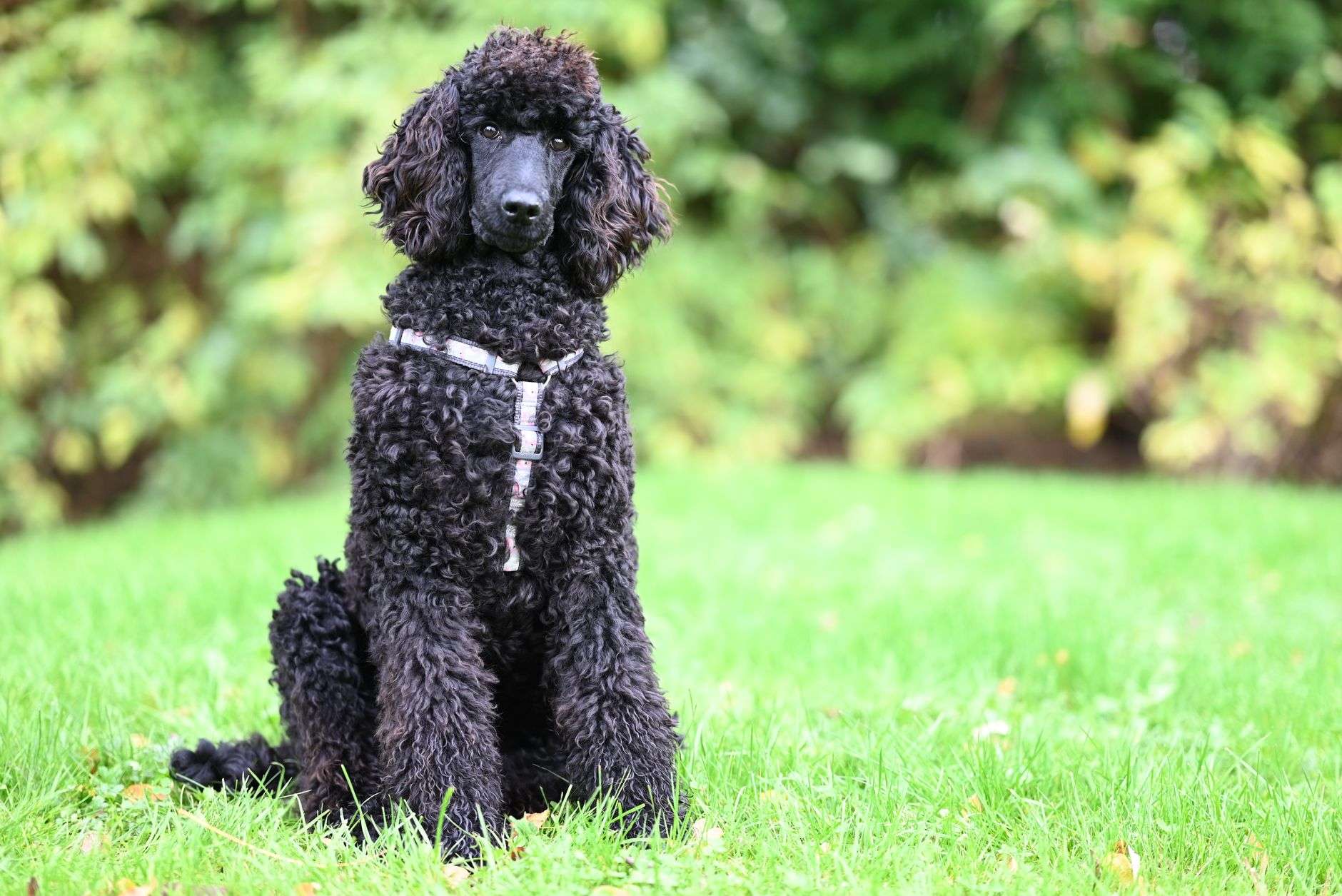
SPANISH FORT, Ala. — The newest officer at the Spanish Fort Police Department weighs less than a duty belt’s worth of gear, has an unapologetic weakness for birds and squirrels, and does not take orders once his vest comes off.
He is also, by his chief’s account, one of the most effective things to happen to the department in years.
Officer Ray is a two-year-old poodle. He wears a K9 officer vest, works a full schedule alongside Spanish Fort police Chief John Barber, and performs a job that no human officer on the roster can do: he can smell stress.
“He is a phenomenal asset for our department and for our community,” Barber said. “I’m extremely happy to have him. It’s been more successful than I could ever dream having him here.”
A Conference in March, a Flight to Oregon by Spring
The idea arrived the way a lot of good policy does — sideways, at a conference.
Barber was attending an officer safety and wellness conference in March when he first heard about wellness dogs. He had been turning over the idea of adding a four-legged officer to the department for some time without settling on what kind. When the conversation turned to stress-detection K9s, the decision made itself.
There was one condition Barber set from the outset: the dog would not be paid for out of the city’s general fund.
So he took the proposal to the Spanish Fort Law Enforcement Foundation, the nonprofit that supports the department.
“They committed to paying for his dog food, his grooming, his vet bills. No cost to taxpayers,” Barber said.
That funding structure matters more than it might appear. Police K9 programs typically carry recurring costs long after the initial purchase — veterinary care, food, grooming, equipment — and those line items compete each budget cycle against patrol vehicles, radios and overtime. Routing them through a foundation removes the program from that annual scramble and insulates it from the kind of mid-year cut that ends a promising pilot before it can prove itself.
Within a few weeks, Barber was on a plane to Oregon to collect his new partner.
The Career Change That Made Him Available
Officer Ray did not start out bound for law enforcement. He is a fifth-generation service dog, and he began his working life in California as a seeing-eye dog.
He was not a good fit. The reason, as Barber learned during training, was an “affliction for birds and squirrels” — a disqualifying distraction in guide work, where a dog’s attention cannot waver from the handler for a moment.
Guide dog programs wash out a substantial share of their candidates for exactly this kind of reason, and those animals are frequently redirected into other service roles where the temperament still fits but the demands differ. Ray went to Oregon, completed a service dog program there, and came out the other side with a different specialty.
That specialty is chemical.
Trained on the Smell of Stress
Officer Ray is imprinted with cortisol — the hormone the body releases in response to stress. When he detects elevated cortisol levels in a person nearby, he responds the way he was trained to: he approaches, offers comfort and leans his weight against them.
In a room of hundreds of people, Barber said, Ray can pick out the ones who need him.
Imprinting is the same foundational process behind every detection K9 — a dog is conditioned to recognize a target odor and to give a trained response when it finds it. Narcotics and explosives dogs are imprinted on the compounds they hunt. What distinguishes a wellness K9 is the target and the response. Instead of alerting a handler to contraband, Ray identifies a person in distress and goes to them.
Three Jobs, One Dog
Barber described three distinct roles Ray fills at the department.
First, he works on the people behind the badge. Officers and dispatchers carry a chronic stress load that rarely gets an outlet during a shift, and Ray is a standing interruption to it.
“You know, it’s hard to see him come up to you and you not pet him or smile or just take a deep breath,” Barber said. “With our profession, we have a lot of stress and so it’s for our officers and dispatchers, and they love him.”
Dispatchers in particular are an often-overlooked population in first responder wellness conversations. They absorb the worst moments of a caller’s life through a headset, frequently without ever learning how the call ended, and they do it from a chair in a windowless room.
Second, he is the department’s most effective ambassador. Ray accompanies Barber to meetings, schools and community events. In the five months the chief has had him, Barber said, the dog has changed the nature of his interactions with the public.
“People want to come up to him, so we’re having conversations that we haven’t had before,” Barber said. “So, it’s been phenomenal from a community policing standpoint.”
The mechanism is simple and worth naming. Approaching a uniformed police chief in a grocery store requires a reason. Approaching a dog does not. The conversation that follows is one that would not otherwise have happened, and it happens on neutral ground.
Third — and this is where Barber’s account turns concrete — Ray works with victims.
Twenty Minutes With His Head on Her Lap
The chief said Ray has proven especially valuable in cases involving children.
In one instance, a domestic violence call ended with a child watching her father placed in the back of a police vehicle. She became extremely emotional. Barber responded to the scene and brought Ray.
“She was screaming and crying, ‘What are you doing to my daddy?'” Barber recalled. “I open up the door. He lays his head on her lap and doesn’t move for 20 minutes until grandma gets there, and she’s no longer screaming about her daddy.”
That kind of scene is one of the hardest things a patrol officer encounters and one of the least solvable by conventional police tools. There is no procedure for it. An officer can secure a scene and complete a report, but an officer in uniform is frequently the last thing that will calm a child who has just watched a parent taken away.
A dog who does not speak, does not ask questions and does not move for 20 minutes turns out to be better suited to the task.
Off Duty, He Is Just a Puppy
At the end of a shift, Ray goes home with Barber, and the vest comes off. The change is immediate.
“When we come home in the evenings and I take that vest off, he’s a puppy,” Barber said. “He’s only two years old. He’s running. I have two other small dogs and he just wants to play. He doesn’t listen to me off duty. He only listens on duty.”
That distinction — total focus with the vest on, total disregard with it off — is a deliberate feature of working dog training rather than a quirk. The equipment becomes the cue that separates work from rest, and a dog that cannot switch off is a dog that burns out.
A Second K9, of a More Traditional Kind
Officer Ray will soon have company. The Spanish Fort Police Department is completing training for another K9: Alpha, a shepherd-Malinois mix who will serve in the conventional role, working drug detection and tracking.
The pairing gives the department two very different capabilities from the same unit — one dog trained to find what people are hiding, and one trained to find the people who are struggling.
For a city of Spanish Fort’s size on the Eastern Shore of Mobile Bay, that is an unusually broad K9 program. And half of it, Barber notes, arrived by way of a squirrel-obsessed poodle who washed out of his first career.