A Thomasville Couple Took Grieving Families’ Money for Memorials That Never Arrived. They Just Pleaded Guilty.
Anthony Kirven Williams and Teresa Cobb Williams, operators of Williams Granite Memorial in Thomasville, pleaded guilty to theft charges and must pay more than $50,000 in restitution to grieving families.
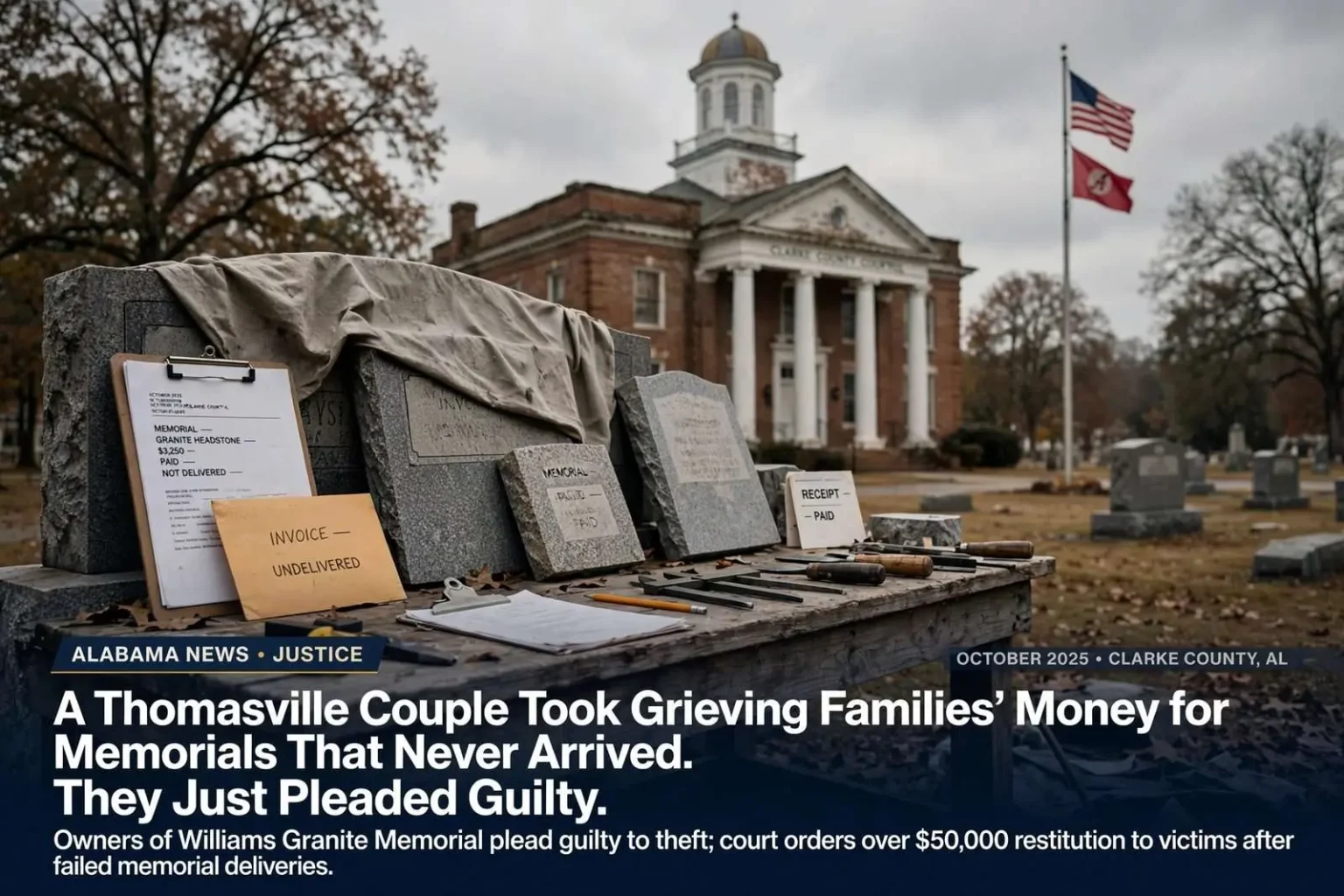
The husband-and-wife operators of a Thomasville monument business have pleaded guilty to theft charges after authorities said they took payment from grieving families for memorial markers and granite work that was never delivered.
Anthony Kirven Williams and Teresa Cobb Williams, who ran Williams Granite Memorial in Thomasville, entered guilty pleas as part of a case brought by Alabama Attorney General Steve Marshall’s office. As part of the plea, the couple must pay more than $50,000 in restitution, structured so that each identified victim receives full reimbursement for the memorial items they paid for but never received.
Teresa Williams pleaded guilty to five felony counts and two misdemeanor counts of theft. Anthony Williams pleaded guilty to nine misdemeanor counts of theft. The differing charge structures reflect how prosecutors divided the couple’s roles in the transactions at issue, with the felony counts carrying the potential for more significant penalties than the misdemeanors to which her husband admitted.
How the investigation began
The couple was arrested in August 2025 following an indictment from a Clarke County grand jury, the result of an investigation carried out jointly by the Thomasville Police Department and the Attorney General’s Consumer Interest Division.
The partnership between a small-city police department and the state’s consumer protection unit is a common architecture for cases like this one. Local investigators are typically the first to hear from victims, since complaints about a local business arrive at the police department closest to it. But cases involving a pattern of payments for undelivered goods — spread across multiple families, multiple transactions and potentially multiple counties — require subpoena power, financial record analysis and prosecutorial resources that a municipal department rarely has on its own. The Attorney General’s Consumer Interest Division exists specifically to take on that kind of case, and its involvement signaled early that investigators believed the pattern extended beyond any single transaction.
That suspicion proved well founded. Investigators later uncovered additional victims, leading to a second indictment against the couple covering further alleged theft cases beyond the original charges. In consumer fraud prosecutions, the victim count frequently grows once an initial indictment becomes public, because families who paid and never received their memorials — but who had not known where to turn — come forward once they learn others suffered the same experience.
The nature of the harm
What set this case apart, in the view of the officials who pursued it, was who the victims were. The customers of a monument business are almost by definition people in the middle of grief: families who have just buried a parent, a spouse or a child, arranging a headstone or marker in the weeks and months after a loss. Prosecutors and consumer protection agencies treat theft from that population with particular seriousness, because the harm is not measured in dollars alone.
Restitution in this case was structured to make victims whole, with each identified family reimbursed in full for what they paid for memorials that never arrived. More than $50,000 in total payments will flow back to victims under the terms of the pleas. While the amounts in individual transactions were, in many cases, relatively modest by the standards of major fraud prosecutions, the aggregate reflects the number of families affected and the accumulation of deposits and payments collected over time.
Restitution orders in Alabama criminal cases are enforceable as part of the sentence, and failing to pay can expose a defendant to further legal consequences. For victims, the structure of this deal offers something a trial verdict often cannot: a defined path to recovering their money without the uncertainty of years of appeals.
The Clarke County courthouse pipeline
The case moved through the Clarke County court system, with the Clarke County District Attorney’s Office assisting prosecutors throughout. That assistance mattered practically: grand jury presentments, victim coordination and local court scheduling all run through the district attorney’s office, and its cooperation allowed the state Attorney General’s prosecutors to keep the case moving from indictment in August 2025 to guilty pleas without a protracted procedural fight.
Thomasville, the seat of activity in the case, sits in the northwestern corner of Clarke County in southwest Alabama, a small city where a local monument business serves families across a wide rural radius. In communities of that size, a business like Williams Granite Memorial is not an anonymous vendor — it is a storefront people drive past every week, recommended by funeral homes and known by name. When the operators of such a business are accused of taking payment for markers that never arrive, the sense of betrayal is felt across the whole town, and word travels quickly through churches, cemeteries and family networks.
What the pleas mean
Guilty pleas resolve the criminal charges without trial, but they are also formal admissions that the transactions described in the indictments occurred. The felony counts to which Teresa Williams pleaded expose her to the greater sentencing range of Alabama’s felony theft statute, while the nine misdemeanor counts admitted by Anthony Williams fall under a lower sentencing tier. Sentencing outcomes will be determined by the court under state law, taking into account the restitution obligations the couple has now assumed.
For the families involved, the pleas close a chapter that began when they trusted a local business with one of the most personal purchases they will ever make: a permanent marker for someone they loved. The state’s message in pursuing the case to a conviction — through two indictments and coordinated local-state investigation — was that theft from grieving customers is treated as a priority, not a civil footnote.
Protecting yourself when buying a memorial
Consumer protection officials say cases like this one are a reminder of practical steps families can take when purchasing headstones, markers and memorial work. The purchase typically happens on a compressed timeline after a funeral, when families are least equipped to vet a vendor carefully — which is precisely the dynamic that bad actors exploit.
Among the precautions that consumer advocates commonly recommend: get every detail of the order in writing, including the stone’s specifications, inscription, granite color, installation location and delivery date; pay with a credit card or traceable method rather than large cash payments, preserving a record and potential dispute rights; ask when the stone will be ordered from the supplier and confirm that timing in the contract; and check whether the business is registered and whether complaints have been filed against it with the Better Business Bureau or the Attorney General’s Consumer Interest Division, which accepts complaints online and by phone.
Families who have paid for memorial work that has not been delivered within the agreed timeframe are encouraged to document the payments and communications and to file a complaint with the Attorney General’s office — the same office that brought this case. Complaints from multiple families are what transform an individual dispute into the kind of pattern case that supports a criminal indictment.
Where the case stands
With the guilty pleas entered and restitution obligations fixed, the remaining steps in the case are sentencing and the payment schedule ordered by the court. The Clarke County Circuit Court will determine the terms under state sentencing law, and the Attorney General’s office has said the restitution structure is designed to reach every identified victim.
For Thomasville and the surrounding communities of Clarke County, the case’s resolution brings both accountability and a cautionary lesson. The families who paid for markers that never arrived will be made whole financially, but no reimbursement replaces the closure a properly placed monument represents. The officials who built the case — Thomasville police investigators, the Attorney General’s Consumer Interest Division, and the Clarke County District Attorney’s Office — have signaled that when a business targets customers at their most vulnerable, the combined resources of local and state law enforcement will follow.
Why memorial fraud cases get priority treatment
The Attorney General’s Consumer Interest Division handles a wide range of consumer complaints, from auto sales to home repair scams, but cases involving funeral and memorial services tend to move up the priority list. The reasons are practical as well as moral: the victims are numerous but scattered, the individual losses are small enough that few families would sue on their own, and the proof — invoices, payments and cemeteries with no stone in the ground — is unusually clear once investigators look for it.
Criminal theft statutes cover the conduct fully. When a business accepts payment with no intention or ability to deliver the product, each transaction can be charged as a separate count, which is how a single storefront operation produced eleven admitted counts between the two defendants here. The multiple-count structure also mirrors the multiple families harmed, giving the court a clear record of the scope of the conduct at sentencing.
For consumers across southwest Alabama, the case is a reminder that the complaint process works. The additional victims uncovered during this investigation came to light after the first indictment, when word spread that investigators were already building a case. That pattern — one family’s complaint leading to justice for many — is exactly how the state’s consumer protection machinery is designed to function.