A Weekend Guide to Mobile’s Best Museums, From Colonial Forts to the USS Alabama
From the History Museum of Mobile to the USS ALABAMA Battleship Memorial Park, this three-day itinerary covers Mobile's top museums and the city's history, art and maritime heritage.
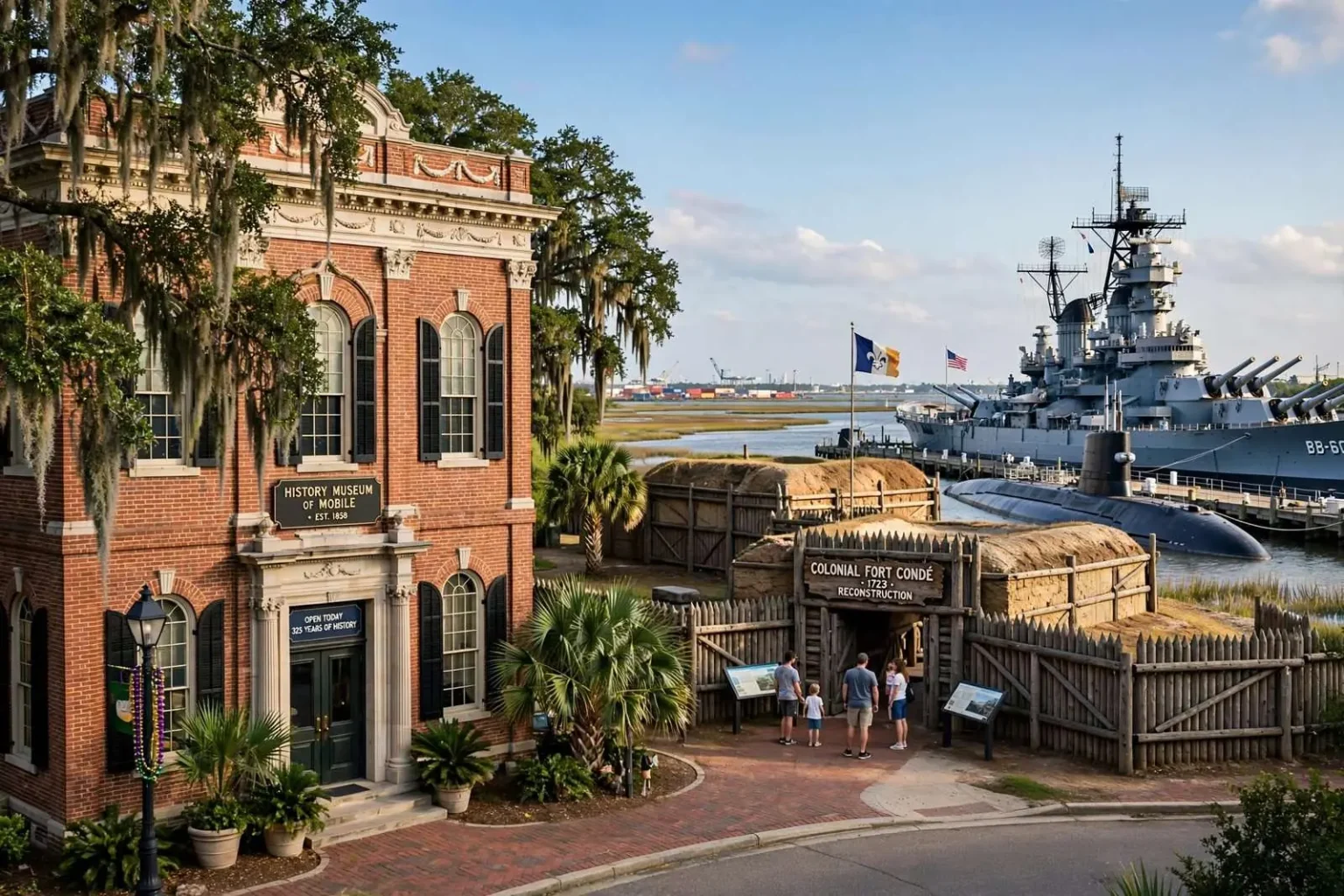
History, art, science and storytelling all have a home in Mobile, where a dense cluster of museums traces the city’s path from a colonial port to a modern Gulf Coast hub. Visitors planning a museum-focused getaway can spend an entire weekend moving through exhibits that cover nearly 325 years of Mobile’s history, its Mardi Gras traditions and its maritime legacy.
Few cities of Mobile’s size pack so much into so short a radius. The downtown historic districts hold several of the city’s flagship institutions within a few blocks of one another, the university museums sit just north and west, and the waterfront anchors the military and maritime collections that draw visitors from across the region. A weekend visitor can walk much of the itinerary, drive the rest in minutes, and still leave time for the restaurants and streetscapes that make the museum districts pleasant in their own right.
Day one: A journey through time
A museum weekend in Mobile can begin in Church Street East, the city’s oldest historic district, home to the History Museum of Mobile. Housed in the city’s first city hall, the museum walks visitors through nearly 325 years of Mobile’s story with artifacts and immersive exhibits chronicling its beginnings as a port city.
The building itself is part of the collection. The old city hall — an Italianate landmark completed in the mid-nineteenth century — served the city’s government for generations before the museum took residence, and its galleries now carry the story from the French colonial founding in 1702 through Spanish and American rule, the antebellum cotton economy, the Civil War, and the modern city. Exhibits weave together the strands that make Mobile unlike its neighbors: a founding older than New Orleans’ and Atlanta’s alike, a Mardi Gras tradition that predates most of the country’s, and a port that connected the Gulf Coast to the world.
Just across the street sits Colonial Fort Conde, a kid-friendly, scaled-down replica of the original French fort. The site houses artifacts and models illustrating how the fort looked under Spanish, French and English rule, offering a hands-on look at the shifting colonial powers that once controlled the city. For families, it is the natural first stop with children in tow — the walls are climbable, the footprint is manageable, and the exhibit panels explain, better than any textbook, how Mobile changed flags among three empires before joining the United States.
From there, the Mobile Medical Museum offers a look at nearly 300 years of medical advancements tied to the city’s public health history. Mobile’s location made it a frontier for medicine in the South — a port city that battled yellow fever epidemics for a century and built public health institutions in response. The museum’s collections trace that arc from colonial-era practice through modern medical education on the Gulf Coast.
Nearby, the Archaeology Museum at the University of South Alabama covers more than 12,000 years of Mobile and Gulf Coast history, with artifacts and life-sized replicas depicting the daily lives of area residents ranging from mound-building Mississippian peoples to post-Civil War African American families. It is the deep-time counterweight to the downtown museums: long before any European ship entered the bay, the delta’s waterways sustained dense native communities whose pottery, tools and earthworks survive in the collection. The university’s archaeological work across the region feeds the exhibits, and the museum doubles as a teaching institution where visitors see active research as well as display cases.
Day two: Keeping it cultural
The second day of a Mobile museum tour turns toward the city’s cultural heritage. The Historic Avenue Cultural Center, once the Davis Avenue Branch of the Mobile Public Library, has been revitalized into a space highlighting Mobile’s African American heritage and the history of Davis Avenue, once a vital hub for Black residents that was significantly affected by urban renewal. The center anchors Mobile’s growing Civil Rights and Cultural Heritage District.
The building’s own story is a lesson in the history it now interprets. The Davis Avenue library branch served generations of Black Mobilians during the era of segregation, when it stood as an intellectual and social anchor of a thriving commercial corridor. The avenue’s decline — driven by mid-century urban renewal projects that carved up Black neighborhoods across American cities — emptied blocks that had pulsed with Black-owned businesses, clubs and churches. Reopening the old library as a cultural center is part of a deliberate effort to reclaim that history, interpret it honestly, and rebuild the district’s civic life around it.
Nearby, Africatown preserves a story that has drawn international attention: the community founded by the survivors of the Clotilda, the last known ship to bring enslaved Africans to the United States. The men and women carried illegally to Mobile in 1860 founded their own settlement after emancipation, and their descendants have maintained the community and its story for more than 150 years. Interpretive exhibits there tell the voyage, the community’s founding, and the decades-long effort to have the history recognized. The Africatown connection is one of the most significant heritage sites on the Gulf Coast, and it sits a short drive north of downtown.
The waterfront and the battleship
No Mobile museum weekend is complete without the USS Alabama Battleship Memorial Park, the sprawling waterfront park at the mouth of Mobile Bay where the centerpiece is the battleship that earned nine battle stars in the Second World War. Visitors walk the decks, descend into the gun turrets and crew spaces, and tour the submarine USS Drum parked alongside — one of the most complete World War II museum submarines anywhere. Aircraft, tanks and memorials fill the park grounds, and the scale of the ship alone makes it the stop children remember longest.
The park pairs naturally with the city’s maritime story told downtown. Mobile’s economy has run through this bay for three centuries — shipbuilding, the port, the ferry and fishing fleets — and the exhibits downtown and at the park trace the same history from different angles.
Practical planning for the weekend
The itinerary rewards a little structure. Downtown’s cluster — the History Museum, Fort Conde and the surrounding historic districts — is walkable, so parking once and touring on foot saves time and parking fees. The Medical Museum and the university’s Archaeology Museum require short drives, as do Africatown and the battleship park. Most downtown institutions close by late afternoon, so the cultural centers and galleries are best scheduled for morning and midday, leaving evenings for Dauphin Street’s restaurants and theaters.
Hours vary by institution and by season, and some of the smaller museums — the Medical Museum chief among them — keep limited days and hours, so checking ahead is worth the two minutes. Several sites offer discounts for children, seniors and military visitors, and the battleship park’s admission covers both ship and submarine. Weekend visitors arriving during Mardi Gras season should note that parade routes can reshape downtown traffic plans entirely; the museums nearest the route stay open, but parking requires local knowledge or patience.
What the two days add up to is a portrait of Mobile that no single museum could draw. The colonial story explains the street grid and the forts; the port story explains the wealth and the shipyards; the African American heritage story explains Davis Avenue, Africatown and the Civil Rights district; and the battleship explains why the city’s harbor still matters. A weekend visitor who follows the trail — Church Street East to Davis Avenue to the bay — will have walked, in two days, nearly the whole arc of a city founded in 1702 and still writing its history.
Why the museum trail matters
The concentration of institutions is unusual, and it is not accidental. Mobile’s museums have grown out of the city’s successive obsessions with its own past — the colonial commemorations of the early twentieth century, the medical and archaeological collections built by local physicians and university researchers, and the heritage districts organized by neighborhood leaders determined that the story of Davis Avenue and Africatown be told by the people who lived it. Each institution answers a different question about the same place, which is what makes the weekend itinerary cohere into something larger than a checklist.
Visitors often arrive expecting the Gulf Coast’s beach towns and find instead a city whose founding in 1702 makes it older than every major city on the coast save a handful. The museum trail is the fastest route to understanding that: French banners at Fort Conde, yellow fever quarantine records at the Medical Museum, Mississippian pottery at the Archaeology Museum, the Clotilda story in Africatown, and the battle stars on the Alabama’s bow. Taken together, they make the case that Mobile’s waterfront has been the coast’s most consequential for three centuries.
For locals, the same trail works as a series of short return visits rather than one long weekend — a single museum on a rainy Saturday, the battleship when out-of-town family arrives, the cultural center’s rotating exhibits in between. The institutions anchor the districts around them, and each new exhibit season gives the city another reason to keep the museum habit. A weekend covers the highlights; a year of Saturdays covers the whole story.