AIDT and Alabama Works Step In to Help Displaced Virginia College Welding Students
AIDT and the Southwest Alabama Workforce Development Council arranged shipyard testing for displaced Virginia College welding students, offering a path to a job despite the school's closure.
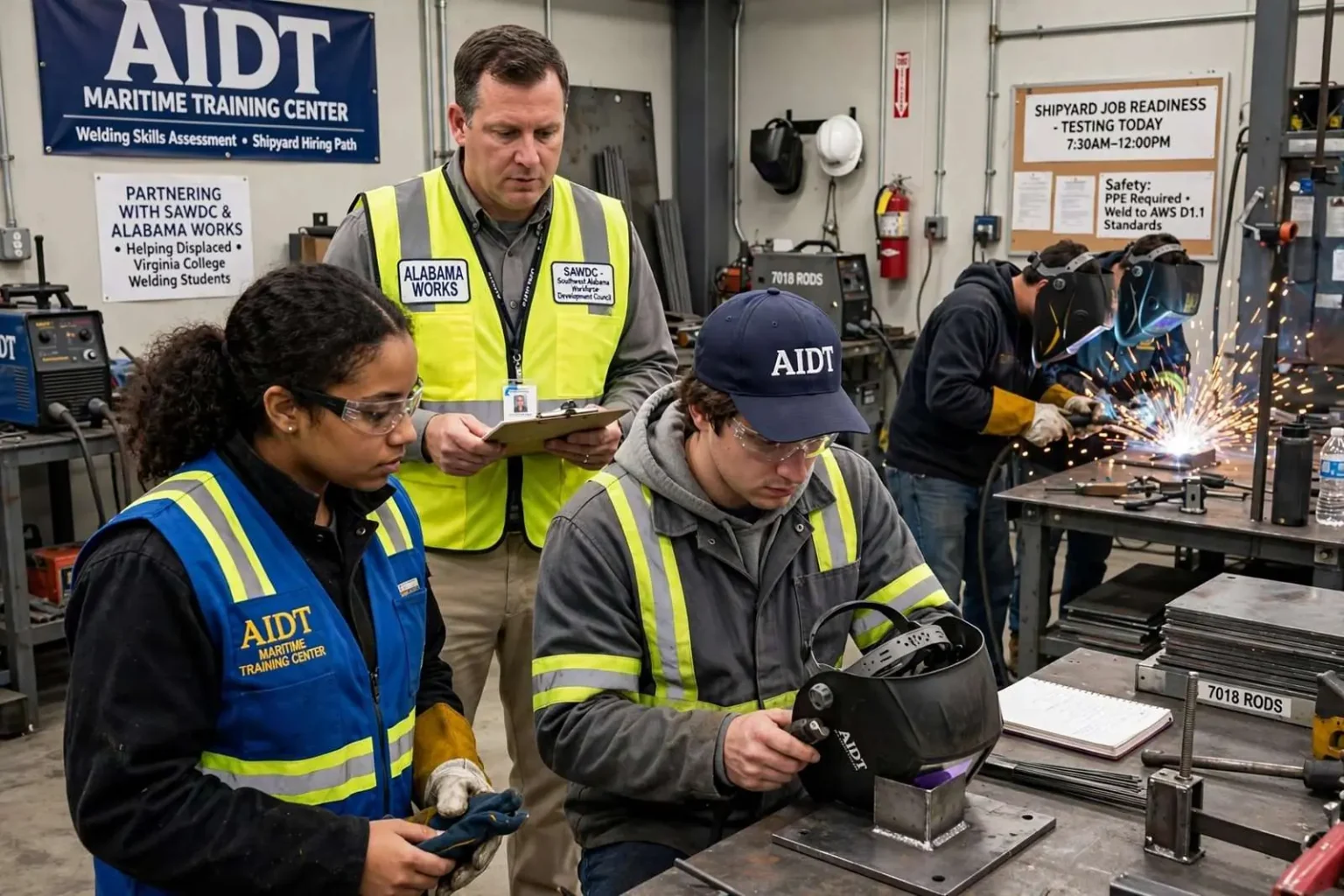
Students left in limbo by the closure of Virginia College locations are getting a hand from state workforce agencies. AIDT, in partnership with the Southwest Alabama Workforce Development Council and Alabama Works, arranged testing this week aimed at helping former Virginia College welding students move directly into local shipyard jobs.
The effort came together quickly. After Virginia College’s abrupt shutdown left welding students without a program to finish, AIDT and the SAWDC Maritime project manager began fielding calls from students who had been enrolled in the welding program and wanted to know what options remained for them. Rather than let the training go to waste, the two organizations decided to connect the students with a local shipyard that was looking to hire.
The testing took place at the AIDT Maritime Training Center, where students who had been working toward their welding credentials were given the chance to demonstrate their skills for a potential employer. About eight students from Virginia College were expected to take part, with testing running from 7:30 a.m. until roughly lunchtime.
For students who pass, the payoff is immediate: a job offer from a local shipyard, allowing them to put their training to use without having to wait out a lengthy search for work elsewhere.
What the Shutdown Meant for Students
The sudden closure of Virginia College campuses left thousands of students across the region in an uncertain position, but the stakes were particularly immediate for those in hands-on trade programs. Welding students had spent months building practical skills — cutting, fitting and joining metal to precise standards — without necessarily holding the certifications or employer connections that turn those skills into a paycheck. When the school’s doors closed, the credits and the coursework were only part of what mattered; what students needed most was a bridge to an employer.
That is the gap the state agencies moved to fill. By treating the displaced students as a ready-made candidate pool and arranging skills testing on a tight timeline, AIDT and its partners compressed what could have been a months-long job search into a single morning at the training center.
The partnership between AIDT and SAWDC reflects a broader push in coastal Alabama to keep skilled workers, including welders, pipefitters and other tradespeople, in the pipeline for the region’s maritime and shipbuilding industry, which regularly looks to local training programs to fill open positions.
AIDT and the State’s Workforce System
AIDT, Alabama’s publicly funded workforce training agency, has operated for decades as one of the state’s principal tools for matching employers with trained workers. The agency runs training programs tailored to specific industries and employers, and its maritime training operations on the Gulf Coast focus on the specialized skills that shipbuilding and ship repair demand. Training at an AIDT facility is provided at no cost to job seekers, which makes the agency’s programs an especially valuable fallback for students whose private-school plans fell apart.
The Southwest Alabama Workforce Development Council, one of the regional workforce boards operating under the state’s workforce development system, connects employers, educators and job seekers across the southwest corner of the state. Its maritime arm tracks the hiring needs of the region’s shipyards and works to build training pipelines that feed them. Alabama Works ties the pieces together at the state level, coordinating the agencies and programs that help dislocated workers retrain and find employment quickly.
Why Shipyards Need Welders
The Gulf Coast maritime industry is one of coastal Alabama’s largest economic engines, employing thousands of workers in shipbuilding, repair and related trades. Welders sit near the center of that workforce: hulls, piping systems and structural components all depend on welders who can meet exacting standards, and experienced marine welders are consistently among the trades most in demand at the region’s yards. Shipbuilders routinely partner with training organizations to keep a steady flow of qualified applicants, and a certified welder who can pass a skills test can often move into a well-paying position quickly.
The demand runs across the trade pipeline. Beyond welding, yards recruit pipefitters, electricians, painters, fitters and riggers, and the region’s training infrastructure — community colleges, technical centers and programs like AIDT’s — exists largely to keep those positions filled. For displaced students with partial training, the industry’s appetite for skilled hands means that a program cut short does not have to mean a career cut short.
The quick turnaround also highlights the role state workforce programs can play when private training providers close their doors unexpectedly. By stepping in with an alternative path to certification and employment, AIDT and Alabama Works aimed to ensure that students who had already invested time and effort into their welding education were not left without a way forward.
A Model for Handling Displaced Students
The Virginia College shutdown became a case study in how quickly state and regional agencies can respond when a major training provider collapses. Rather than waiting for students to navigate the job market alone, the agencies identified the affected population, contacted the employer side of the equation and arranged a skills-based evaluation within days. The model relies on a simple insight: students who were mid-program already possess most of the skills employers screen for, and what they lack is the credential and the introduction, not the ability.
For the students themselves, the arrangement also removed a barrier that often trips up dislocated workers — the cost and delay of restarting a program from scratch. Testing at the maritime center evaluated what they could do, not where they had learned it, and the employer was positioned to make offers the same day for those who performed well.
Workforce officials noted that the approach could apply to students from other displaced programs as well. Whenever a training provider closes, the first weeks matter enormously: students either find a bridge to employment or education quickly, or they drift into unrelated work and the region loses the investment already made in their skills. Moving fast preserves both.
The eight students expected at the testing session represented a small group, but the implications were broader. Every displaced student who lands in a shipyard job becomes a working example of the pipeline the region has spent years building, and every successful placement strengthens the case for pairing state workforce agencies with private-sector hiring needs from the start.
The Maritime Training Center’s Role
The AIDT Maritime Training Center serves as the practical heart of the region’s effort to build a skilled maritime workforce. Facilities of this kind provide hands-on training bays, welding stations and classrooms designed to simulate the conditions graduates will encounter in production work. Hosting the displaced students’ testing there meant the evaluation happened in a professional environment, using the same equipment standards the shipyards themselves apply.
Testing sessions of this type typically assess core competencies: weld quality, technique across positions, safety practices and the ability to read and follow specifications. For an employer watching the process, the morning offers a direct look at candidates in action — a far more reliable signal than a transcript from a school that no longer exists.
What Comes Next for the Students
For the students who test well, the transition from displaced learner to employed welder could come within days. Shipyard work offers a defined path for new hires: orientation, safety training and assignment to a production crew, followed by opportunities to add certifications and advance into higher-skill classifications over time. Experienced welders in the maritime trades can build long careers, and the region’s yards have historically promoted from within.
The students also carry something else forward from the episode — proof of resilience that employers notice. A candidate who finished most of a welding program, weathered the shutdown of their school and showed up to test within weeks of the collapse has demonstrated exactly the kind of persistence production supervisors value.
A Broader Lesson for the Gulf Coast
The episode underscored a structural reality of the regional economy. Coastal Alabama’s workforce system depends on a mix of public training institutions, private career colleges and employer-run programs, and when one link breaks, the others have to absorb the load. The response by AIDT, SAWDC and Alabama Works showed that the safety net works best when the agencies treat employer hiring needs as the starting point rather than the afterthought.
It also reinforced the value of the region’s shipbuilding base as a destination for displaced workers. Because the maritime industry hires in volume and trains on the job, it can absorb workers whose training came from an unexpected direction. A student who arrives with solid fundamentals can be brought up to shipyard standards on the floor, and the yards have every incentive to do so given the competition for skilled welders.
For now, the attention shifts to results: the students who spent the morning at the maritime center will learn whether their skills translated into offers, and the agencies involved will have another data point on how to respond the next time a training provider leaves students stranded. Either way, the message to students in similar programs around the region is clear — a school closing does not have to mean the training, or the career, is lost.