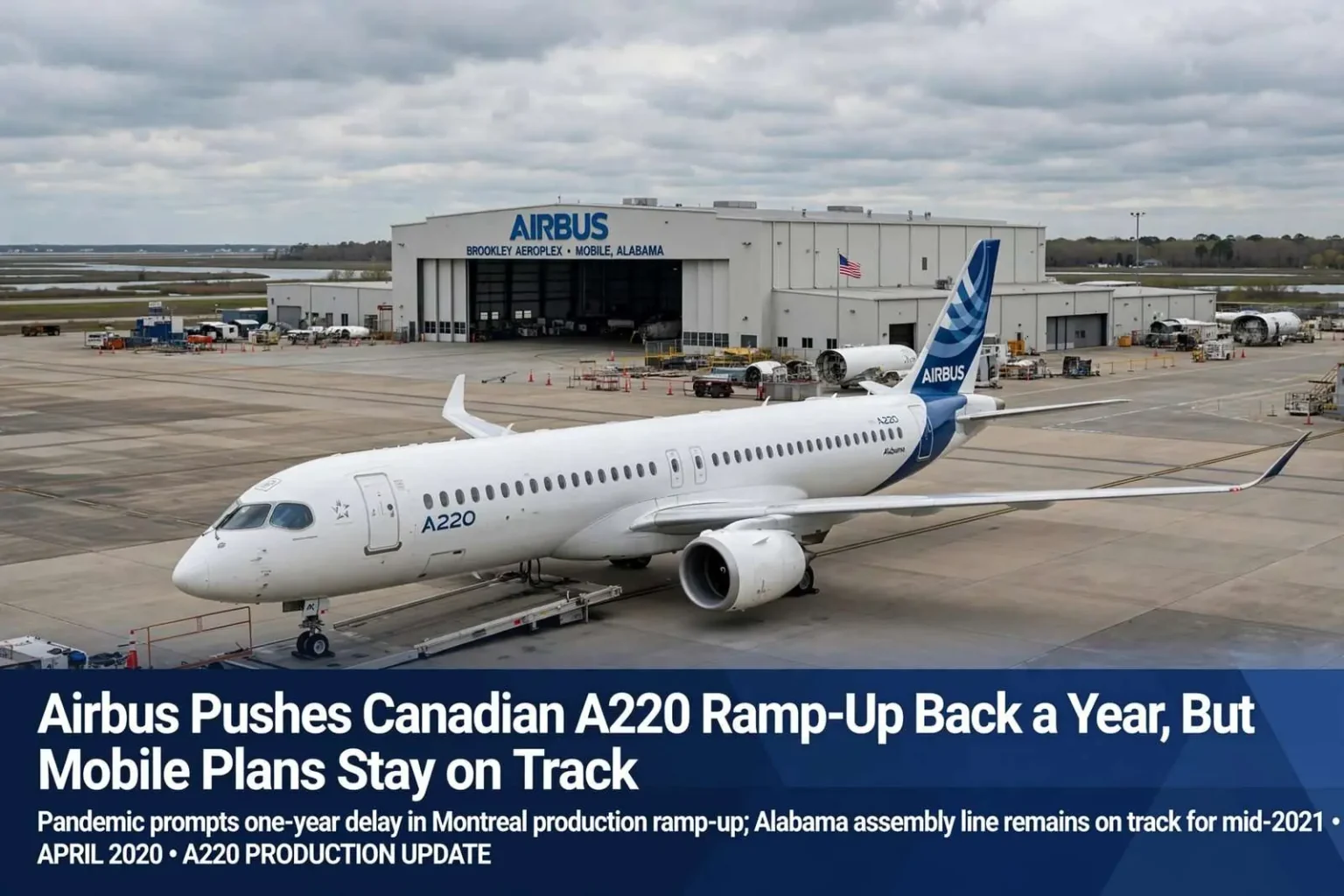
Airbus is slowing the pace of A220 production increases at its Canadian plant, but the company says its Mobile operation is moving ahead as planned despite the disruption the coronavirus outbreak is causing across the airline industry. A company spokeswoman said the pandemic is weighing on overall airline demand for new aircraft. As a result, Airbus has pushed back by a year — until mid-2021 — a planned ramp-up at its Mirabel facility near Montreal, where the narrowbody jet is currently built at a rate of four per month. The company still hopes to reach ten jets a month there by the middle of the decade.
The announcement reflects the strange economics confronting aerospace manufacturers in the middle of 2020. Global air travel collapsed as countries closed borders and airlines parked hundreds of aircraft, wiping out the near-term demand for new jets. Yet aircraft are ordered years in advance and delivered into a future market, so manufacturers must decide whether to slow assembly lines now and risk falling behind when traffic recovers, or keep building and watch finished jets pile up. Airbus chose a measured approach on the A220: slowing the rate of increase without abandoning the program’s long-term growth targets.
Mobile Line Unaffected
The slowdown in Canada does not change Airbus’ plans for Alabama. The company’s A220 assembly line at the Brookley Aeroplex in Mobile opened last August, after Airbus acquired the jet program from Canada’s Bombardier. Airbus continues to target a production rate of four A220s per month in Mobile by mid-2021, according to spokeswoman Marcella Cortellazzi.
That the Mobile line’s plans survived the industry downturn unchanged was welcome news for the Gulf Coast’s aerospace sector. Brookley, the former Air Force base on Mobile Bay that now anchors the city’s aviation industry, has become one of the region’s most important economic engines, and Airbus is its centerpiece. The A220 line added a second aircraft family to the site, joining the A320 Family jets Airbus has assembled in Mobile since 2015, and brought with it hundreds of jobs and a growing network of suppliers along the Gulf Coast.
The A220’s path to Mobile was unusual. The jet began life as Bombardier’s C Series, a Canadian-designed single-aisle aircraft that ran into financial and trade troubles before Airbus took a majority stake in the program and rebranded it. Setting up a second assembly line at Brookley allowed Airbus to produce the jet on American soil, insulating it from import tariffs and placing production in one of the country’s strongest aviation manufacturing corridors. Workers hired for the Mobile line trained alongside their counterparts in Mirabel as the new facility came together.
Both Sites Feel the Pandemic
Both sites are feeling the pandemic’s immediate effects, however. Production at the Mobile plant has been paused until at least April 29 because of coronavirus concerns, while work in Montreal is on hold until at least May 4.
The pauses are part of a pattern that swept through aerospace factories worldwide in the spring of 2020, as manufacturers halted lines to protect workers and adjust to collapsing demand. Each pause carries costs — delayed deliveries, shifted schedules and assembly line workers idled — but health officials and company leaders alike treated the shutdowns as necessary to slow the virus’s spread in workplaces where hundreds of employees work in close proximity on complex assemblies.
For Mobile, the temporary halt came with an important caveat from the company: the stoppage was a health measure, not a demand decision. Airbus continued to describe its long-term commitment to the Brookley campus in firm terms, and city and state officials have repeatedly pointed to the plant’s growth as evidence that the region’s aerospace bet is paying off. The A220 line, which opened shortly before the pandemic upended the industry, is central to that story.
Why the A220 Matters to the Industry
The A220 occupies a distinctive place in the market for single-aisle jets, the workhorses that carry most of the world’s airline passengers. Smaller than an A320 but larger than a regional jet, the A220 is designed for airlines flying thinner routes — mid-sized cities and longer, quieter sectors — while burning significantly less fuel per seat than the older aircraft it replaces. That efficiency has made it attractive to carriers trying to rebuild networks economically in the aftermath of the coronavirus downturn.
Reaching a rate of ten aircraft per month at Mirabel by the middle of the decade would put the A220 among Airbus’s highest-volume programs, a remarkable trajectory for a jet that struggled commercially under its original owner. The one-year delay in the ramp-up is aimed at matching production growth to a demand recovery that airlines themselves cannot yet predict. Airbus executives have consistently described the A220’s long-term prospects as intact; the question is timing, not viability.
For the flying public, the arrival of A220s built in Mobile matters in practical ways. Airlines across the United States and around the world use the jet on routes to and from Gulf Coast and Southern cities, and the aircraft’s quieter cabin and larger windows have made it a favorite among passengers. Each delivery from Brookley supports not only Airbus’s own workforce but the machinists, engineers and logistics firms that cluster around the Aeroplex.
Mobile’s Aerospace Economy
Airbus’s presence has transformed Mobile’s economy over the past decade. When the company chose Brookley for its first U.S. assembly plant, officials described it as the biggest industrial announcement in the city’s modern history. The final assembly line opened in 2015, and the campus has expanded steadily since — first with additional A320 Family capacity and then with the A220 line announced after Airbus took control of the Canadian program.
Surrounding the Airbus campus, a web of suppliers has grown along the Gulf Coast, from companies that fabricate subassemblies to firms handling paint, interiors and flight testing support. Educational partnerships with area schools and community colleges train workers for aerospace careers, creating a pipeline that recruiters cite when attracting additional manufacturers to the region. The Aeroplex’s runway access to Mobile Bay also gives the site logistical advantages that few inland plants can match.
The pandemic has tested that ecosystem, but the industry’s fundamentals remain long-term in nature. Airlines retire older aircraft every year, fuel costs keep pressure on carriers to renew their fleets with efficient jets like the A220, and manufacturers that maintain production capability through a downturn tend to emerge with stronger positions when traffic recovers. That is the calculation behind Airbus’s decision to slow, rather than shrink, its A220 ramp-up.
What to Watch Next
The near-term dates are set: production in Mobile is paused until at least April 29, work in Montreal until at least May 4, and the Canadian ramp-up is now slated to resume its climb toward higher rates in mid-2021. The Mobile line remains targeted at four A220s per month by that same mid-2021 mark, a rate that will make Alabama one of only two places in the world building the jet.
Beyond those dates, much depends on the pace of the travel recovery. Every airline’s delivery decisions flow from its own balance sheet, and a faster rebound in domestic leisure travel — which along the Gulf Coast is a cornerstone of the summer economy — could pull deliveries forward, while a slower recovery could prompt further schedule adjustments. Airbus has experience managing through such cycles; the company survived previous industry shocks and emerged with its narrowbody programs larger than before.
For now, the message from the company to Mobile is one of continuity: the pandemic is pausing work, not redirecting it. The A220 line at Brookley opened with considerable fanfare less than a year ago, and despite the most severe crisis commercial aviation has ever faced, the plan to build the jet in Alabama at an accelerating rate remains exactly where Airbus left it.
Company officials have emphasized that the A220 program’s long-term targets — including the ten-per-month goal in Canada by the middle of the decade — remain part of Airbus’s planning, with the one-year delay serving to keep production growth aligned with airline orders rather than ahead of them. Matching output to demand in a downturn protects both the program’s finances and its workers, since a factory building jets nobody is ready to receive is more expensive to sustain than one that paces itself.
The virus outbreak also reshaped how the plants operate even when lines are running. Distancing measures, staggered shifts, mask requirements and enhanced cleaning became standard across aerospace manufacturing floors, adding complexity to processes that depend on crews working side by side around large fuselage sections. Airbus and other manufacturers extended paid time off and adjusted schedules to limit workers’ exposure, part of an industry-wide effort to keep factories safe as essential operations.
Aviation’s recovery will be measured in stages, and aircraft manufacturers sit at the end of the chain. Passenger traffic must return first, airlines must restore revenue and rebuild confidence, and only then do delivery schedules accelerate. Analysts following the industry have consistently noted that single-aisle, fuel-efficient aircraft like the A220 are best positioned for the post-pandemic market, because airlines rebuilding their networks favor the smaller jets that let them restore routes profitably.
For the communities around Brookley, the practical effect of the current pause is temporary: Airbus workers are expected to return to the line, and the mid-2021 rate target still stands. The company’s decade in Mobile has already weathered trade disputes, program transitions and a global pandemic, and the plan to assemble one of the industry’s newest jets on Mobile Bay remains on the books.