
Bomb Squad Called to Airway Drive for a Suspicious Object That Turned Out to Be a Geocache
A suspicious object that closed Airway Drive near John R. Jones Athletic Park for more than two hours Thursday turned out to be a sealed geocaching container, the sheriff's office said.
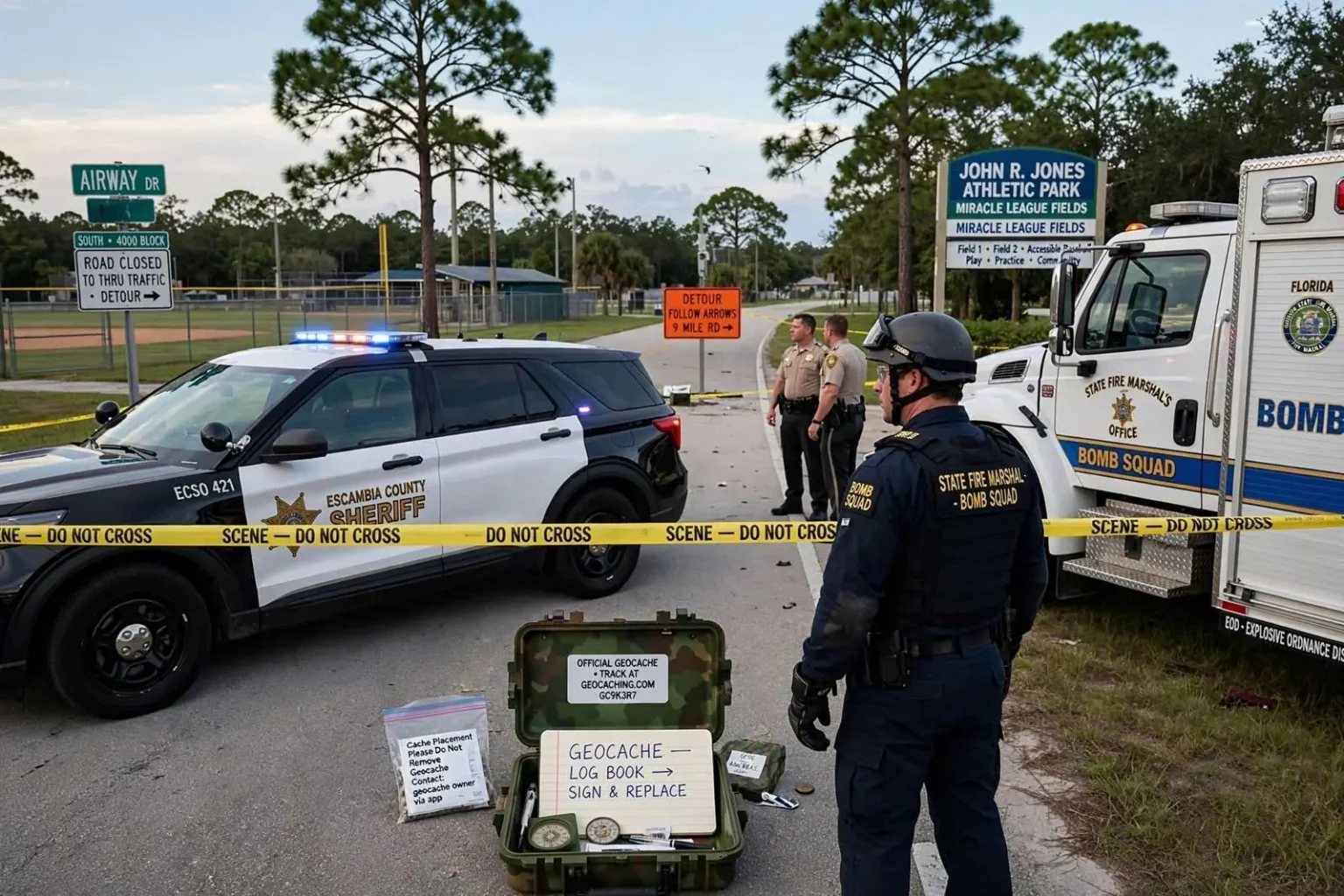
PENSACOLA, Fla. — A stretch of Airway Drive south of Nine Mile Road was closed for more than two hours Thursday afternoon while authorities investigated a suspicious package. The object turned out to be a sealed container placed there as part of a geocache. The Escambia County Sheriff’s Office shut down the roadway south of the Miracle League Fields at John R. Jones Athletic Park and requested the State Fire Marshal’s Office Bomb Squad to inspect the item. The bomb squad rendered the package safe.
The closure snarled afternoon traffic along a corridor that connects residential neighborhoods to one of the busier recreation complexes in the county’s northern reaches. Deputies positioned the closure south of Nine Mile Road, diverting drivers while the bomb squad worked, and the roadway was reopened once the container was cleared. No injuries were reported and no charges were announced, consistent with what authorities describe as a well-intentioned hobby item mistaken for a threat.
What geocaching is
Geocaching is a global, GPS-based outdoor scavenger hunt. Participants hide weatherproof containers — typically holding a logbook and sometimes small trinkets — then publish the coordinates online for others to find. Millions of caches are placed worldwide, frequently in parks, along trails and near public landmarks. The hobby dates to the year 2000, when improved civilian GPS accuracy turned a military technology into a global treasure hunt, and it has since grown into a network of websites and smartphone apps that list cache locations, difficulty ratings and logs of previous finders.
Placements near athletic fields and public parks are common precisely because those locations are accessible and easy to describe. They are also, unavoidably, locations where an unfamiliar sealed container sitting in the open can look like something else entirely to a passerby. Cache owners often go to lengths to disguise their containers — camouflaged boxes, magnetic holders, fake bolts — and the better the disguise, the more likely an unmarked container is to draw a second look from someone who does not know the game.
Pensacola and the surrounding Escambia County are dense with geocaches, from beachfront hides along Santa Rosa Island to woodland caches in the county’s interior. The area’s parks, trails and historic sites make it a popular region for cache owners, and local players maintain an active logging community. Authorities in the region have responded to similar calls before, and area geocaching groups routinely remind members that a container found by someone outside the hobby should be expected to generate a phone call.
The response was the right one
An outcome like this can read as an overreaction in hindsight. It is not. Deputies had an unidentified sealed container in a public space near a park where children play, and no way to know its contents from the outside. Closing the road and calling in trained explosive-ordnance personnel is the correct sequence, and the fact that the answer proved benign is the best possible result rather than evidence of a wasted afternoon.
The response also reflects standard practice across the Gulf Coast, where law enforcement agencies have refined their suspicious-package procedures through years of drills and real incidents. A typical sequence runs from an initial caller report, to perimeter and road closure, to a request for the regional bomb squad, to a controlled inspection — and the entire apparatus exists for the rare occasion when the container is not a hobby item. The two-hour closure on Airway Drive is the ordinary cost of that caution.
The Miracle League Fields themselves add context to the choice. The complex hosts baseball for players with disabilities, drawing children, families and volunteers to John R. Jones Athletic Park on a regular schedule, and deputies handling the call knew that any risk assessment had to account for a busy youth sports venue a short distance away. Closing the road south of the fields — rather than attempting an in-place inspection — kept the investigation away from the park’s traffic and gave the bomb squad room to work.
The State Fire Marshal’s Office bomb squad is one of the specialized units Florida agencies call on for suspected explosive devices, and its technicians are equipped to X-ray, examine and, if necessary, disrupt a suspicious container on site. Rendering a package “safe,” in the unit’s terminology, means the item has been inspected and its contents ruled out as a hazard — a procedure that can take anywhere from minutes to hours depending on the container and its location.
Avoiding the next scare
Geocachers are generally advised to place containers in ways that reduce alarm — using clear labeling, avoiding sensitive infrastructure such as bridges, utility boxes, government buildings and transportation facilities, and steering clear of spots where a container might be mistaken for something dangerous. The hobby’s listing sites publish those guidelines prominently, and cache reviewers reject submissions that violate them. Containers marked with a geocaching label and a contact note give finders an immediate explanation, which is often the difference between a phone call and a road closure.
Veteran players also follow a rule of thumb: never bury a cache, never place one where it requires digging or concealment inside anything that looks like infrastructure, and assume that any passerby — a deputy, a maintenance worker, a parent at a ballgame — may be the next person to encounter it. The Airway Drive container evidently lacked the labeling that would have headed off the call, though its owner presumably meant no harm.
Incidents of this kind occur periodically around the country and usually end exactly as this one did — with a harmless logbook inside a weatherproof box and an afternoon’s worth of inconvenience for drivers. Public safety officials say the lessons run in both directions: hobbyists should label and place their caches with a suspicious stranger in mind, and residents who spot an unattended container should leave it alone and report it rather than pick it up or move it.
Airway Drive reopened following the inspection. For the Escambia County Sheriff’s Office and the State Fire Marshal’s bomb squad, the afternoon qualified as a success by their own preferred measure — a thorough response, a safe resolution and a community that can go back to using its park and its roads. And for the region’s geocachers, the episode is a fresh reminder that the best hides are the ones no one but a player would ever think twice about.
A hobby built on public spaces
The close relationship between geocaching and public parks is no accident. The hobby depends entirely on landowners willing to tolerate small containers on their property, and most parks and recreation departments have come to see the game as a partner rather than a nuisance: geocaches draw visitors to trails, boat ramps and greenways that might otherwise go unused, and many agencies publish their own geocaching policies listing where hides are welcome. Escambia County’s network of athletic parks, conservation lands and beach access points offers exactly the mix of terrain the hobby thrives on, which is why finds in the region number in the thousands.
Cache listings carry ratings for difficulty and terrain, hint text, and a logbook trail where finders record their visits, and the community’s etiquette centers on leaving the site exactly as found — trading trinkets evenly, signing the log, and reporting damaged or misplaced containers to the owner. A well-maintained cache can sit in place for a decade or more, found by hundreds of players, which is why the community treats careless placements that trigger emergency responses as a threat to everyone’s access.
Local players note that the northern Escambia corridor where Airway Drive runs is familiar territory for the hobby, threading between residential subdivisions and the athletic complex. It is the kind of area where a cache might be tucked at the edge of a right-of-way or near a trailhead, visible to anyone walking past and anonymous to anyone not looking for it. That ambiguity — a container that is deliberately unremarkable — is precisely what makes occasional false alarms unavoidable, and geocaching groups generally accept the trade-off: the game stays invisible to most people, and every so often the invisibility backfires.
What residents should know
For the general public, the practical guidance from law enforcement is consistent. If you encounter a container that seems out of place — taped to a sign, wired to a fence, half-buried near a playground — do not pick it up, open it or move it. Note the location, step away, and call the non-emergency line or 911 depending on the circumstances. Dispatchers and deputies would far rather clear a hundred geocaches than miss one genuine device, and the process moves fastest when the caller can describe exactly what they saw and where.
Drivers who encounter a road closure like Thursday’s should expect delays of an hour or more and follow posted detours, since bomb squad work cannot be rushed. Agencies note that closures are lifted as soon as the item is rendered safe, and in this case traffic was moving again on Airway Drive the same afternoon.
The episode ends with no charges, no injuries and a container presumably returned to its owner — the routine conclusion of a routine call that looked anything but routine from the roadway. It also ends with the two halves of the story, the deputy and the hobbyist, understanding each other a little better: one saw a threat and responded exactly as trained, the other placed a treasure and learned, once again, that the best hiding spot still has to pass the test of a stranger’s eyes. On Airway Drive, that test took two hours, one bomb squad and a traffic detour — and it ended the way nearly all of them do.


