
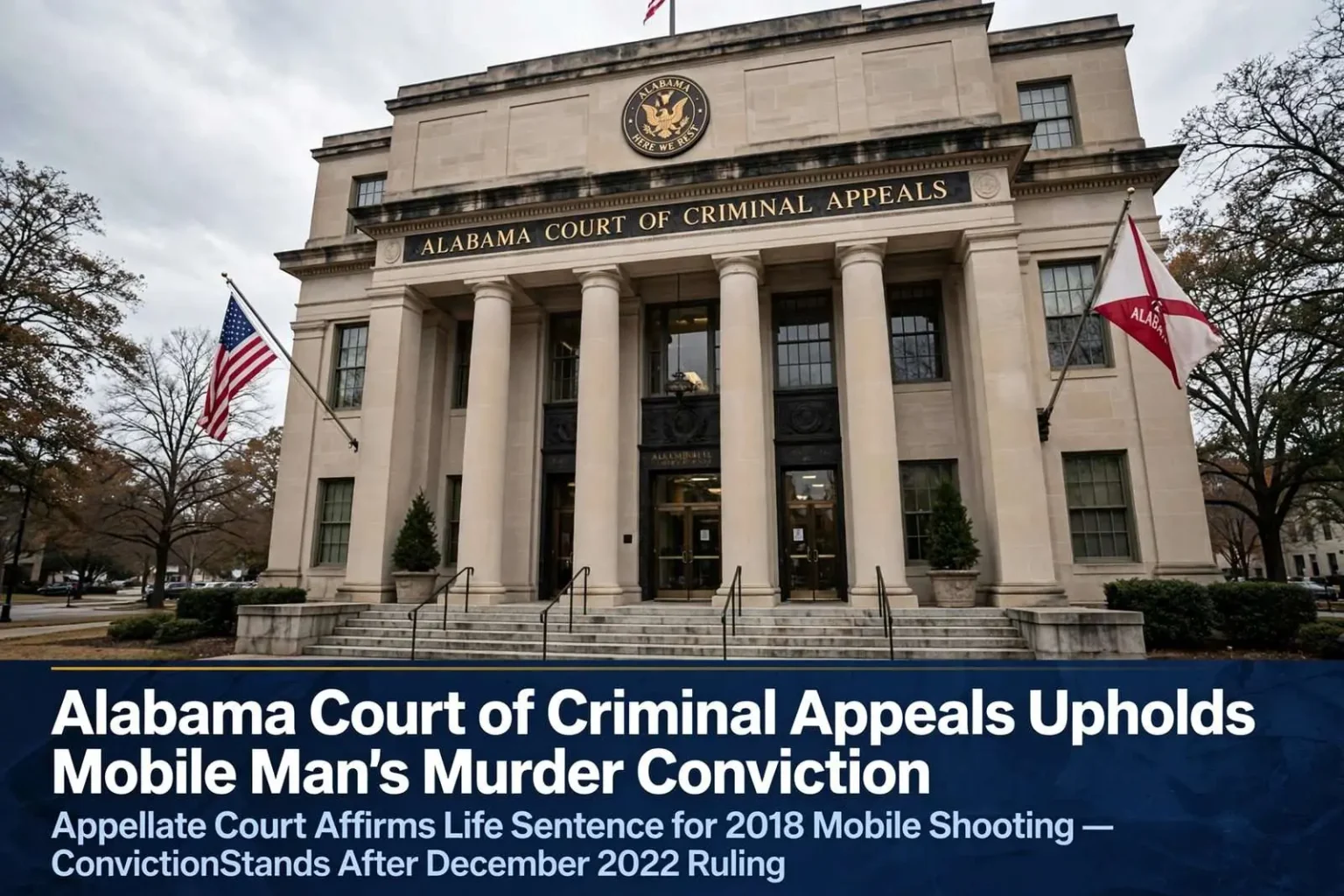
The Alabama Court of Criminal Appeals has affirmed the murder conviction of a Mobile man who will now spend the rest of his life behind bars, according to the Alabama Attorney General’s Office. Alexander Bridges, now in his mid-twenties, was convicted in Mobile County Circuit Court on October 28, 2021, for the 2018 killing of Richard Smith. He was sentenced to life in prison on January 5, 2022, and later asked the appellate court to reverse the conviction. That effort failed when the court upheld the conviction on December 9, 2022.
The decision brings to a close the appellate stage of a case that began more than four years earlier, when Smith was shot and killed outside a family home in Mobile. For Smith’s relatives, the ruling means the sentence imposed after a Mobile County jury’s verdict will stand. For prosecutors in the Attorney General’s Office, it validates both the trial outcome and the evidence that supported it. And for the local court system, it is one more example of how a case moves from a deadly night in a residential driveway through trial and, eventually, through the appellate courts that review nearly every serious felony conviction in Alabama.
How the case reached the appellate court
In Alabama, anyone convicted of a felony has a right to appeal, and murder convictions from Mobile County Circuit Court are reviewed by the Alabama Court of Criminal Appeals, a five-judge panel based in Montgomery that hears criminal appeals from the state’s circuit courts. The court reviews the trial record, considers arguments raised by the defense, and decides whether legal errors occurred that would require a new trial or a new sentence. Its decision can itself be further reviewed by the Alabama Supreme Court or the federal courts, but in the vast majority of cases the intermediate appellate ruling is the final word.
That is the process Bridges followed. After he was convicted and sentenced in early 2022, his legal team filed an appeal asking the Court of Criminal Appeals to reverse the conviction. The state, represented through the Attorney General’s Office, defended the conviction and the sentence. On December 9, 2022, the appellate court sided with the state, affirming the judgment of the Mobile County trial court. With that affirmation, Bridges’ life sentence stands.
Mobile County Circuit Court, where the trial took place, is one of the busiest trial courts in Alabama, handling felony prosecutions for the city of Mobile and the surrounding county. Murder cases that end in conviction there routinely draw appellate review, and the Court of Criminal Appeals’ docket is filled with similar cases from across the state’s 41 judicial circuits. The court’s affirmation of a conviction means it found the trial was conducted properly and that the evidence presented was legally sufficient to support the jury’s verdict.
What happened on the night of the shooting
Investigators said Smith was shot and killed on June 24, 2018. According to the Attorney General’s release, Smith and his brother were sitting in a car in the driveway of their mother’s home when a man later identified as Bridges waved a gun through the driver’s side window. Smith got out of the car and reached for a gun of his own, and prosecutors said Bridges fired multiple shots. Smith died from three gunshot wounds.
The setting — a family driveway on a June evening — is the kind of ordinary backdrop that has made the case resonate with Mobile residents. Smith and his brother had been in the vehicle outside their mother’s home, a place most people would consider safe, when the confrontation began. Instead of driving away or staying inside the car, Smith got out and reached for his own weapon, and within moments the encounter turned fatal. Three gunshots ended his life before the dispute could escalate further or be defused.
Prosecutors argued at trial that the shooting was not a random flash of violence. The state’s case, as outlined by the Attorney General’s Office, rested on the theory that Bridges came to the scene armed and confrontational, brandished his gun at the occupants of the car, and opened fire when Smith moved to defend himself. The jury that heard the evidence in the fall of 2021 agreed, returning a guilty verdict on October 28, 2021, more than three years after the shooting.
The evidence that built the case
Detectives built the case against Bridges on two key pieces of evidence cited by state attorneys: he was believed to have broken into the victim’s vehicle the day before the shooting, and he sent a threatening message on Facebook to one of those in the car just hours before Smith was killed.
Together, those two threads gave investigators a timeline. The day before the killing, someone broke into Smith’s vehicle — an act prosecutors tied to Bridges. On the day of the shooting itself, a threatening Facebook message was sent to one of the people sitting in the car, and prosecutors said Bridges sent it. Hours later, the confrontation in the driveway left Smith dead. Prosecutors presented the sequence as evidence of escalating hostility rather than a chance encounter, and the appellate court’s decision to uphold the conviction indicates it found the trial evidence sufficient.
Social media evidence has become a fixture of modern criminal prosecutions, and this case was a Mobile example of how a Facebook message can figure prominently in a murder trial. Detectives and prosecutors routinely obtain records from social media platforms to establish who communicated with whom and when, and juries have grown accustomed to seeing those exchanges introduced alongside physical evidence and witness testimony. In this case, the threatening message sent just hours before the shooting helped prosecutors establish intent and connection, while the vehicle break-in tied Bridges to the victim in the days before the killing.
Attorney General reacts to ruling
Attorney General Steve Marshall welcomed the appellate court’s decision.
“Mr. Bridges callously took the life of Richard Smith and his quest to avoid full justice for his crime has failed,” Marshall said in the announcement.
Marshall’s office has made appellate defense of criminal convictions a standing priority, with an appeals unit that responds whenever defendants challenge verdicts won by state prosecutors. The office regularly announces affirmances in murder cases, both to publicize the outcome and to signal that convictions won at trial will be defended all the way up the appellate chain. In this case, the announcement emphasized both the finality of the ruling and the circumstances of the crime itself.
Marshall, who has served as Alabama’s attorney general since 2017, has frequently spoken about violent crime in Mobile and other Alabama cities, and his office has taken an active role in cases connected to gun violence. The language he used in announcing the Bridges ruling — describing the killing as callous and the appeal as an effort to avoid “full justice” — reflected the office’s posture in contested murder appeals: that a jury’s verdict deserves deference and that a defendant’s appellate remedies, while guaranteed by law, do not erase the facts found at trial.
What a life sentence means in Alabama
With the appeal denied, Bridges’ life sentence stands. In Alabama, a sentence of life imprisonment for murder is indeterminate, and the state’s parole system determines whether an inmate will ever be released. Unlike a sentence of life without the possibility of parole, a standard life term leaves open the possibility of parole eligibility, but parole in murder cases is rare and typically comes only after decades of incarceration, a clean institutional record, and a parole board decision that release is consistent with public safety.
For the family of Richard Smith, the affirmation of the sentence closes a legal chapter that began with the 2018 shooting and stretched through a 2021 trial, a 2022 sentencing, and a late-2022 appeal. Appeals in murder cases routinely take a year or more to resolve, and victims’ families often describe the appellate period as a second waiting game that follows the trial itself. The Court of Criminal Appeals’ decision means there will be no new trial and no new sentencing hearing unless a higher court were to intervene, which is uncommon after an affirmance at this level.
Gun violence and the Mobile courts
The case is one of many Mobile County murder prosecutions built around disputes that escalated into gunfire in residential neighborhoods. Local law enforcement officials have repeatedly pointed to the combination of readily available firearms and personal conflicts — between acquaintances, neighbors, and family members — as a persistent driver of the city’s homicides. The driveway setting of Smith’s death, and the fact that both men were armed when the confrontation began, fit a pattern that Mobile police and prosecutors have described in case after case.
The conviction and its affirmance also illustrate the role that digital evidence increasingly plays in those prosecutions. Investigators in Mobile regularly pull Facebook messages, text logs, and location data to establish timelines and relationships, and the Bridges case relied on exactly that kind of record — a break-in alleged the day before a killing and a threat sent on social media hours before it. For prosecutors, those records have become an efficient way to connect defendants to victims and to demonstrate state of mind; for juries, they provide a documentary thread that testimony alone often cannot.
The appellate road ahead
Under Alabama law, a defendant whose conviction is affirmed by the Court of Criminal Appeals may petition the Alabama Supreme Court for review of the case, and may later pursue post-conviction relief through a petition in the trial court or a federal habeas corpus action. Those avenues are rarely successful, and none suspends the underlying sentence while they are pending. Unless one of them changes the outcome, the December 9, 2022, affirmance is the final word on Alexander Bridges’ conviction for the murder of Richard Smith.
For now, the ruling stands as the Attorney General’s Office described it: a Mobile man will spend the rest of his life in prison for a shooting that killed Richard Smith in his mother’s driveway in June 2018, and the courts that reviewed the case found nothing in the trial that would undo the jury’s verdict.


