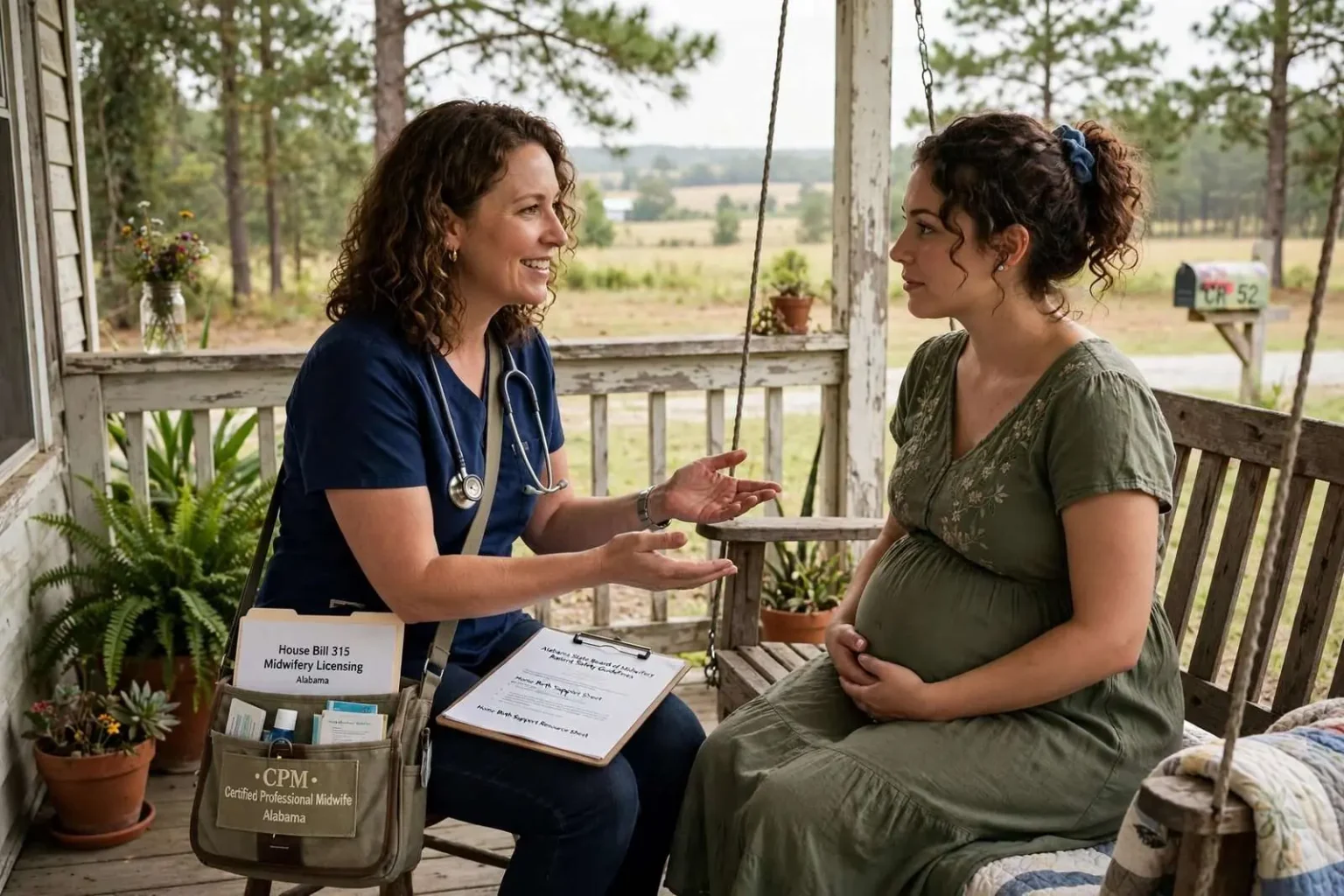
After four decades in which practicing midwifery outside a hospital setting was a crime in Alabama, a new state law now allows certified midwives to legally attend births in homes and birth centers across the state. Gov. Kay Ivey signed House Bill 315 last week, capping a years-long campaign by mothers, midwives and doulas who argued the old restrictions left families with few options, particularly in rural communities where hospital labor and delivery units have been closing.
Ivey called the bill’s passage “a perfect example of the people of Alabama playing an active and effective role in lobbying their government.” In a statement, she said the law gives mothers more options for how they deliver their babies while ensuring midwives who practice in the state are properly qualified. “It strikes the appropriate balance of removing regulations to allow midwives to practice, while also making sure offered services are safe for and in the best interests of mothers and children,” she said.
For Courtney Gordon, a certified doula in Mobile who has been training to become a midwife, the new law is welcome news for herself and for mothers around the state. Gordon said she has worked as a doula for a little more than three years and has watched families struggle to find the kind of care they wanted. “It’s been such a hassle for moms and families who want to have a home birth,” Gordon said. “Some do, but they have had to cross the Mississippi border.”
While many women choose midwifery care so they can give birth at home or receive continuous support from the same provider throughout a pregnancy, others turn to it out of necessity as hospitals in rural parts of the state shutter or close their labor and delivery units to cut costs. As of 2014, only 29 of Alabama’s 67 counties had hospitals still offering obstetrical services. Gordon said extending legal midwifery care to mothers in those underserved areas is one of the biggest benefits of the new law.
“There are also a lot of rural counties where mothers have to drive two and three hours every time they have a prenatal appointment, and again when they finally go into labor,” Gordon said. “We’re hoping those areas will be able to benefit from this.”
To those who tracked its progress through Montgomery, House Bill 315’s success came as something of a surprise. Colleen Tullis, a Mobile resident who has worked as a certified midwife for more than a decade, said she and other advocates had watched similar bills die in committee year after year. Tullis is certified in Louisiana and has practiced across the state line in Mississippi, providing out-of-hospital care to hundreds of mothers even as the same work remained illegal in her home state.
“We’ve presented this bill or some form of it for years, and we’d always get shot down,” Tullis said. After 13 years of failed attempts, she said there was little reason to expect this year’s regular legislative session would end differently. “This year, it just started flying though, especially compared to our previous experiences,” she said.
The bill moved through the House with relatively little resistance, but it slowed considerably in the Senate, where supporters had to accept several concessions to keep it alive. Lawmakers added requirements that midwives carry liability insurance and barred them from attending certain “high-risk” pregnancies, including those involving multiple babies or mothers who have previously had a cesarean section. The final version also requires midwives to track and report the number of births, deaths and hospital transfers that occur in the course of their work.
In the final hours of the session, lawmakers also created a regulatory board empowered to approve, renew, suspend or revoke midwifery licenses. The seven-member board will be appointed by the governor and confirmed by the Senate, and will include four certified midwives, a nurse midwife or registered nurse, a nurse practitioner and a consumer who has used a midwife’s services. Initial nominees are expected to be submitted to the governor’s office jointly by the Alabama Birth Coalition, which helped drive the bill’s passage, and the Alabama Midwives Alliance, of which Tullis is a member.
Tullis said she is pleased with how the board is structured. With midwives making up a majority of its seats, she called the arrangement “excellent,” adding that “many states would like Alabama’s arrangement.”
One of the last obstacles for House Bill 315 came from Sen. Slade Blackwell, R-Montevallo, who turned what supporters expected to be a brief discussion on the session’s final day into an extended series of objections. Sen. Vivian Davis Figures, D-Mobile, emerged as a forceful defender of the bill on the Senate floor, at one point directly challenging Blackwell: “Who are you working for? Who has you at the mic trying to kill this bill?” The bill ultimately passed the Senate 30-0.
Tullis said she shared Figures’ frustration with the last-minute opposition, saying she believed critics of the bill “pulled out all the stops” once it became clear the legislation had enough support to pass. “It was very frustrating,” she said. “So much of what they started trying to tack on, we’d been asking for for years.”
The Medical Association of the State of Alabama had long been one of the most prominent opponents of midwifery legislation in the state. In a statement on the final bill, the association said it remained concerned about the safety of at-home births but was satisfied that amendments added during the session would provide additional protection for mothers and infants that had not been part of the original bill. The group noted the final version also included liability protections for physicians and hospitals that may have to take over care for a midwife’s patient in the event of complications.
Despite that history of opposition, Gordon said she hopes to eventually see obstetricians and midwives in Alabama working side by side rather than at odds. “Other places around the country have that, and we’d like to see that model of care that supports families and women by giving them the choices they desire,” she said. “When we do that, there are better maternal and fetal outcomes and lower rates of postpartum depression.”
With a licensing board still to be seated, regulations still to be written and a shortage of certified midwives in the state, Tullis said it could be a year or more before anyone is legally practicing midwifery in Alabama under the new law. Still, she said she is hopeful that more midwives, including trainees like Gordon, will eventually be able to meet demand for a service that was a crime just weeks earlier. “We will put a board together and have all these rules and regulations in place. This will all come to fruition,” Tullis said. “After 13 years, we’ve proven that perseverance pays off. If people speak loud enough, you can make the government listen. It’s not easy, but you can do it.”
How Licensing Will Work
The license created under the new law is tied to the Certified Professional Midwife credential, a national certification awarded by the North American Registry of Midwives to midwives trained in out-of-hospital birth. The new Alabama State Board of Midwifery will be responsible for writing the rules and issuing the licenses that allow those midwives to practice legally in the state.