
Alabama Joins $45M Cash App Settlement Over Fraud Claims
Alabama will receive $595,421 from a $45 million multistate settlement with Cash App parent Block Inc. over claims it misled users and failed to prevent fraud.
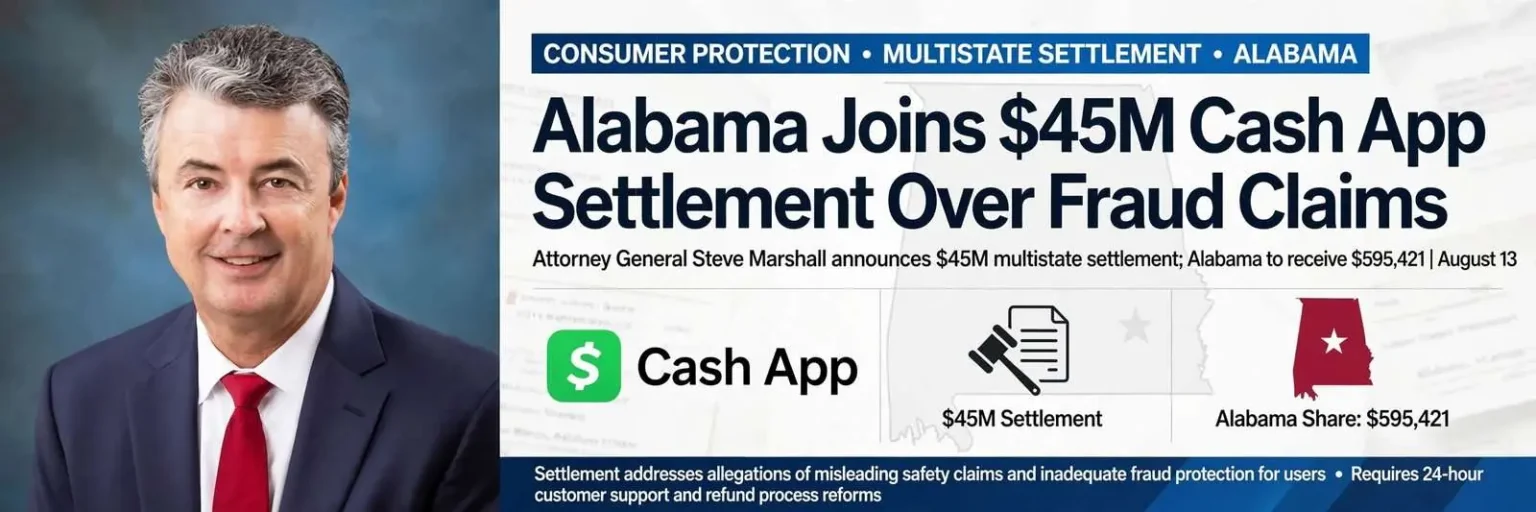
Alabama Attorney General Steve Marshall has announced a $45 million multistate settlement with Block Inc., the parent company of the payment app Cash App, following allegations that the financial technology firm misled users about safety and failed to protect them from widespread fraud. Alabama will receive $595,421 as its share of the agreement, Marshall announced on Aug. 13.
The settlement addresses claims that Block falsely implied Cash App offered bank-like protections while aggressively expanding its user base — particularly among unbanked and underbanked consumers — without maintaining adequate customer support or security infrastructure to protect them. The distinction matters because millions of Americans rely on peer-to-peer payment apps as their primary financial tool, and the claims alleged that users were led to believe their balances carried safeguards comparable to a traditional bank account when they did not.
“We have long advised consumers to use caution when using peer-to-peer programs for payments,” Marshall said. “This settlement sends a clear message that companies offering these services must be transparent, secure and accountable.”
Why the Case Matters in Alabama
Cash App has become one of the most widely used payment platforms in the country, popular for splitting bills, paying rent, and transferring money instantly between individuals. Its growth has been fastest among consumers who lack traditional banking relationships — the population state regulators say was most exposed to the practices the settlement addresses. Alabama’s share of the settlement flows back to the state as part of the multistate resolution negotiated with the company.
The case also reflects a broader enforcement concern in the mobile-payments era. Unlike a card transaction, a peer-to-peer transfer is often instantaneous and irreversible, which makes the apps attractive to scammers who persuade victims to send money under false pretenses. When platform safeguards and support systems lag behind user growth, regulators argue, the gap is filled by fraud — and users absorb the losses.
Allegations of Lax Security
According to state officials, Block’s streamlined account creation required minimal identity verification, allowing scammers to easily open fraudulent accounts. The same simplicity that made the app easy to adopt made it easy to abuse: an account could be stood up in minutes, used to receive stolen funds or run confidence schemes, and abandoned before the platform could react.
For years, the platform also lacked telephone customer service. Users locked out of their accounts or seeking help often searched online for support numbers, leading many to fake toll-free lines operated by scammers who stole login credentials or drained funds. The scam fed on the vacuum — a customer with a frozen balance and no one to call would type a search, find a polished toll-free number, and hand over the credentials that emptied the account.
Officials said Block was aware of the pattern but delayed setting up an official support line or warning consumers. That delay, in the states’ view, compounded the harm: the longer the company waited, the more users fell victim to impersonators masquerading as the company’s own help desk. The settlement’s customer-support requirements aim directly at that failure, requiring staffing levels that make legitimate help reachable.
Required Changes
Under the terms of the settlement, Block must change several business practices, including: maintaining 24-hour live customer support, with human representatives accessible by phone at least 13.5 hours a day and via live chat at least 18 hours a day; ceasing false or misleading statements about platform safety and fraud prevention; ending promotional practices that increase fraud exposure and launching direct consumer education on common scams; and complying with legal requirements to investigate unauthorized transactions and issue refunds to affected users.
The dispute-resolution requirements may prove the most consequential for everyday users. Customers who report unauthorized transactions will be entitled to investigation under defined legal standards, with refunds where those standards are met — replacing a system where victims often describe hitting a wall of automated responses and account closures with no path to recover their money.
The consumer-education mandate also shifts responsibility onto the platform itself. Rather than leaving users to learn about fraud schemes through personal experience, the settlement requires the company to teach its customer base the red flags: unsolicited support numbers, requests for credentials, “refund” pitches from strangers, and pressure tactics that push users to send money quickly.
A Multistate Effort
The $45 million agreement was negotiated jointly by a group of state attorneys general, a structure that has become the standard vehicle for holding large technology and financial platforms accountable. By combining their leverage, states can extract conduct reforms that no single office could obtain alone, and the monetary payments are distributed among participating states according to the size of their affected user bases. Alabama’s $595,421 share reflects that allocation.
Marshall’s office has made consumer protection a recurring theme in its enforcement work, targeting scams that strike hardest at vulnerable populations — from senior-focused telephone fraud to digital-platform abuses. The Cash App settlement fits the pattern: a fast-growing consumer product, a gap between marketing and reality, and a settlement that forces structural change rather than simply writing a check.
What Users Should Do
For Alabamians who use Cash App or similar services, the settlement’s terms are a reminder of the basics of peer-to-peer payment safety. Send money only to people you know and have verified, because the apps are built for payments between trusted parties and generally treat transfers as final. Treat anyone who contacts you claiming to be from the app’s support team with suspicion, especially if they ask for your password, a one-time code, or a “test” payment — no legitimate representative requests any of those.
Users should also be skeptical of reverse-refund schemes, in which a stranger sends an unexpected payment and then asks for it back through a different channel. The original payment is often made with a stolen card, and the reversal leaves the victim’s own account on the hook. Enabling security features — PIN locks, notification alerts and two-factor authentication where offered — closes off the easiest paths into an account.
Anyone who has lost money through a payment app can file a complaint with the Alabama Attorney General’s consumer protection division, which tracks complaints and uses them to build future enforcement actions. Users affected by the issues addressed in this settlement can also watch for the platform’s notifications about the claims and refund processes the agreement requires.
State officials said the settlement will be monitored to ensure Block delivers the promised changes, from the staffing hours to the refund investigations. For consumers, the bottom line is unchanged from the attorney general’s standing advice: peer-to-peer payment programs are convenient, but the caution a user brings to them — not the logo on the app — remains the first line of defense.
How the Alleged Harm Reached Users
The harm described in the settlement followed a chain that ran through the platform’s own design choices. Fraudsters opened accounts with minimal friction, impersonated the company’s support team to desperate users, and harvested credentials that gave them control of real balances. Because transfers move instantly, a drained account was often emptied before the legitimate owner even knew the credentials had been taken, and without a phone line to call, recovery options were limited to email channels that users described as slow and impersonal.
Regulators also pointed to the mismatch between marketing and mechanics. A traditional bank account comes with federal deposit insurance, dispute rights and fraud liability rules that customers have learned to expect; a payment app balance, under the practices the states alleged, did not deliver comparable protection despite imagery and language that suggested otherwise. The settlement does not convert the platform into a bank, but it does require the company to stop blurring that line and to tell users plainly what protections they do and do not have.
The unbanked and underbanked populations the app courted were, in the states’ view, the most exposed. Consumers without a traditional bank often rely on payment apps not for convenience but for necessity — receiving wages, paying bills, holding balances between paychecks. When those balances were stolen, the losses were proportionally more damaging, and the absence of customer support left precisely the users least equipped to navigate recovery on their own.
The Standard This Sets
Enforcement officials describe settlements of this kind as much about future behavior as past harm. The staffing requirements, the refund obligations and the education mandate give regulators concrete, measurable commitments to check against — hours of phone availability, response timelines, published scam warnings — rather than vague promises to “do better.” Companies watching the case now know that a platform’s growth story does not excuse a hollowed-out support system.
For the peer-to-peer industry, the message lands alongside similar actions other states have pursued against payment platforms in recent years. Instant payment apps have become embedded in American commerce, and the settlements collectively push the sector toward what consumers already assume exists: working identity checks, reachable human support, and honest disclosure about what happens when something goes wrong.
For Alabama, the $595,421 share is a modest sum by corporate settlement standards, but the conduct changes apply nationwide and shape how the platform treats its users everywhere — including the Alabamians who make up its customer base. Marshall’s office urged consumers to keep reporting problems, noting that the complaints from individual users are what alert state attorneys general to patterns worth investigating in the first place.


