Alabama Lawmakers Nearer to a Vote on Legalizing Medical Marijuana
A bipartisan 2019 Alabama bill to legalize medical marijuana gained support from Carly's Law families and UAB researchers while police pushed back.
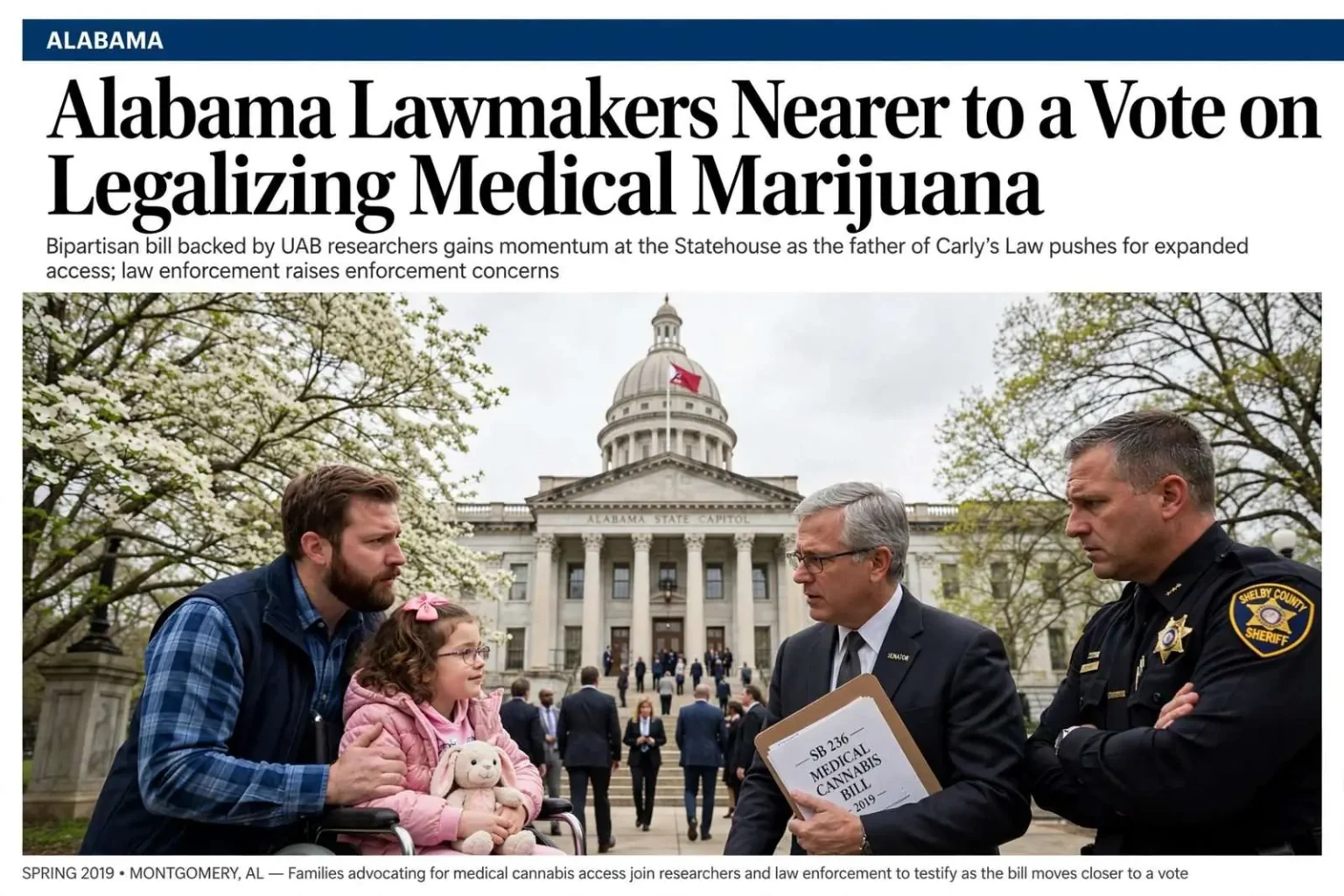
A bill to legalize medical marijuana in Alabama was picking up bipartisan support at the Statehouse in spring 2019, moving lawmakers closer to a vote on allowing patients with certain conditions to use medical-grade cannabis. The measure was sponsored by Sen. Tim Melson, a Republican with a background in medical research, and it drew backing from an unexpected corner of the medical establishment: researchers at the University of Alabama at Birmingham.
The debate put Alabama in line with a growing number of states reconsidering cannabis policy, but it also exposed a familiar divide at the Statehouse — medical advocates and researchers on one side, law enforcement officials on the other, and legislators in between weighing how far a conservative state was willing to go.
Carly’s Law and a Father’s Fight
Among the most prominent voices for the bill was Dustin Chandler, father of 8-year-old Carly, the namesake of Carly’s Law — the earlier statute that allowed her to receive medical-grade cannabis under a doctor’s supervision. Carly suffers from CDKL5 deficiency disorder, which causes seizures, a rare genetic condition that produces frequent, hard-to-control seizure activity in young children and leaves families searching for treatment options that conventional medicine has not been able to provide.
Chandler’s testimony before lawmakers carried the weight of a family that had already fought one legislative battle and won it. “Your daughter that’s being affected by something that you can’t control and you finally get help for it — and then knowing that it could potentially help thousands of others, why aren’t we doing that?” Chandler said. “If my daughter could talk, she’s receiving help, and I know she would tell me, ‘Daddy, why aren’t we helping other people?'”
The argument he presented was a simple one: Carly’s Law had opened a door for a narrow group of patients, and the experience of families like his had shown what medical-grade cannabis could do. Extending that access to other patients with debilitating conditions, he argued, was the natural next step rather than a radical departure.
Carly’s Law itself had been a landmark when it passed, making Alabama one of the states to authorize limited use of cannabidiol for seizure disorders under strict medical oversight. For the families who fought for it, the law was as much a proof of concept as a treatment program — evidence that the state could allow cannabis-derived medicine without the dire outcomes opponents had predicted.
Researchers See Potential
Dr. Jerzy Szaflaski of UAB said cannabis showed potential to help with many conditions and that the bill would give researchers like him the opportunity to study it further. That endorsement from a major research university mattered in a state where the medical establishment’s opinion carries weight with legislators, and it reflected a broader shift in the scientific community’s assessment of cannabis-derived compounds.
UAB had been at the center of the state’s early experience with medical cannabis research through its work connected to Carly’s Law, giving the institution firsthand experience with the questions the new bill raised. Researchers argued that a properly regulated program would not only treat patients but also generate data Alabama could use to shape policy going forward — an argument aimed squarely at lawmakers who wanted evidence before they expanded access.
Police Push Back
The strongest opposition came from law enforcement. “If this passes, it will greatly hinder any enforcement opportunity enforcement may have with possession of marijuana,” warned Clay Hammac, director of the Shelby County Drug Enforcement Task Force, who feared the bill could open the door to broader legalization.
Hammac’s objection reflected the practical concern that dominates law enforcement testimony on cannabis bills: officers would have no reliable way to distinguish legal medical cannabis from illegal possession in the field, and any program that legitimizes the product for some users complicates enforcement against everyone else. The slippery-slope argument — that a medical program becomes the first step toward recreational legalization — has accompanied nearly every medical cannabis debate in the South, and Alabama’s was no exception.
Task force directors like Hammac also pointed to the federal picture, where cannabis remained a Schedule I controlled substance regardless of what states did. For agencies that receive federal funding and coordinate with federal partners, the gap between state and federal law created a genuine operational dilemma that legislators had to weigh alongside the medical testimony.
A Multi-Year Effort Takes Shape
The spring 2019 debate set the stage for what would become a multi-year effort that eventually brought limited medical cannabis to Alabama — legislation that affected patients in South Alabama and across the state alike. The bill’s bipartisan support in its early stages was notable for a measure touching cannabis, with Republican and Democratic lawmakers alike citing constituents whose families had run out of conventional options.
The path from that session’s debate to a working program proved longer than supporters hoped. Lawmakers spent the sessions that followed refining the details that decide how such a program actually functions: which conditions qualify, who can recommend treatment, how products are tested and labeled, where they can be dispensed, and who regulates the whole system. Each of those questions became its own negotiation between the medical community, law enforcement, and legislators wary of anything that resembled a recreational market.
What eventually emerged was one of the most restrictive medical cannabis frameworks among the states that authorize the drug — a program built from the ground up with state licensing, physician certification and a closed list of qualifying conditions, rather than the open-ended systems some other states adopted. For the families who had testified year after year, the restrictions were less important than the principle: Alabama would allow medical-grade cannabis for patients whose doctors determined it could help them.
What It Means for South Alabama Patients
For patients in Mobile, Baldwin and the rest of South Alabama, the practical effect of the legislation will depend on how the program’s infrastructure reaches the region. Patients who qualify must connect with certifying physicians, and the location of licensed dispensaries and testing facilities will determine whether access is convenient or requires a long drive. Advocates have pressed regulators to ensure that coverage extends beyond the population centers so that rural patients are not left out.
The journey from Carly’s Law to a broader program also illustrates how medical cannabis policy has moved in conservative states: not all at once, but in careful steps, each one tested against the experience of the last. Families like the Chandlers supplied the testimony that moved the first step, researchers supplied the credibility, and the legislature ultimately supplied the framework — a combination that has repeated itself in state after state across the region.
As Alabama’s program takes shape, the debate that played out at the Statehouse in spring 2019 stands as the moment the state’s position began to shift, with the arguments on both sides — the father asking why other families were still waiting, and the task force director warning about enforcement — now part of the record that shaped the law.
How Alabama’s Debate Compared to Other States
The questions Alabama lawmakers faced in 2019 were the same ones playing out in legislatures across the South. Mississippi, Florida, Arkansas and Louisiana had each approved medical cannabis programs of varying scope by then, giving Alabama legislators a set of neighboring examples to study — and to criticize. Supporters of the Alabama bill pointed out that none of the dire consequences opponents predicted in those states had materialized, while opponents countered that each program had grown broader than its authors promised.
The legislative mechanics mattered as much as the politics. A cannabis bill in Alabama required more than a simple majority to create a functioning program, because the legislation touched licensing, regulation, agriculture and health care all at once. Committees with jurisdiction over each of those areas could amend the bill, and each amendment risked tipping the balance that kept its fragile coalition of medical advocates, libertarians and compassionate-conservatives intact.
Melson’s background as a medical researcher gave the bill its most credible advocate in the Senate chamber. A sponsor who could answer questions about dosing, testing and study design in scientific terms changed the character of the floor debate, forcing opponents to argue about policy rather than stereotype. Colleagues on both sides of the aisle acknowledged that having a pharmacist-legislator carry the bill made passage more conceivable than it had been in earlier sessions.
The Families Behind the Testimony
The hearings that spring repeatedly returned to the families who made the drive to Montgomery to speak. Parents of children with severe epilepsy and related seizure disorders described medications that failed, side effects that compounded the underlying condition, and the choice some families made to move to states with established programs rather than wait for Alabama to act. Those stories — Carly Chandler’s among them — did more to move votes than any policy paper.
Dustin Chandler’s role in the debate grew out of that experience. Having already persuaded the legislature to act once for his daughter, he became a familiar face in committee rooms, arguing that the state’s caution had been tested and found wanting. His question to lawmakers — why help was available for one child but not thousands of others — framed the bill as a matter of consistency rather than ideology, and no opponent ever fully answered it.
The bill’s opponents never disputed that families like the Chandlers faced hard circumstances. Their argument was narrower: that the state could help those patients without creating an enforcement problem for everyone else, and that any program should be built tightly enough that it could not drift toward general legalization. The final legislation, with its qualifying-condition list and licensed-chain-of-custody structure, was an attempt to answer both sides at once.
As the sessions that followed turned the spring 2019 debate into statute, the arguments on both sides became part of the framework’s foundation — the assurance to law enforcement that the program would stay closed and regulated, and the promise to families that relief would finally reach every patient the system could serve.