Alabama Plans to Sink $22.5 Million Into Gulf Habitat, With a New Big Ship Still Undecided
Alabama officials are directing $22.5 million in Deepwater Horizon settlement money toward new reef habitat in the Gulf, Mobile Bay and nearshore waters.
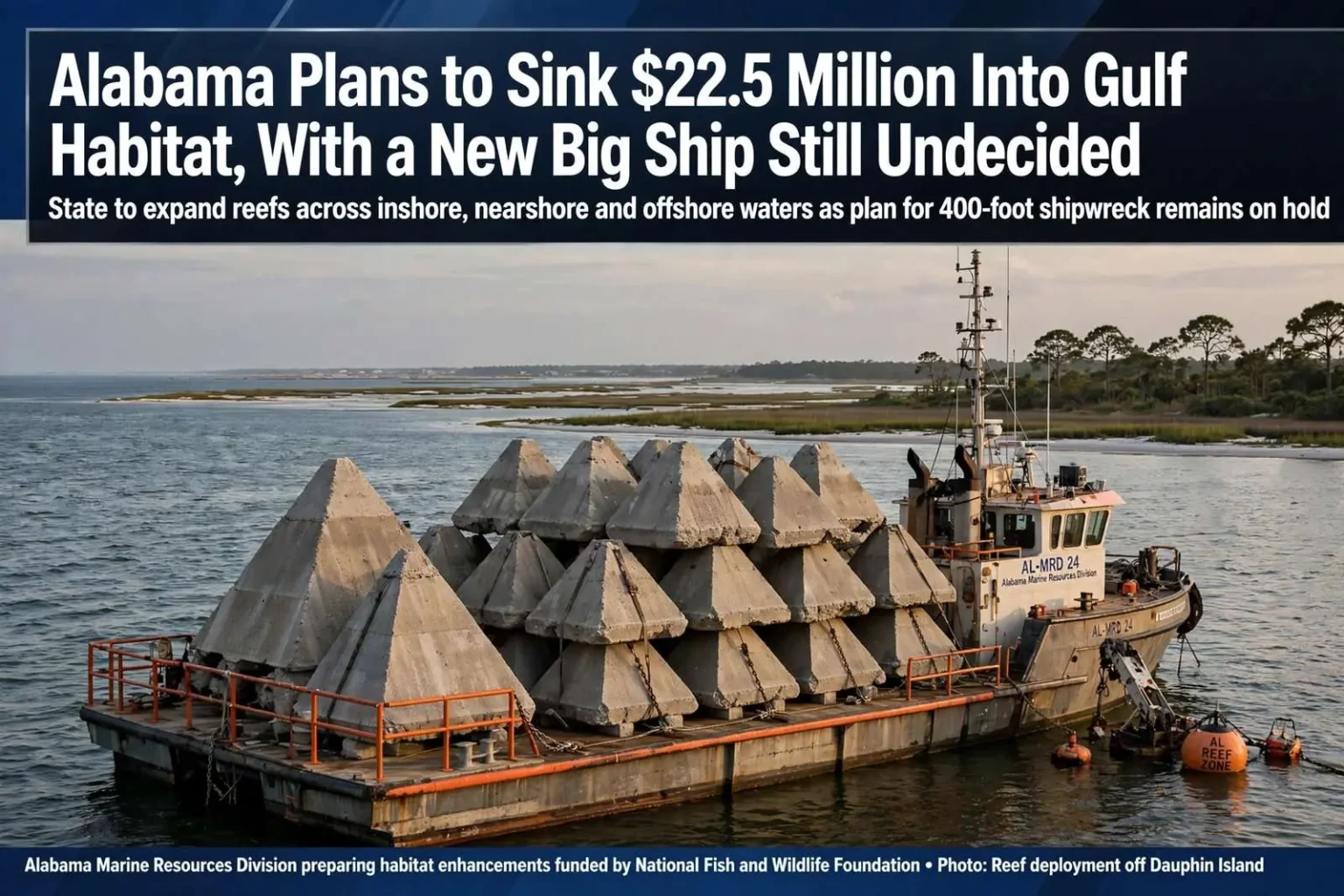
Alabama officials are preparing to pour $22.5 million into new fish habitat across inshore, nearshore and offshore waters, though one of the most eye-catching pieces of the plan – adding another large ship to the state’s artificial reef system – remains up in the air.
Craig Newton, a biologist with the Alabama Marine Resources Division, said the agency would love to sink another big vessel, in the range of 400 feet, but it is not yet clear whether any of the money can be used that way.
“We have about $7.5 million available for offshore reefs and we’re hoping that we can get large ships on the scale of 400 feet or so out of this,” Newton said. “That’s undecided right now whether or not we’re going to be able to use it for large shipwreck reefs or what type of reefs we’ll be able to build with that.”
Where the Money Comes From
The $22.5 million is funded through the National Fish and Wildlife Foundation, using penalty money tied to the 2010 Deepwater Horizon oil spill. Newton said the foundation wants additional research before it will sign off on spending the money on large shipwreck reefs specifically.
“These funds are strictly for habitat-enhancement projects that will result in the greatest net benefit to the resources,” Newton said. “We’d like to build large shipwreck reefs with it, but the funding agency needs some more monitoring information and information about the production potential of different sizes of reefs before they agree to let us use that money for those.”
If a ship deal does not come together, Newton said the offshore portion of the funding would instead go toward deploying more of the 25-foot-tall pyramid reefs the state has already been placing across the Gulf.
Building on Earlier Work
The new funding extends a reef-building push the state has had underway for the past two to three years, which already placed roughly 600 pyramid reef structures between Dauphin Island and Orange Beach. Those 10-foot structures were deployed six to nine miles offshore as part of an earlier $11.8 million project that also included sinking the New Venture, a 250-foot former research vessel sent to the bottom about 20 miles south of Orange Beach.
“This $22.5 million is a continuation of that enhancement strategy that we began implementing three years ago,” Newton said.
Spreading the Investment Across Three Zones
The plan calls for spending across offshore, nearshore and inshore waters, with the goal of creating a more connected, more productive reef ecosystem for species that move between habitats throughout their life cycle.
“The overall goal of these construction projects was to create a more productive reef ecosystem in the inshore, nearshore and offshore waters,” Newton said. “Also, to provide connectivity between different habitats for fish like sheepshead and flounder that spend a bunch of time inshore and then go to the nearshore waters for spawning purposes.”
Offshore, roughly $5 million of the funding would go toward 250 of the 25-foot pyramid reefs. Closer to shore, about $2.1 million is earmarked for new reef structures in Mobile Bay, aimed largely at boosting oyster and pinfish production.
“The reefs in Mobile Bay are going to be inshore reefs to help with our oyster production and pinfish as well,” Newton said. “We’re designing these structures to provide high-quality settlement substrate for larval oysters. Once the oysters become established it will become a more productive community. But we also have fish like spotted sea trout, flounder and sheepshead and gray snapper, which will also utilize these reefs.”
Nearshore waters are set to see roughly 1,500 smaller reef structures, including about 300 placed in the surf zone and another 1,200 spread across the six- to nine-mile range. Newton said those structures, low-relief concrete and limestone discs about four feet high, have already proven valuable for juvenile fish.
“We’re going to deploy about 1,200 juvenile fish shelters,” Newton said. “These are shelters that are relatively low-relief and they are going to go in the nearshore reef zones. We already have quite a few of these structures out there now and they’ve been extremely productive in providing habitat for juvenile triggerfish. We’re hoping we can find some additional utilization opportunities for juvenile triggerfish to allow more of them to enter our fishery.”
Newton said the shelters act as a kind of way station for fish that hatch inshore and gradually move to nearshore and eventually offshore waters as they mature.
“[The shelters will] provide connectivity between different habitats for fish like sheepshead and flounder that spend a bunch of time inshore and then go to the nearshore waters for spawning purposes,” Newton said. “Also, as snapper spend the early part of their lives in the estuaries, as they grow, they move offshore. The nearshore reefs provide kind of like a stepping stone in that intermediate region for them to have refuge and foraging opportunities before they get farther offshore. Overall, the goal was to increase survivorship and increase production potential of our whole system through habitat enhancements.”
Permitting and Red Snapper Research
A portion of the funding, roughly $1.4 million, is earmarked for permitting to expand the state’s artificial reef program by about 95 square miles, work that requires sign-off from the U.S. Army Corps of Engineers.
“The permitting process has become more cumbersome over the years, and to satisfy all of the requirements of the [U.S. Army] Corps of Engineers we’re going to end up spending about $1.4 million to acquire permits for the new water bottoms,” Newton said.
Another roughly $3.3 million is set aside for research and monitoring tied to management of the region’s red snapper fishery.
“This is critical to allow us to continue our management of the red snapper and continue to allow access to the red snapper fishery,” Newton said. “So, we’re going to fund research that provides high-quality data that can be included in our management strategy of red snapper.”
What the Earlier Phase Delivered
Newton said the previous $11.8 million phase of the program placed 166 structures in the surf zone, 170 of the 25-foot pyramid reefs offshore, 600 four-foot disc reefs in the six- to nine-mile zone, 15,000 tons of limestone aggregate for juvenile reef fish, two offshore shipwrecks, 125 juvenile fish shelters off Orange Beach and Gulf Shores, and enhancements to 15 reef sites using roughly 850 concrete culverts, junction boxes and pipes.
The Alabama Marine Resources Division, part of the Alabama Department of Conservation and Natural Resources, manages the state’s artificial reef program in cooperation with the U.S. Army Corps of Engineers, the Gulf States Marine Fisheries Commission and other partners. The program has deployed thousands of structures in the Gulf of Mexico over the past several decades.
The 2010 Deepwater Horizon oil spill resulted in billions of dollars in criminal and civil penalties paid by BP and other responsible parties. The Natural Resource Damage Assessment process directed much of that funding to restoration projects across the Gulf Coast, including barrier island restoration, oyster reef construction and the artificial reef expansion referenced in the Alabama plan.
Artificial reefs in the northern Gulf of Mexico serve multiple purposes: they create habitat for snapper, grouper and other reef-associated species; they enhance recreational fishing opportunities; and they support diving and other coastal tourism. Alabama’s reef program has placed a mix of pyramid reefs, low-relief juvenile fish shelters and shipwrecks at depths ranging from nearshore to deep offshore.
The red snapper fishery in the Gulf of Mexico is one of the most closely managed recreational fisheries in the country. Recreational catch limits, size restrictions and seasonal closures are set through a complex process that involves the Gulf of Mexico Fishery Management Council, state agencies and federal partners, with ongoing research playing a key role in determining sustainable harvest levels.
The Gulf of Mexico Fishery Management Council, which sets catch limits and management measures for federal waters in the Gulf, has been at the center of debates over red snapper management for years. State agencies like the Alabama Marine Resources Division work closely with the council to set season lengths, bag limits and size restrictions for both recreational and commercial red snapper harvest. The research funded through the $22.5 million plan will feed directly into that management process.
Artificial reef programs in other Gulf states, including Florida, Mississippi, Louisiana and Texas, have produced decades of data on the effectiveness of different reef structures for fish production. Alabama’s reef program has drawn on that experience to refine its deployment strategy over time, balancing the productive capacity of larger pyramid reefs with the juvenile-fish benefits of smaller low-relief shelters.
Oyster reef restoration has become a major focus of Gulf Coast environmental work, with Alabama and neighboring states investing in reef construction to compensate for historic losses of natural oyster habitat. Healthy oyster reefs provide habitat for a wide range of marine species, filter water, and protect shorelines from erosion. The Mobile Bay reefs planned under the $22.5 million program will add to a regional effort that has gained significant momentum in the past decade.