
Library Service Staff Urge Board Not to Fill New Compliance Job; Wahl and Minton Disagree
APLS staff urged the board not to fill a new compliance position, calling it unnecessary. Board Chair John Wahl and member Amy Minton disagreed, and a final decision was delayed.
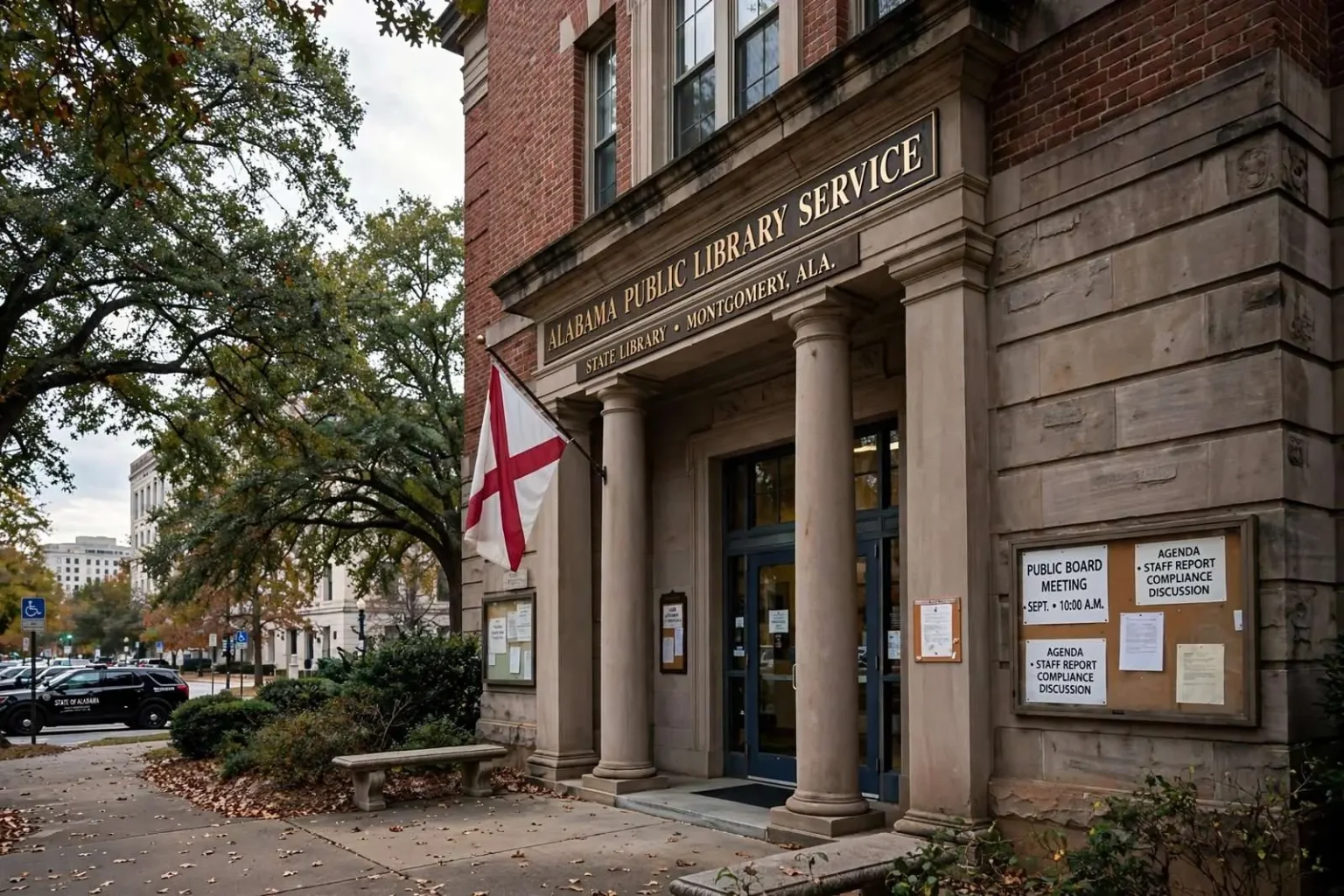
MONTGOMERY, Ala. — Alabama Public Library Service staff advised board members Thursday not to fill a position created to help libraries comply with administrative code changes adopted over the past two years, setting up a disagreement with two of the board’s most prominent members.
Pennie Broussard, who works in the APLS human resources department, told the board she recommended rescinding the job posting without filling it. “We really have no need for this position,” Broussard said. “The agency really has no need for this position. We have got an assistant director, and some of the duties that were mentioned for this position to do are Katie’s (Bailey) duties that she is graded on for her appraisal.”
The position in question was established following revisions to the Alabama Administrative Code that govern public library operations across the state. Those changes, adopted over a two-year period beginning in 2022, introduced new reporting requirements, collection development standards, and compliance metrics that local libraries must meet to maintain state funding eligibility. The proposed compliance role was intended to serve as a liaison between the state agency and the more than 220 municipal and county library systems that depend on APLS for guidance, grants, and certification.
Background on the administrative code changes
The administrative code revisions originated from Act 2022-387, passed by the Alabama Legislature during the regular session and signed by Governor Kay Ivey. The legislation directed the APLS board to promulgate rules establishing minimum standards for public libraries receiving state aid, with particular attention to materials available to minors. The resulting code changes, finalized in late 2023 after a public comment period that drew more than 1,200 submissions, require libraries to adopt written collection development policies, implement age-based access restrictions for certain categories of material, and submit annual compliance certifications signed by the library director and governing board chair.
For many of Alabama’s smaller library systems, these requirements represent a significant administrative burden. The Everett Community Library in Ozark, serving a population of roughly 14,000 with two full-time staff members, previously had no formal collection development policy beyond general guidelines from the American Library Association. The new rules require documented procedures for acquisition, weeding, reconsideration requests, and age-appropriate shelving — all of which must be reviewed and updated annually. Similar challenges face libraries in Monroeville, Eufaula, and Andalusia, where staff wear multiple hats as directors, catalogers, program coordinators, and technology managers.
Board members push back
Board Chair John Wahl, the Republican nominee for lieutenant governor, and board member Amy Minton disagreed with the staff recommendation. Both said they believed the position was necessary after hearing from libraries about the resources required to align with the code.
“I think putting someone in this role that could really work with local libraries, and make sure we go above and beyond, to make sure they do have someone they can lean on and a resource they can use, I think that is good for local libraries,” Wahl said in an interview after the meeting.
Wahl’s position carries particular weight given his role as chair of the Alabama Republican Party and his current campaign for lieutenant governor. His advocacy for the compliance position aligns with a broader legislative push that has seen increased state oversight of public library collections and programming, particularly regarding materials accessible to minors. Minton, a longtime board member from the Mobile area, has similarly emphasized the need for dedicated support to help smaller, rural library systems navigate the new regulatory landscape.
Opponents call it a censorship office
Read Freely Alabama, an organization opposed to restricting access to library books, also argued the position is unnecessary. “Board member Amy Minton admitted that she intends for the ‘sole job’ of the assistant director to be to identify individual books libraries would be forced to censor or lose their state funding,” the organization said in a statement. “This creates a state censorship officer, and expands inappropriate state control over local libraries.”
The group’s characterization reflects a growing national debate over the role of state library agencies in content regulation. In Alabama, the administrative code changes followed the passage of legislation that empowers the APLS board to withhold state aid from libraries that do not comply with standards regarding “age-appropriate” materials. Critics argue that the compliance position would function as an enforcement mechanism for subjective judgments about book content, while supporters maintain it would provide much-needed technical assistance to libraries struggling to interpret the new rules.
Read Freely Alabama has tracked dozens of book challenges across the state since the new standards took effect, with particular concentration in Baldwin, Shelby, and Madison counties. The organization contends that a dedicated compliance officer would accelerate a trend toward centralized control over local collection decisions, undermining the professional judgment of librarians who hold master’s degrees in library science and are trained in collection development according to American Library Association standards.
The Alabama Library Association, the state chapter of the ALA, has also weighed in on the debate. In a position statement released last month, the association expressed concern that a compliance-focused role could create a chilling effect on collection development, leading librarians to preemptively avoid acquiring potentially controversial but educationally valuable materials. The association noted that Alabama already faces a shortage of certified librarians, with 34 counties lacking a single librarian holding a master’s degree in library science, according to data from the State Department of Education.
Director delays decision
APLS Director Kelyn Ralya delayed a final decision because of the concerns raised by Minton and Wahl. Ralya, who has led the agency since 2021, told the board she wanted time to review the staffing analysis prepared by Broussard and to consult with the Alabama Department of Finance, which must approve all new state positions before they can be filled.
The enforcement problem at the center of the dispute stems from the practical reality that APLS, with a staff of fewer than 20 full-time employees, is responsible for monitoring compliance across a library network that serves communities from the Tennessee border to the Gulf Coast. The agency’s current compliance oversight consists of annual reporting forms and periodic site visits, which staff say are insufficient to ensure consistent application of the new standards.
Ralya’s hesitation reflects a broader institutional challenge. APLS has seen its state appropriation remain essentially flat for the past decade when adjusted for inflation, even as the number of libraries in the system has grown and the regulatory expectations have expanded. The agency’s budget for fiscal year 2024 was approximately $3.2 million, of which roughly 60 percent goes to personnel, 25 percent to the statewide library automation system, and the remainder to grants, continuing education, and administrative costs. Adding a new compliance position with salary and benefits would require either a supplemental appropriation or reallocation from existing programs.
Alabama’s public library system operates through a hybrid funding model. The state provides baseline support through the Education Trust Fund, while local libraries rely heavily on municipal and county appropriations, millage referendums, and private donations. State aid represents a critical but variable portion of most library budgets — typically 10 to 15 percent for urban systems like the Birmingham Public Library and the Huntsville-Madison County Public Library, but up to 40 percent for rural libraries in counties like Wilcox, Perry, and Greene, where local tax bases cannot sustain full operations.
This funding dependency gives the APLS board significant leverage over local library policies. When the board adopts administrative code changes, libraries that fail to demonstrate compliance risk losing state aid payments that can amount to tens of thousands of dollars annually. For a small-town library operating on a $150,000 budget, a 30 percent reduction in state support can mean cutting hours, eliminating programs, or reducing book purchases.
The compliance position debate also highlights a structural tension within APLS itself. The agency’s professional staff, many of whom are career librarians with decades of experience in public service, tend to view their role as supportive — helping local libraries succeed. Board members appointed by the governor and confirmed by the Senate often approach the agency with a more directive mindset, seeing state funding as a tool to ensure alignment with legislative priorities. This tension has surfaced in previous debates over library construction grants, broadband expansion, and summer reading program guidelines.
Rural libraries face disproportionate impact
The practical impact of the compliance requirements falls most heavily on rural systems. The Pine Hill Municipal Library in Wilcox County operates 20 hours per week with a single part-time director who also serves as the town clerk. The new annual certification requirement means the director must complete paperwork that previously did not exist, taking time away from patron services. In Coosa County, the Rockford Public Library shares a building with the county courthouse and has no dedicated children’s librarian — the age-based shelving requirements require physical reorganization that the library lacks the staff and shelving units to accomplish.
Urban systems have more capacity to absorb the changes. The Mobile Public Library system, with nine branches and a staff of 85, has assigned a full-time coordinator to oversee compliance implementation. The Jefferson County Library Cooperative, serving 40 municipal libraries in the Birmingham metro area, has retained outside counsel to review its policies against the new code. But these resources are unavailable to the majority of Alabama’s library systems, which serve populations under 25,000.
For now, the position remains unfilled. Ralya said she would bring a revised recommendation to the board’s next meeting, scheduled for September, after consulting with Finance and reviewing whether existing staff can absorb the compliance workload through reallocation. The outcome will signal whether Alabama’s library agency leans toward a service model or an enforcement model in its relationship with the local libraries it was created to support.