Alabama Skips Appeal, Lets Federal Court Weigh Its Near-Total Abortion Ban
Alabama let the deadline pass without appealing the federal injunction blocking its near-total abortion ban, aiming instead to reach the U.S. Supreme Court.
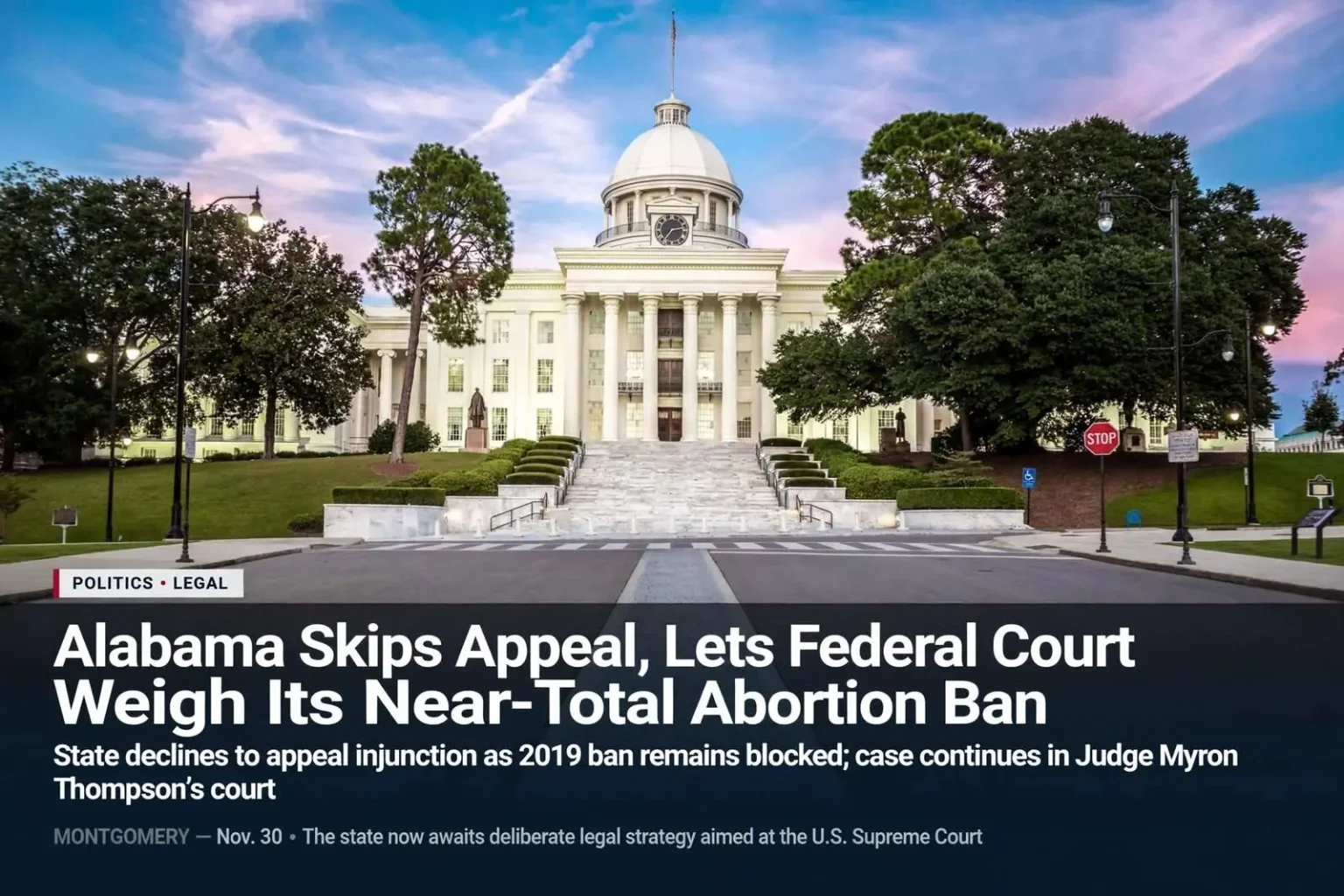
Alabama’s near-total abortion ban will remain blocked by a federal judge after the state chose not to appeal the injunction halting the law while a constitutional challenge plays out in his courtroom. The decision by Attorney General Steve Marshall’s office keeps the 2019 statute unenforced for now and sets the stage for a deliberate, years-long legal strategy aimed squarely at the U.S. Supreme Court.
U.S. District Judge Myron Thompson issued a preliminary injunction that stopped the 2019 law from taking effect on Nov. 15 while he hears a lawsuit challenging it as unconstitutional. The measure would make performing an abortion a felony in almost all cases, a prohibition more sweeping than any other state’s restrictions then on the books. Absent the injunction, the law would have moved Alabama from regulating abortion to criminalizing it, with physicians facing felony charges for procedures that remained legal nationwide under federal constitutional precedent.
A spokesman for Attorney General Steve Marshall confirmed the state did not appeal the injunction before the Nov. 29 deadline, which meant the deadline passed without a notice of appeal and the case stays with Judge Thompson. The choice surprised some observers who expected the state to fight the injunction immediately, but it was consistent with what the attorney general’s office had been signaling publicly for months about its larger aims.
Why the State Waited
Marshall has said the state’s goal is to carry the fight to the U.S. Supreme Court and persuade justices to reconsider Roe v. Wade and Planned Parenthood v. Casey — the rulings that established a nationwide right to abortion and later affirmed it while permitting limited state restrictions. In that framing, appealing a preliminary injunction to a regional appeals court is a detour, not a destination. An intermediate appellate ruling would delay the showdown and could produce a decision that never reaches the Supreme Court on the terms the state wants.
“It will take time to develop a record in support of our arguments that Roe and Casey were wrongly decided and should be overruled,” said Mike Lewis, a spokesman for the attorney general. “And for that reason, we have not appealed the preliminary injunction.” The explanation put the state’s litigation posture in plain terms: Alabama intends to litigate the case in the district court, build a factual and legal record, and position the eventual ruling for Supreme Court review rather than seek a quick appellate fix.
Randall Marshall, executive director of the ACLU of Alabama, noted that the appeal deadline had been Nov. 29, underscoring that the state’s inaction was a deliberate choice rather than a missed date. His organization is among those challenging the law in Thompson’s court, and the group has argued throughout that the ban is flatly incompatible with existing Supreme Court precedent.
The State Has Acknowledged the Ban Is Likely Unenforceable
Underlying the strategy is an acknowledgment the attorney general’s office has already made on the record: the ban is probably unenforceable unless the Supreme Court makes a major shift on abortion rights. In a court filing over the summer, state lawyers wrote that existing precedent “regrettably requires” a judge to block enforcement — an unusually candid concession that the 2019 law conflicts with current Supreme Court rulings legalizing abortion and that Judge Thompson, whatever his personal views, is bound to follow the higher court.
That admission cuts two ways. It clarifies why a district court injunction was nearly inevitable and why appealing it would likely have changed nothing in the short term. It also frames the real battlefield: not the meaning of the Alabama statute, which the state concedes cannot stand under current precedent, but whether five justices can eventually be persuaded to overturn or hollow out the rulings that established the nationwide right in the first place.
For Alabama clinics and the patients they serve, the immediate effect of the state’s decision is continuity. The law does not take effect on Nov. 15 as written, and abortion remains legal in Alabama up to the thresholds set by earlier state restrictions and federal precedent. Providers can continue operating while the constitutional challenge proceeds, though the litigation itself casts a long shadow over long-term planning for anyone in the field.
What the 2019 Law Would Have Done
The statute passed by the Alabama Legislature in 2019 was written to be the most direct challenge available to federal abortion precedent. It would make performing an abortion a felony in almost all cases, with no exception for pregnancies resulting from rape or incest — a deliberate omission by the law’s authors — and exceptions only where the pregnancy seriously risks the mother’s health. The design was intentional: rather than inching toward restriction with waiting periods or gestational limits, the state drafted a flat ban and dared the courts to strike it down.
That approach reflects a belief shared by the law’s sponsors that the Supreme Court’s membership had changed in ways favorable to reversing decades of precedent. Alabama was among the first states to pass a ban of this scope, joining a wave of similarly aggressive measures in other states, and the statute was written with litigation as its primary purpose from the day it was signed.
The Judge and the Case Ahead
Judge Myron Thompson, a longtime federal district judge in Alabama’s Middle District, now presides over the challenge to the law. The preliminary injunction he issued is a standard pre-trial device: it preserves the status quo while the court examines whether the law is likely to be found unconstitutional under existing precedent. In practical terms, the injunction means the felony ban cannot be enforced while the case proceeds, no matter how confident the state is in its long-term strategy.
The record-building the attorney general’s spokesman described will unfold in Thompson’s courtroom through briefing, evidence, and possibly testimony about how the ban would operate if enforced. That process takes time — months at minimum, often longer in a case of this profile — and whoever loses at the district court level would then have the appellate path available, with the state explicitly hoping the destination is Washington. By declining to appeal now, the state avoids an appellate ruling that might decide the case on narrower grounds before the Supreme Court ever considers it.
The Nov. 29 deadline passing without action also removes a layer of uncertainty for clinics and patients in Alabama, who had faced the possibility of a sudden appellate ruling altering the legal landscape mid-litigation. With the state’s posture now public, the near-term schedule belongs to the district court rather than to an appeals calendar.
The Broader National Stakes
Alabama’s decision to play the long game reflects the national stakes attached to its statute. Roe v. Wade, decided in 1973, established a constitutional right to abortion, and Planned Parenthood v. Casey reaffirmed that right in 1992 while allowing states to impose regulations that do not place an undue burden on access. Every state law restricting abortion operates in that framework, and a direct, near-total ban like Alabama’s is designed to give the Supreme Court the cleanest possible vehicle for revisiting it.
Advocates on both sides of the issue see the Alabama case as a potential endpoint of a decades-long legal contest. Supporters of the ban argue that the issue should return to the states and that the Court should correct what they view as an error of longstanding. Opponents argue that reversing the rulings would strip a constitutional protection from millions of women and would immediately criminalize care in states like Alabama. Both camps will now watch a single district court case in Montgomery for signals about how that final argument will be framed.
What It Means for Alabamians Right Now
While the legal strategy unfolds, the practical reality in Alabama is unchanged from the day the injunction issued. The 2019 ban is blocked; performing an abortion remains lawful under the restrictions that predated it; and providers continue to serve patients at the state’s remaining clinics. The state’s choice not to appeal means no looming deadline threatens that status quo, giving patients and providers a measure of predictability that the litigation rarely allows.
At the same time, the attorney general’s stated goal — persuading the Supreme Court to overrule Roe and Casey — means the current stability is explicitly temporary by design. The state is not defending the ban as enforceable law under today’s precedent; its own filing concedes the opposite. It is building toward a future ruling that would change the precedent itself. For residents of a state where the legislature has passed some of the most restrictive abortion measures in the country, the difference between those two postures is the difference between a law in effect and a law in waiting.
The ACLU of Alabama and the other challengers, for their part, will use the district court proceedings to make a record that supports keeping the injunction in place under current law, even as they prepare for the possibility that the case travels upward. Randall Marshall’s observation that the deadline came and went serves as a reminder that every stage of this litigation is being watched, by advocates and officials alike, for what it reveals about the endgame both sides anticipate.
A Test Case Defined by Patience
The uncommon feature of Alabama’s litigation strategy is patience. Most states defend their laws the conventional way — appealing injunctions, fighting through the circuits, preserving arguments for appeal. Alabama is doing the opposite, accepting a district court loss it concedes is required by existing precedent in order to reach the only court that can change that precedent. Whether the gamble pays off depends on justices who have not yet agreed to hear the case, on a record that is only beginning to be built, and on the outcome of a trial-court process that will take months or years to complete. In the meantime, the ban remains what it has been since Judge Thompson blocked it: a law passed, signed, and waiting — but not in effect.