
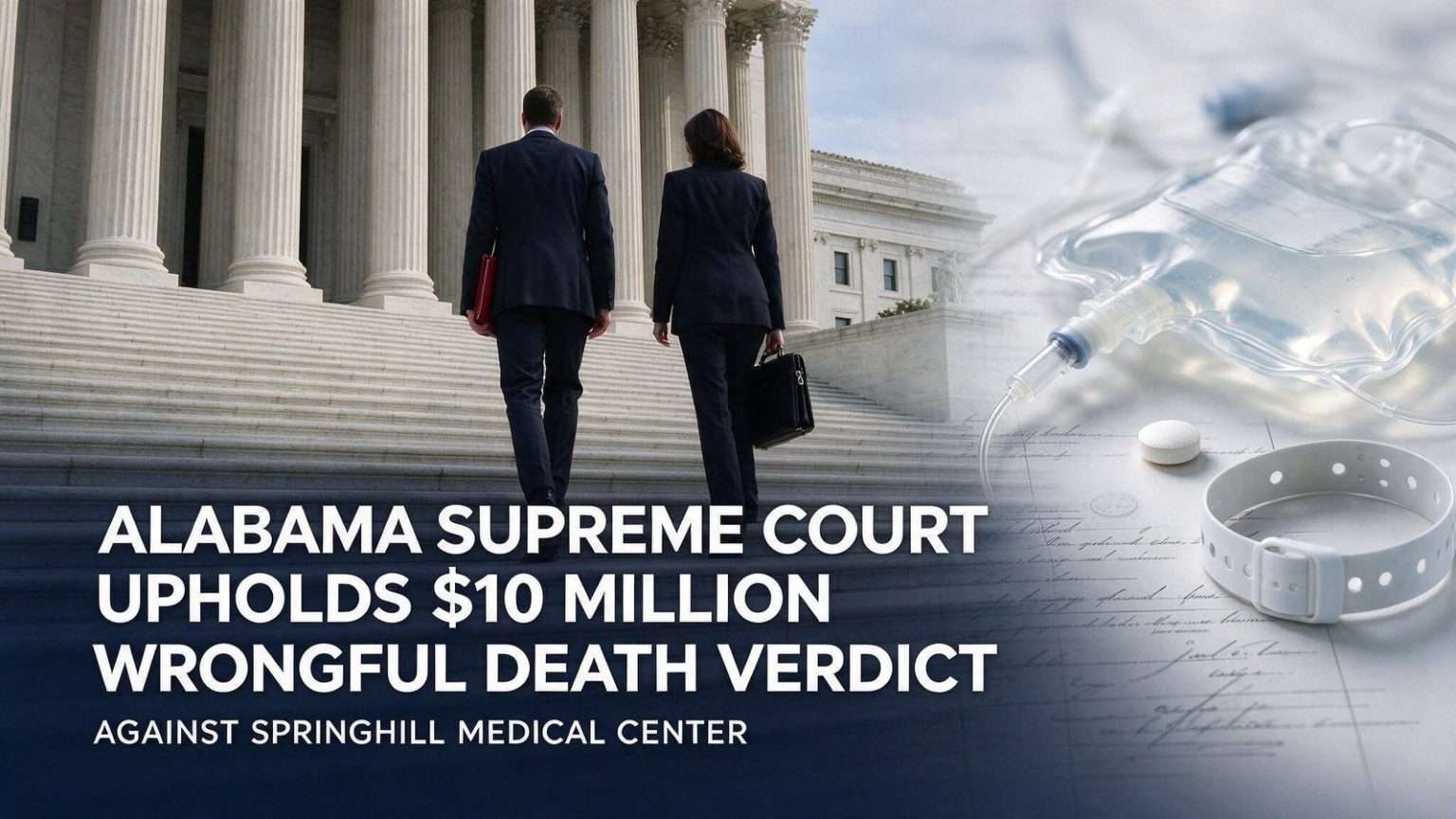
The Alabama Supreme Court has affirmed a $10 million judgment against Springhill Medical Center in Mobile, marking the largest amount ever upheld by the state’s highest court in a single wrongful death lawsuit.
The case stemmed from the 2014 death of Jay West, who died in the hospital after a routine thumb surgery. According to attorneys at Cunningham Bounds, who represented West’s family, West had cut the tip of his left thumb while working at his cabinet shop on June 14, 2014. He drove himself to Springhill Medical Center, where doctors surgically repaired the injury.
What should have been an uncomplicated evening of recovery became instead the case that now anchors Alabama’s medical-malpractice case law. The affirmance closes a legal chapter that began with a workshop accident in west Mobile and ended with the state’s highest court putting its weight behind one of the largest verdicts in Alabama history, and it delivers a message to hospitals statewide about the standard of care required when patients are prescribed powerful pain medication.
A Fatal Dose of Pain Medication
After the procedure, a surgeon prescribed West Percocet for pain and ordered up to 4 milligrams of IV Dilaudid as a backup. West was transferred to the hospital’s orthopedic floor for the night and was scheduled to go home the next day. Within 10 hours of surgery, West was found dead in his hospital room.
Attorneys said his nurse had administered 4 milligrams of IV Dilaudid, then gave him another 4 milligrams less than two hours later. After the second dose, West was not monitored by any member of the nursing staff.
The details of that night form the factual core of the case. Dilaudid, known generically as hydromorphone, is a powerful opioid several times stronger than morphine, and it suppresses breathing as it suppresses pain. An overdose does not announce itself; a patient simply drifts toward respiratory depression, which is why clinical guidelines emphasize spacing, dosage limits, and — above all — monitoring. A patient receiving two full doses within two hours, with no staff checks afterward, was left without the safety net that every published standard describes as essential.
For West’s family, the sequence raised a question that litigation would spend nine years trying to answer: how a healthy man admitted for a thumb repair could die overnight in a hospital room without anyone noticing until morning.
Failure to Follow Safety Guidelines
According to the Sentinel Event Alert published by the Joint Commission for Accreditation of Healthcare Organizations, West should have been identified as being at high risk for opioid-induced respiratory depression. Attorneys argued that Springhill Medical Center failed to implement safety measures or provide training to its nursing staff on protecting patients from the dangers of opioid-induced respiratory depression.
The Joint Commission occupies a central place in that argument. The independent accrediting body evaluates and certifies the overwhelming majority of American hospitals, and its Sentinel Event Alerts are distributed precisely so that facilities can correct known, recurring dangers before they kill again. The alert at issue catalogued the risks of opioid overdoses in hospital settings and described the monitoring practices — continuous assessment of sedation and respiratory status, capnography where appropriate, and clear protocols for combining opioids — that make such deaths preventable.
Attorneys for the family argued the hospital had none of it in place that night: no meaningful identification of high-risk patients, no training reinforced in the nursing staff, no protocol that flagged two rapid Dilaudid doses as a warning. The Mobile County Circuit Court jury agreed, and the trial court’s rulings survived every stage of appeal up to and including the state’s highest court.
Nine Years of Litigation
Brian Duncan, one of the attorneys who represented the West family, said the case took nine years to resolve. “Mrs. West deeply values the dedication and bravery demonstrated by every juror involved in the case,” Duncan said. “She expresses her heartfelt gratitude for the Alabama Supreme Court’s affirmance of the Mobile County Circuit Court’s rulings. After a nine-year legal battle, the family finally has the accountability they sought from the very beginning.”
The nine-year timeline tells its own story about how medical-malpractice cases move through Alabama’s courts. From the initial filing, through discovery, trial, post-judgment motions, and successive appeals, each stage consumed years — a familiar pattern in cases against institutional defendants, which can afford sustained litigation in ways individual families cannot. The Alabama Supreme Court’s affirmance ended that process definitively, leaving the $10 million judgment standing and foreclosing further review.
That finality carries significance beyond the West family. By upholding the verdict, the court effectively ratified the trial record — including the expert testimony about monitoring standards and the hospital’s own documents — as a template other plaintiffs can point to. Verdicts of this size are rare in Alabama, where damages caps and appellate scrutiny have historically limited recovery in medical cases, which is what makes the court’s embrace of this one notable.
The Opioid Safety Context
The case lands amid a national reckoning with opioid safety that has transformed hospital practice over the past decade. Pain management was long treated as a patient-satisfaction metric, with nurses encouraged to keep patients comfortable and medication flowing. The consequences — respiratory depression, overdoses, deaths on ordinary hospital floors — became a documented pattern that regulators and accreditors spent years working to reverse.
Hospitals across the country have since adopted continuous monitoring for high-risk patients, standardized opioid order sets, and mandatory staff training on recognizing over-sedation. The West case stands as an Alabama example of what happens when those measures are absent: a routine procedure, a standard prescription, and a death that an alert nurse checking at reasonable intervals would likely have prevented.
For patients and families, the practical lessons are sobering. A hospital admission for minor surgery still involves potent medications whose risks compound quickly, and the public typically has no way of knowing whether the facility caring for them has implemented the monitoring standards regulators recommend. Verdicts like this one function as an enforcement mechanism of last resort, converting abstract guidelines into financial consequences that hospital boards cannot ignore.
What the Ruling Means in Mobile
For Springhill Medical Center, the affirmance closes the legal question but leaves the institutional one open. The hospital, which serves communities across west Mobile and beyond, now carries both the financial judgment and the public record of what the jury heard about its practices in June 2014. Hospitals that face verdicts of this magnitude typically respond with the very measures at issue in the case — revised opioid protocols, monitoring technology, and retraining — and the decade of national patient-safety reform since West’s death has given them an established playbook.
For Cunningham Bounds, the Mobile firm that carried the case from filing through the state’s highest court, the outcome adds to a record of high-stakes litigation on behalf of Alabama families. The firm’s attorneys emphasized throughout that the case was never only about one night or one patient; it was about whether the standards published to prevent exactly this kind of death carry any force inside Alabama hospitals unless a jury makes them matter.
The ruling also resonates locally because of who Jay West was. He was not an elderly patient with complicating conditions; he was a craftsman who cut his thumb at the cabinet shop where he worked, drove himself to the emergency room, and expected to be home the next afternoon. The ordinary nature of the admission is precisely what made the outcome so difficult for the family to accept, and so persuasive to the jurors who heard the evidence.
Alabama’s appellate courts have now spoken on the record the trial built. A $10 million judgment, the largest the state’s highest court has ever upheld in a single wrongful death suit, is a measure of both the loss and the lapse. For hospitals across the state, the arithmetic is hard to miss: the cost of training nurses and following published monitoring standards is a rounding error compared with the cost of the alternative.
The broader lesson for Alabama patients is worth stating plainly. Sentinel Event Alerts, hospital accreditation standards, and nursing protocols only protect people when institutions commit to them in practice — in the staffing schedule, the training calendar, and the equipment budget. Families choosing a hospital for a procedure can and should ask direct questions about how opioid safety is handled on the floors where they will recover, because the West case demonstrates what the answer can mean.
Nine years after a cabinet maker cut his thumb on a June afternoon, the state’s highest court has affirmed what a Mobile County jury concluded after hearing all the evidence: the death was preventable, and preventability has a price. The judgment stands. The records now show why. And the standards that were ignored that night in 2014 are, in every hospital that chose to learn from cases like this one, the first thing a newly hired nurse is trained on.


