
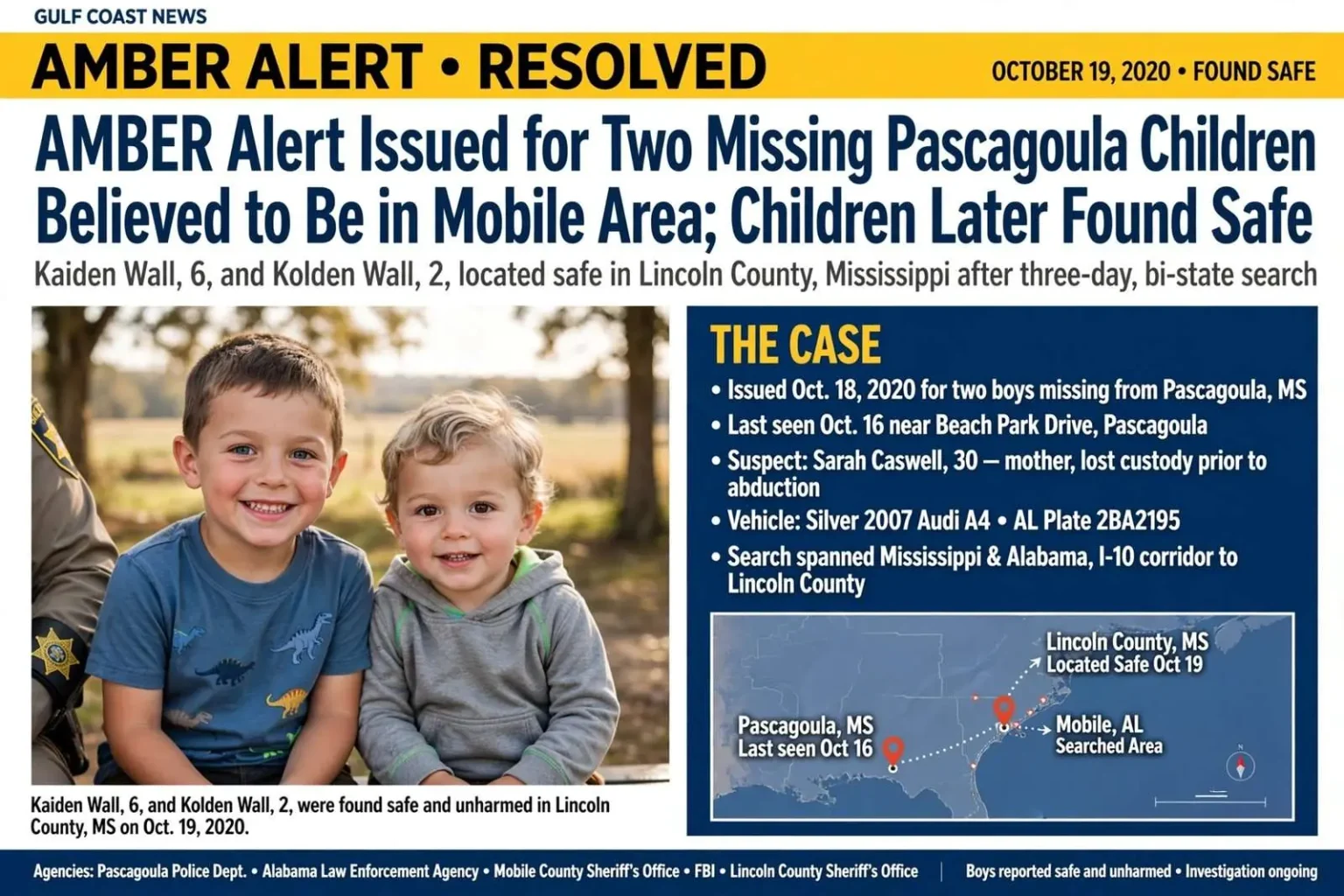
An AMBER Alert was issued on October 18, 2020, for two young boys from Pascagoula, Mississippi, who were believed to be in the Mobile, Alabama area. The children were later located safe in Mississippi. The case, which scrambled law enforcement on both sides of the state line for days, ended with the boys found unharmed — but it also exposed the tensions and time pressures that shadow every AMBER Alert activation along the Gulf Coast.
The Alabama Law Enforcement Agency (ALEA) issued the Child Abduction Emergency on behalf of the Pascagoula Police Department for Kaiden Wall, 6, and Kolden Wall, 2. The alert blasted across phones, highway signs and broadcast media in Alabama because investigators believed the children had been carried into the Mobile area, making the case a genuinely bi-state operation: Mississippi authorities sought the boys, while Alabama agencies, particularly in Mobile County, watched for the vehicle described in the alert.
The boys were last seen on October 16 at approximately 5:21 p.m. in the area of Beach Park Drive in Pascagoula. Beach Park sits near the heart of the city, close to the waterfront that gives Pascagoula its identity, and the Friday-evening sighting was the last confirmed trace of the children before the search widened across two states.
The search for the boys
According to authorities, the boys were abducted by Sarah Caswell, 30, who the Mobile County Sheriff’s Office identified as the children’s mother. MCSO stated that Caswell had lost custody of the boys prior to the abduction. The children were taken from their foster home in Pascagoula on Friday. That custody history shaped the investigation from the start, giving authorities a clear person of interest and a likely motive — a custodial abduction — while also complicating the response, since family abductions follow different patterns than stranger abductions and often involve travel to relatives or familiar places across state lines.
Caswell was believed to be traveling in a silver 2007 Audi A4 2.0 with Alabama tag number 2BA2195 and may have been in the Mobile area. The Alabama plate was a telling detail: it suggested the vehicle’s registered home was on the Alabama side of the line, feeding investigators’ belief that Mobile County was a likely destination. The description went out across both states, and drivers along the Interstate 10 corridor — the main artery linking Pascagoula to Mobile — were asked to keep watch for the silver sedan.
The Mobile County Sheriff’s Office said it was working alongside the FBI on the case. Federal involvement is standard in child abduction cases that cross state lines, bringing resources that a local department alone cannot muster: the FBI’s child abduction response teams, national databases, and coordination channels that reach beyond the Gulf Coast if the vehicle traveled farther. For a case centered on Pascagoula but aimed at Mobile, that partnership placed Mobile County deputies at the center of the search.
Timing questions around the alert
Capt. Paul Burch of MCSO expressed frustration with the timing of the AMBER Alert, noting that it was issued at a time when many people were asleep. He said the department had attempted to get a second alert sent out but was told by AMBER Alert officials that no new information warranted an additional notification. The complaint touched on one of the system’s enduring tensions. AMBER Alerts are deliberately rationed — the criteria are strict, and officials resist re-issuing or duplicating alerts without substantive new details, in part because overuse dulls the public’s response. But for the agencies hunting a missing child, every hour that passes without fresh public attention is an hour the trail grows colder, and an overnight alert that most sleeping residents never saw was, in Burch’s view, a missed window.
The AMBER Alert system itself takes its name from Amber Hagerman, a 9-year-old Texas girl abducted and murdered in 1996, and it now operates in every state as a voluntary partnership between law enforcement, broadcasters and transportation departments. Alerts interrupt radio and television programming, ping wireless phones in a targeted geographic area and light up highway message signs. Activation requires reasonable belief that a child has been abducted, that the child faces serious danger, and that descriptive information exists that could help locate them — criteria this case plainly met once the details of the foster-home taking were confirmed.
For Gulf Coast residents, the October 2020 alert was a familiar interruption: the phone buzz, the sign over the interstate, the description of a vehicle to watch for. Whether those interruptions shorten cases is the subject of ongoing debate among researchers, but investigators in Mobile County argued that the eyes of the public were the single most valuable resource in a search like this one — and that the public needed to be awake to help.
Found safe in Mississippi
Update (October 19, 2020): Kaiden Wall, Kolden Wall, and Sarah Caswell were located and reported safe in Lincoln County, Mississippi, according to authorities. The resolution, roughly three days after the boys were last seen in Pascagoula, brought the bi-state search to a close with the outcome every AMBER Alert activation hopes for: children recovered alive and unharmed. Lincoln County sits in southwest Mississippi, near Brookhaven along the I-55 corridor — a considerable distance from the coast, and a reminder that abducted children can travel farther and faster than the initial search radius assumes.
The ending was a relief to the agencies involved and the communities that had followed the case, but it left the underlying circumstances — the custody battle, the foster placement, the taking — to be sorted through the courts and child-welfare systems on the Mississippi side. Custodial abductions by a parent who has lost custody remain among the most common AMBER Alert scenarios nationwide, and each one sets off the same tri-state machinery this case did.
Anyone with information about missing children is encouraged to contact local law enforcement or call 911. The instruction is the permanent footnote of every alert: the system works only when the public participates, reporting sightings of the child, the vehicle or the suspect. In this case, the machinery of two states, a sheriff’s office, an FBI partnership and an alert that reached a million phones ended where it always hopes to — with two little boys found safe.
How a Gulf Coast AMBER Alert unfolds
When a child is reported abducted in Pascagoula and the trail points toward Alabama, the response follows a choreography that area agencies have practiced for years. The requesting department — here, the Pascagoula Police Department — supplies the case details to the state alert coordinator, who evaluates the activation criteria and, once satisfied, pushes the alert through the statewide systems. Because the suspect vehicle carried an Alabama plate and was believed to be heading toward Mobile, ALEA became the activating agency for Alabama’s alert, blanketing the coastal counties with the Child Abduction Emergency message that appeared on phones and highway signs from the state line to the Bay.
Meanwhile, the investigative work split into parallel tracks. One traced the suspect’s likely route and destinations, working from family connections, phone records and any sightings reported along the corridor. Another worked the public-facing angle: press releases, social media posts from the sheriff’s office and police department, and coordination with media outlets to keep the vehicle description in front of drivers. The FBI’s involvement added a national layer, ensuring that if the silver Audi turned up hundreds of miles away, the description was already in the systems that troopers and deputies everywhere consult.
For Mobile County, the case was personal as well as procedural. The Mobile County Sheriff’s Office put its own captain’s voice on the case, and the department’s familiarity with missing-child operations — an unfortunate specialization for any large county agency — showed in how quickly it mobilized. Deputies knew the argument they needed to make about public attention, and they made it publicly when the second alert was declined.
What the case left behind
The safe recovery in Lincoln County closed the emergency, but cases like this one tend to echo. In Pascagoula, a foster family lost the children in their care to a Friday-evening taking; in Mobile, an alert that arrived in the night tested how a metro area responds when the description lands while the city sleeps; and in southwest Mississippi, a mother and two boys were found hundreds of miles from where anyone was looking. Each strand belongs to a different system — child welfare, emergency management, law enforcement — and the case touched all three before it ended.
For residents of the Gulf Coast, the practical takeaways are the ones that repeat with every alert: keep the wireless emergency alerts enabled on phones, read the vehicle description when one appears on a highway sign, and remember that the first hours matter most. The AMBER Alert network exists precisely because one attentive driver with the right description can end a search before it begins — and in this case, whatever role the public’s eyes played, the search ended with the best possible result: Kaiden and Kolden Wall, found safe.


