
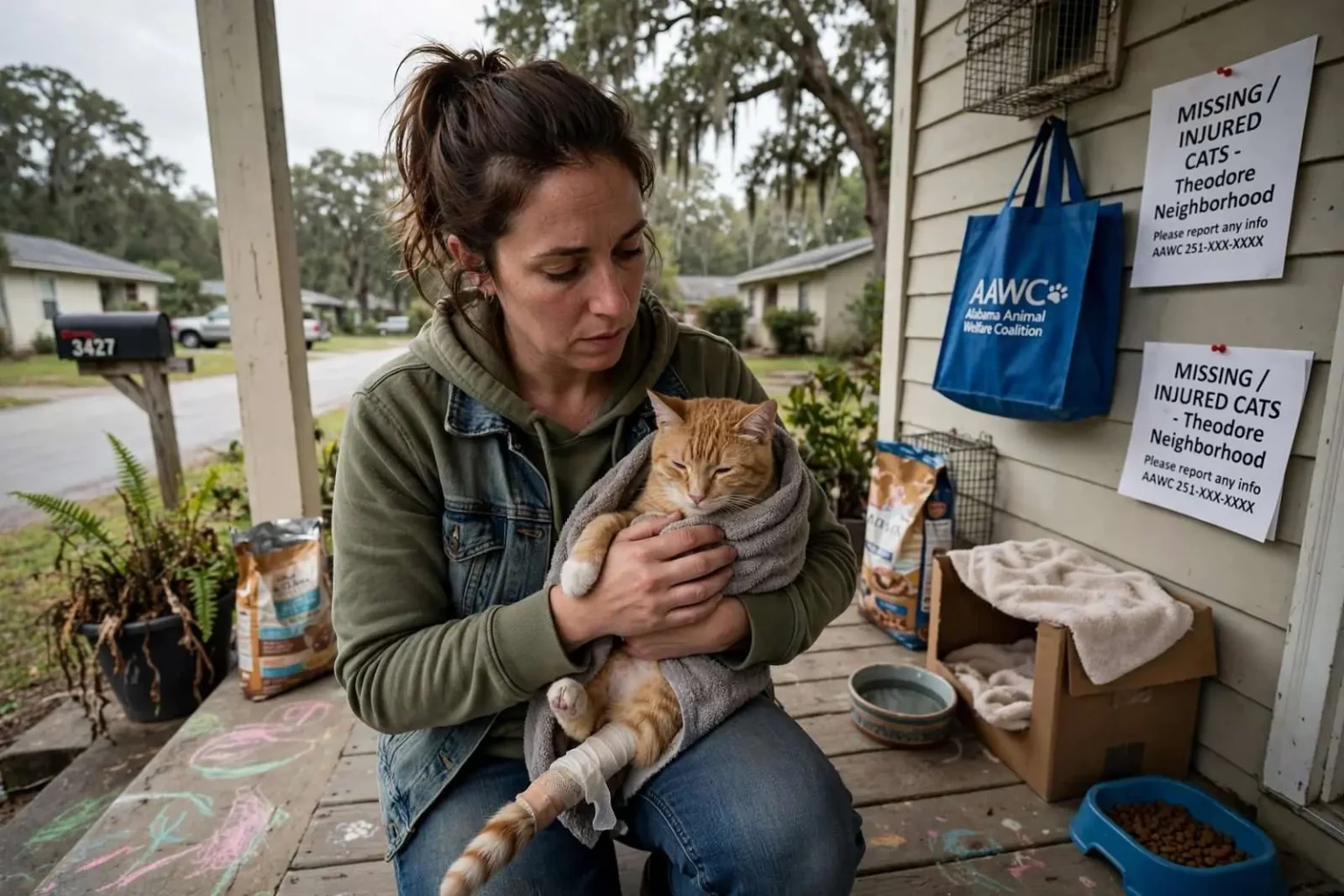
An animal welfare organization is raising alarms after at least four cats in a Theodore neighborhood were found with their tails apparently cut off, and residents fear someone is deliberately mutilating the animals. The Alabama Animal Welfare Coalition (AAWC) posted to its Facebook page over the weekend with photos of two of the injured cats, calling the situation “extreme” cruelty. The organization says the cats are friendly neighborhood strays that residents regularly feed and care for.
Theodore, an unincorporated community south of Mobile along U.S. Highway 90 and the Theodore Industrial Canal, is the kind of place where outdoor cats are part of the neighborhood’s daily rhythm. Residents leave out food on porches, know which cat belongs to which yard, and look out for the strays that nobody owns but everybody feeds. That familiarity is what made the discovery so disturbing: the injured animals were not anonymous ferals but cats with names, routines and people who had been caring for them for years.
Resident Discovers Injured Cats
Hope Brown, a mother of three, said the disturbing discovery began Sunday night when a cat she regularly feeds came to her family’s porch in visible pain. “It was bloody and missing its tail,” Brown said. She initially assumed the injury was an accident, but within hours a second cat appeared on the porch also missing part of its tail. “The next day, two more cats came up, tail-less,” Brown said. She filed a police report and contacted the AAWC for help.
The pattern was what unsettled her. A single injured cat might mean a car strike, a dog attack, or an entanglement with something sharp — the ordinary hazards that outdoor cats face. Four cats turning up in roughly the same span of time, all with the same injury, all from the same small area, pointed to something else. Trauma from traffic or animals does not present identically across multiple victims in a single neighborhood, and the clean nature of the injuries suggested to those who saw the cats that a blade, not an accident, was involved.
Porches became the neighborhood’s field hospital by default. Because the cats were strays that residents fed rather than pets with owners, there was no household responsible for their veterinary care — and no household with the means to shoulder it alone. That gap is what turned a disturbing discovery into a community response, with the people who fed the cats becoming the people responsible for getting them help.
Animal Welfare Group Responds
Kristy Mobley, a board member for the Alabama Animal Welfare Coalition, came to Brown’s neighborhood after being contacted. Mobley said the injuries appeared intentional. “Cutting off on purpose the tails of these animals — I don’t know if I’ve ever seen anything like that,” Mobley said.
Two of the four cats were captured and taken to a veterinarian for treatment. The other two remained at large at the time of the report. The AAWC set up a fundraiser to help cover veterinary costs for the injured animals.
Capturing an injured stray is harder than it sounds. Cats in pain are frightened animals, and a cat that has been deliberately hurt by a person has learned, in the most direct way possible, that humans can be dangerous. Rescuers rely on traps, patience and the cats’ trust in the people who feed them. Every cat secured meant antibiotics, pain management, an examination for deeper injury and a decision about what its future would be once treated; every cat still loose meant continued pain and, possibly, a worsening infection, since untreated tail injuries in animals can turn septic.
The Alabama Animal Welfare Coalition operates in exactly this space — the gap between what individual residents can do and what injured or abused animals need. Organizations like it across Mobile County absorb the costs of veterinary treatment for animals with no owner, coordinate foster placements, and document cases that may later matter to law enforcement. The Facebook post that publicized the Theodore case serves two purposes at once: raising money for the cats’ care and making sure the community is watching for whoever did this.
The police report Brown filed matters beyond paperwork. Deliberate mutilation of an animal is a crime in Alabama, where the state’s animal cruelty statutes cover both neglect and intentional harm, with felony-level penalties available for aggravated cruelty to dogs and cats. Cases involving multiple victims, a pattern of conduct and an identifiable location give investigators something to work with — but only if the conduct is reported promptly and witnesses come forward. Animal welfare groups stress that documentation, including photographs and veterinary findings, is what separates a rumor from a case.
Community on Edge
Brown said the situation has left her worried about the safety of her children and the broader community. “It’s scary to think that we have somebody that’s this cruel that lives in our neighborhood,” she said. “Cats I feel like are small and defenseless in the same way that children are.”
Brown said she now keeps a close watch on her children, unsettled by the knowledge that someone capable of harming animals may be living nearby. Research has long shown a correlation between animal cruelty and violence toward humans, a fact that has added to the neighborhood’s unease.
That research — cited for decades by law enforcement and psychologists — links acts of deliberate cruelty to animals with a heightened risk of violence against people, and it is the reason animal cruelty is treated as a serious-crime indicator rather than a nuisance complaint. For a mother of three in a quiet neighborhood, the logic is visceral rather than academic: whoever did this to four cats in a matter of days is someone the community lives near, and no one yet knows who.
The neighborhood’s response has followed the pattern that residents of close-knit communities fall into when something like this happens. People are watching for strangers, comparing notes about which yards the cats frequent and when the injuries appeared, and keeping food stations in sight of their homes. The cats that remain at large are being monitored by the people who feed them, with word passing quickly whenever one is seen. Nobody in the neighborhood is treating this as an animal problem alone anymore; they are treating it as a question about a person.
For the AAWC, the case is the kind that defines the work. Rescue organizations in south Alabama operate with thin margins and volunteer labor, responding to hoarding situations, abandonment, injury and abuse across a county that stretches from the Mississippi line to the bay. A case involving deliberate mutilation demands the most expensive and emotionally taxing part of that mission: emergency veterinary care for animals nobody is legally responsible for, followed by placement decisions for cats that may carry lasting physical damage.
The fundraiser the organization established covers the immediate veterinary bills, but the broader costs of a case like this are harder to tabulate. Injured strays that recover often cannot simply be returned to the streets they came from, particularly if their injuries leave them vulnerable. That turns a cruelty case into a placement problem — fosters, rescues and adopters must be found, each one a commitment measured in years. The volunteers who feed neighborhood cat colonies in Theodore and communities like it across the county now face the added burden of wondering whether the animals they look after will come home injured.
Animal welfare advocates use cases like this one to make a standing point: cruelty thrives where it goes unreported. A single injured cat on a porch can be rationalized as an accident, as Brown initially did; it took four cats and a pattern before anyone fully understood what was happening. The organization’s public posting of the case — photos included — is designed to shorten that discovery period if it happens again, either in this neighborhood or another. Residents who see an injured animal are encouraged to report it to law enforcement and to contact rescue organizations rather than waiting to see whether the pattern repeats.
Meanwhile, the two cats in veterinary care face their recoveries, the two still at large remain under the neighborhood’s watch, and the police report sits with investigators. Someone in or near this Theodore neighborhood harmed at least four animals that the community had adopted as its own. Until that person is identified, the porches where food bowls sit will stay watched, the children will stay closer to home, and the organization that took on the cats’ care will keep reminding the public that “extreme” is not an overstatement for what happened on a quiet street in Theodore.
The case also underscores how much of animal protection in unincorporated Mobile County happens informally. With no municipal animal control presence of the scale found inside city limits, residents who feed strays, file police reports and call rescue organizations effectively serve as the first responders for the area’s animals. Neighborhood by neighborhood, that unpaid network is what stands between an injured cat and the ditch — which is why the AAWC’s willingness to step in when a resident calls matters so much to the people on the porch.


