
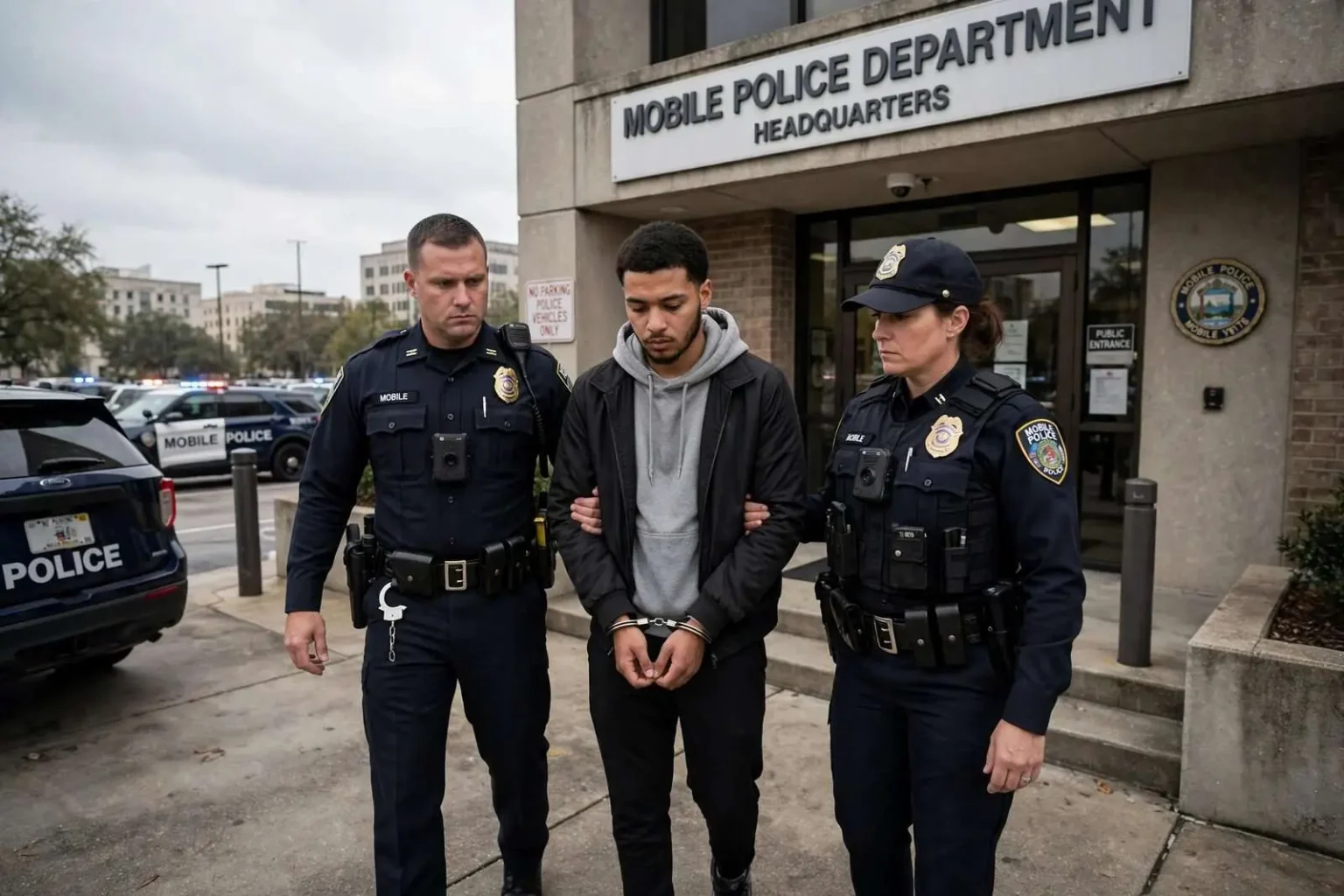
MOBILE, Ala. — Mobile police have taken into custody a suspect in a fatal shooting at USA Health University Hospital that killed a 47-year-old man in April. Algernon Grayson, 22, was escorted to Mobile Police headquarters Thursday afternoon and is expected to be formally charged with murder and shooting into an unoccupied vehicle in connection with the April 17 incident.
The arrest brought to a close the first phase of an investigation that had drawn attention not only because of where the shooting occurred — inside one of the city’s major medical institutions — but because of what it revealed about the criminal history of the man now accused. Homicide investigators with the Mobile Police Department subsequently identified Grayson as their suspect, according to a police news release, and his transfer to headquarters marked the transition from investigation to prosecution.
Shooting into an unoccupied vehicle, the second expected charge, is treated seriously under Alabama law because of the randomness of the danger it creates: a bullet fired at an empty car can strike a passerby, a nearby home, or, as authorities allege happened in this case, a person no one intended to hit. The charge pairing with murder suggests investigators reconstructed a chain of events in which gunfire aimed indiscriminately ended in a death inside the hospital itself.
What Happened at the Hospital
Officers responded to University Hospital in the early-morning hours of April 17 and found Robert McMillian, 47, suffering from multiple gunshot wounds. McMillian was being treated at the hospital but died as a result of his injuries. The circumstances — a shooting victim already inside a hospital emergency environment when officers arrived — made the scene unusually complex for first responders, who had to balance the criminal investigation with the ongoing medical care of a patient in critical condition.
USA Health University Hospital serves as a major trauma center for the region, treating patients from across Mobile and the surrounding Gulf Coast counties. Because of that role, the facility is a frequent destination for gunshot victims transported by ambulance or private vehicle, and its staff routinely works alongside police in cases like this one. A violent death on the hospital campus nonetheless stands apart, raising immediate security questions for an institution whose corridors are normally open to the public at all hours.
For hospital staff, the incident underscored the realities of caring for victims of street violence. Trauma teams see the consequences of shootings every week, but a death on the premises transforms the hospital from a place where violence is treated into a crime scene, involving hospital security, police investigators, and forensic teams in a shared space designed for healing rather than evidence collection.
Grayson’s Prior Criminal History
Grayson has an extensive criminal history in Mobile County. He was booked on a manslaughter charge in 2016, pleaded guilty, and was sentenced to 15 years in prison, arrest records show. He was also arrested twice in the county in 2022, before the hospital shooting.
The first of those 2022 arrests came on March 10, when he was charged with attempting to elude, an offense that typically arises from a driver’s refusal to stop for law enforcement. The second occurred on May 4, when he was one of three people arrested during a SWAT raid at a Prichard home on charges that included possession with intent to distribute crack cocaine and methamphetamine, marijuana trafficking, and possession of a controlled substance. The raid charges positioned Grayson within the drug enforcement cases that authorities in Mobile County prosecute aggressively, given the connection between narcotics distribution and violent crime across the region.
For investigators, that history formed the backdrop of their search for the hospital gunman. Detectives working homicide cases routinely move between witnesses, surveillance footage, and suspects’ known associates to assemble a case, and a suspect with prior violent and drug charges presents multiple investigative threads — parole records, known addresses, prior co-defendants — that can accelerate identification.
How the Investigation Proceeded
The gap between the April 17 shooting and Thursday’s arrest reflects the pace of a careful homicide investigation. Detectives would have needed to establish not only who fired the shots but the sequence that brought the confrontation to the hospital, gathering evidence sufficient to support murder charges and the additional shooting-into-an-unoccupied-vehicle count. Mobile police’s homicide unit carries some of the heaviest caseloads in Alabama, a consequence of the city’s persistently elevated gun violence, and investigators balance speed against the need for cases that survive courtroom scrutiny.
The announcement of the arrest was made through a police news release rather than a public event, consistent with the department’s practice of reserving detailed discussion for charging documents and court proceedings. Formal charges are expected to be lodged as the case moves into the court system, where a judge will determine bond and where prosecutors will lay out the evidence supporting both counts.
The Broader Context of Hospital Violence
The case joins a national pattern of violence that follows gunshot victims into medical facilities. Hospitals across the country have responded by tightening visitor screening, expanding security presence in emergency departments, and coordinating with police when patients arrive with injuries that suggest ongoing disputes. The tension is real: emergency departments must remain accessible to the dying and the injured, yet the same openness makes them difficult to secure against the conflicts that produce the wounds being treated.
Mobile’s experience mirrors that of comparable Southeastern cities confronting elevated rates of gun homicide. Local violence-prevention discussions in recent years have ranged from increased police staffing to community intervention programs aimed at interrupting retaliatory cycles. Each fatal shooting feeds that debate, and a killing that reaches the hospital campus — a place residents of every neighborhood pass through — tends to sharpen the sense that gun violence respects no boundaries.
How Residents Can Help
Anyone with information on the hospital shooting is encouraged to call Mobile police or contact CrimeStoppers of the Gulf Coast. CrimeStoppers allows tipsters to provide information anonymously, with rewards available for tips that lead to arrests, and the program has long served as a bridge between residents hesitant to get involved and investigators who need witnesses to close cases.
That call for tips serves a second purpose beyond this arrest: strengthening the prosecution. Homicide cases are built on corroboration, and witnesses who come forward after an arrest — even weeks or months after the event — can provide the additional detail that resolves what surveillance video and forensic evidence cannot. Authorities in Mobile routinely emphasize that community cooperation remains the single most important factor in solving and prosecuting violent crime.
For the family of Robert McMillian, the arrest represents the first concrete step toward accountability after a death that began, as so many do, with gunfire and ended in an emergency room. The courts will now take up the case that police detectives spent the spring assembling, and the charges — murder and shooting into an unoccupied vehicle — will be tested against the evidence gathered from the early-morning hours of April 17 at University Hospital.
Inside the Response That Morning
The early-morning timing of the April 17 call shaped the response officers encountered. Overnight hours in hospital emergency departments bring a predictable mix of trauma patients, and a gunshot victim arriving in the middle of the night triggers a protocol in which police and medical staff move in parallel: officers secure the scene and begin interviews while trauma teams work on the patient. That McMillian was already under treatment when officers located him suggests he was transported to the hospital before police could reach the site of the shooting itself, a common pattern in urban gun violence.
Treating a patient with multiple gunshot wounds strains even an established trauma system. Surgeons, blood banks, and imaging staff mobilize simultaneously, and outcomes depend on the speed of that mobilization. When the patient dies despite those efforts, the medical record itself becomes part of the eventual murder case, documenting the nature of the wounds that investigators must connect to the weapon and the moment of firing.
The presence of a second expected charge — shooting into an unoccupied vehicle — gives the public the clearest glimpse of the reconstructed sequence. It indicates that at least some of the gunfire in the case was directed at a car no one was inside, and that the fatal shots at the hospital followed from that indiscriminate shooting rather than from a confrontation witnessed by bystanders. Cases of that shape are notoriously difficult to piece together, relying on forensic reconstruction and careful timeline work to establish who fired what, and when.
What Comes Next in the Case
With Grayson in custody and formal charges expected, the case moves into the machinery of the Mobile County court system. Arraignment will follow the filing of charges, at which point the defendant enters a plea and the court addresses bond. Murder prosecutions in Alabama carry the state’s most serious potential penalties, and cases involving deaths on public institutional property typically receive close prosecutorial attention because of the broader security implications for the facility involved.
Defense proceedings will also examine the investigative record — how investigators identified Grayson, the reliability of the evidence linking him to the shooting, and the procedural integrity of the arrest. That scrutiny is standard in every homicide case and explains why police departments invest heavily in documentation during the weeks between a killing and an arrest. The department’s decision to announce the arrest through a formal news release, rather than a press conference, keeps the public record to the verified essentials while the legal process unfolds.
For now, the practical information for residents remains what police have stated: the suspect in the April 17 death at University Hospital is in custody, formal charges of murder and shooting into an unoccupied vehicle are expected, and anyone with additional information is urged to come forward through Mobile police or CrimeStoppers of the Gulf Coast. The arrest closes an investigative chapter; the case’s resolution now belongs to the courts.


