Arrest made in Monroeville murder investigation
An arrest has been made in the killing of Dylan Haimes at a Monroeville motel, the Monroe County Sheriff's Office said.
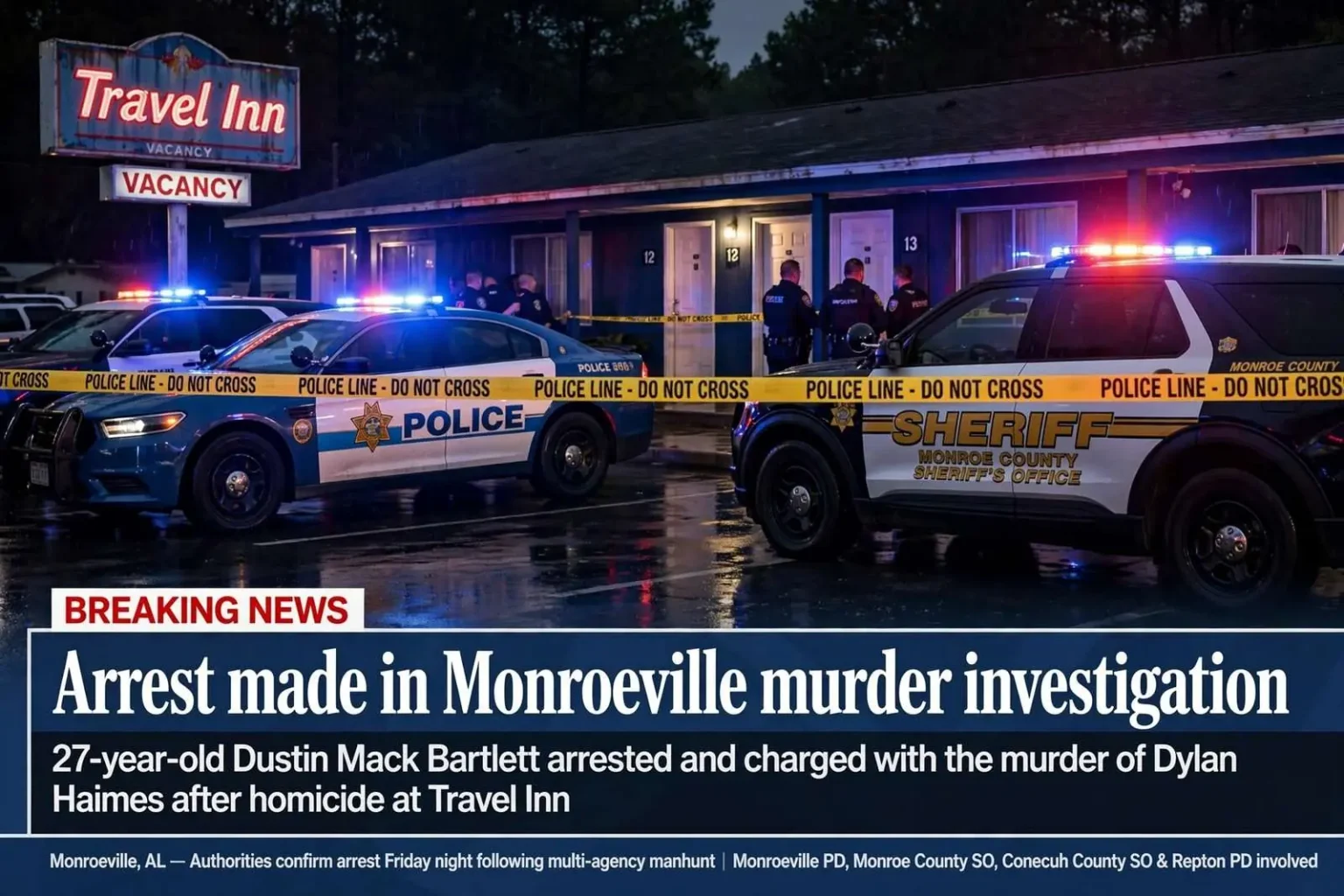
An arrest has been made in connection with a homicide in the Monroeville area, authorities said.
The investigation began Friday morning after a man, identified as Dylan Haimes, was found dead inside the Travel Inn from an apparent gunshot wound. The Monroeville Police Department led the investigation, with assistance from the Monroe County Sheriff’s Office, the Conecuh County Sheriff’s Office and the Repton Police Department.
Earlier, police had identified 27-year-old Dustin Mack Bartlett as a person of interest and said he was considered armed and dangerous. According to a social media post from the Monroe County Sheriff’s Office, Bartlett was later taken into custody and charged with the murder of Dylan Haimes. He was booked Friday night.
Authorities urged anyone with information to contact the Monroeville Police Department at 251-575-3246, and said anyone who made contact with Bartlett should call 911 immediately.
A Death at the Travel Inn
The case began as a death investigation at a roadside motel on Friday morning and became a homicide case as investigators processed the scene. Dylan Haimes was found dead inside the Travel Inn, and the apparent gunshot wound that killed him gave police a crime scene to secure, evidence to collect and a timeline to build from the motel’s traffic that morning.
Motel homicide scenes present particular challenges for investigators. Rooms change hands constantly, surveillance coverage varies, and the comings and goings of guests and visitors rarely leave a paper trail. The first hours at such a scene are decisive: canvassing for witnesses who saw vehicles or people in the parking lot, preserving any camera footage before it loops over, and tracing how the victim and, eventually, a suspect came to be at the location.
The Monroeville Police Department took the lead on the case, an arrangement that follows jurisdictional lines — the crime occurred inside city limits, making the municipal department the primary investigative agency. The assistance of the Monroe County Sheriff’s Office and neighboring agencies multiplied the manpower available for the search that followed.
A Multi-Agency Manhunt
Identifying Dustin Mack Bartlett as a person of interest transformed the investigation into a manhunt, and the warning that he was considered armed and dangerous raised the stakes for officers and residents alike. That designation is not used lightly; it tells the public and every officer on the road that the person sought may be violent and may be carrying a weapon, and it shapes how contact will be made when he is found.
The geographic spread of the assisting agencies reflects the terrain of rural south-central Alabama. Monroe County covers a wide, sparsely populated area around Monroeville, and its sheriff’s office knows the back roads where a fleeing suspect might travel. The Conecuh County Sheriff’s Office and the Repton Police Department brought coverage of the counties and communities to the south and west — Repton sits in Conecuh County on the region’s rural highway network, positioned along routes a suspect could use to leave the area quickly.
Multi-agency cooperation of this kind is routine in rural Alabama homicides, where a single municipal department may have only a handful of investigators. Sharing the search across jurisdictions lets deputies and officers check family connections, known associates and frequent locations across a wider map than one agency could cover in the critical first hours after a killing.
From Person of Interest to Charged Suspect
The progression from person of interest to charged suspect marks a formal shift in the case’s legal posture. A person of interest is someone investigators want to locate and question — not necessarily someone facing charges. Charging Bartlett with murder meant prosecutors had reviewed the evidence gathered during the Friday investigation and concluded it supported the state’s most serious homicide charge.
Bartlett was booked into custody Friday night, closing the manhunt that began hours earlier. Booking at the county jail records the formal charge, fingerprints the suspect and begins the paper trail of an Alabama murder prosecution — bond proceedings, initial appearances before a judge and, in due course, presentation of the case to a grand jury.
A murder charge in Alabama carries the state’s most severe penalties, and cases of this kind are prosecuted in circuit court after grand jury indictment. The speed of the arrest — within a single day of the body being found — reflects the combination of a focused investigation and the regional cooperation that put multiple agencies on the search simultaneously.
Monroeville’s Small-Town Stakes
Monroeville, the seat of Monroe County, is a town of about 6,000 residents best known nationally as the hometown of Harper Lee and the literary model for Maycomb in “To Kill a Mockingbird.” Its courthouse square, museums and annual stage production of the novel draw visitors from around the world, and the town wears its “Literary Capital of Alabama” designation proudly.
For a community of that size, a homicide at a local motel lands heavily. Violent deaths are rare enough in small Alabama towns that each one becomes a shared civic event — a matter of conversation at cafes and church services, and a test of the local institutions that respond to it. The Travel Inn sits along the commercial corridor that serves travelers passing through town, a reminder that small-town motels see a constant flow of strangers as well as local guests.
The public communication in the case followed the modern pattern for rural Alabama law enforcement: the Monroe County Sheriff’s Office announced the arrest through social media, a channel that reaches residents quickly in communities where local news coverage of breaking crime can lag. The same post carried the essential public-safety guidance — that anyone who had contact with Bartlett should call 911 immediately rather than approach him.
How the Public Helped
Requests for information in cases like this one are not ceremonial. Investigators rely on tips about a suspect’s movements, associates and vehicle sightings to close the search radius, and the tip line — 251-575-3246 for the Monroeville Police Department — remained open even after the arrest, since prosecutors build murder cases from every available source of information about the events surrounding the killing.
The warning to call 911 upon any contact with the armed-and-dangerous suspect carries a practical lesson for rural residents: a person who has just fled a homicide scene may seek help, transportation or shelter from acquaintances or strangers, and every encounter matters to the investigation. People who provided Bartlett rides, lodging or assistance before his capture could find themselves both witnesses and, in some circumstances, subjects of the inquiry.
That dynamic underscores why authorities broadcast the warning quickly once Bartlett was identified. Hours matter in a rural manhunt — a suspect with local ties can cover the region’s highway network in any direction, and the faster the public knows who to watch for, the smaller the space he has to move in.
The Legal Road Ahead
With Bartlett in custody and charged, the case moves into the machinery of the Alabama courts. The initial appearance before a magistrate or district judge comes first, where the charge is formally read and bond is addressed. Murder cases in Alabama can carry bond or be held without it depending on the circumstances, and the court will weigh the nature of the charge, the evidence presented and the defendant’s ties to the community.
From there, the case proceeds to a grand jury, which reviews the evidence investigators assembled and votes on whether to return an indictment. An indictment sends the case to circuit court for arraignment and, unless a plea agreement resolves it, trial. Murder prosecutions in rural Alabama circuit courts routinely take many months, with the timeline shaped by lab work on forensic evidence, witness availability and the court’s docket.
The evidence in a case built this fast typically includes the crime scene work from the Travel Inn, witness statements from the morning the body was found, any surveillance footage from the motel and surrounding businesses, and whatever the manhunt produced — interviews with people who saw or communicated with Bartlett during the hours between the killing and the booking. Each piece will be tested through the defense’s challenge as the case advances.
What the Agencies Did Right, and What Comes Next for the Region
The single-day resolution of the manhunt stands out in rural Alabama law enforcement, where small departments often spend weeks searching for homicide suspects. The quick identification of Bartlett as a person of interest, the public warning about his armed-and-dangerous status and the coordination across four agencies compressed a search that can drag on into an arrest before Friday night.
For Monroe and Conecuh counties, the episode is a reminder of how interdependent rural law enforcement has become. A crime in Monroeville can send a suspect down a farm-to-market road into Conecuh County within minutes, and the sheriffs’ offices and small municipal departments along those routes are each other’s first line of reinforcement. The assistance from the Conecuh County Sheriff’s Office and the Repton Police Department in this case exemplifies the mutual-aid habits that hold the region’s safety net together.
The victim’s family now begins the long process that follows every homicide — funeral arrangements, unanswered questions and the years of court proceedings that a murder case entails. Authorities have asked anyone with information about the events surrounding Dylan Haimes’s death to contact the Monroeville Police Department at 251-575-3246, and the investigation remains open even after an arrest, as prosecutors and police continue to build the record the courts will eventually weigh.
As with any criminal charge, Bartlett’s guilt or innocence will be decided in a courtroom, not in the arrest report. The charge of murder filed after his Friday night booking is the state’s formal accusation, and the presumption of innocence follows him through every stage that remains — from bond proceedings to grand jury to trial — in the Monroe County courts.