
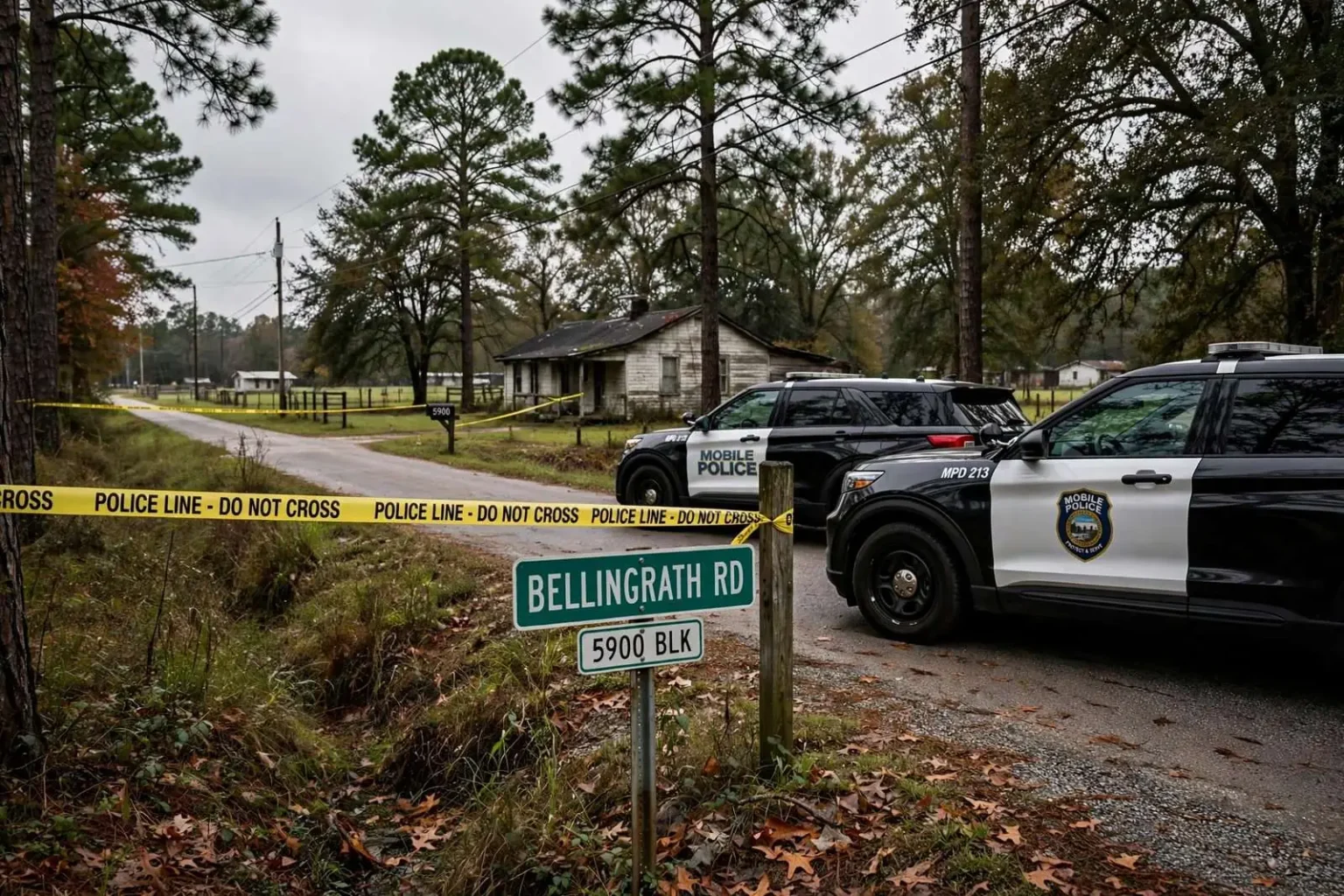
MOBILE COUNTY, Ala. — Mobile police have made an arrest in the Oct. 20 shooting death of 35-year-old William Burton in the Theodore community, moving the investigation from an open homicide into the early stages of the court process. The arrest answered more than two weeks of questions in a case that unfolded on one of southern Mobile County’s most rural roads.
Officers said Burton was shot at a home on the 5900 block of Bellingrath Road while visiting a female friend. The circumstances — a daytime visit that ended in gunfire at a residence in a quiet stretch of the county — unsettled residents along Bellingrath Road, where violent crime is rare enough that the shooting stood out immediately in the community.
Kerry Miller, 31, was taken into custody in connection with the homicide, according to Mobile police. The department announced the arrest after investigators developed the case in the days following the shooting, and Miller was transported to department headquarters in Mobile for questioning, the standard procedure following an arrest in a homicide case.
When questioned at department headquarters, Miller denied the allegations against him. “I’m sorry for the misunderstanding,” Miller said. “We’re going to get this straight.” The statements, made as investigators pressed him on the events of Oct. 20, maintained his denial while the department continued building its case. He now faces the legal process ahead, and any determination of guilt or innocence belongs to the courts.
The community where it happened
Theodore sits in southern Mobile County, and Bellingrath Road runs through some of the area’s most rural stretches between U.S. Highway 90 and the Fowl River communities. The road takes its name from the region’s best-known landmark — the Bellingrath Gardens and Home estate downstream along the Fowl River — and it threads a landscape of modest homes, small farms, and wooded parcels that feels a world apart from Mobile’s urban core, though it lies only a short drive south of the city.
That rural character shaped the investigation. Response times, sight lines, and the spacing between neighbors all differ from what detectives encounter in the city’s denser precincts, and the department’s ability to work the case depended on the cooperation of the residents along the road. Shootings of this kind in south Mobile County communities draw intense local attention, precisely because they are so uncommon on streets where most crime runs to burglaries and property offenses.
The 5900 block of Bellingrath Road sits in the middle of that stretch, where the road narrows and the homes sit back from the shoulder. Neighbors described the area as the kind of place where people know the cars that belong on the street — which made the arrival of police tape and patrol units on Oct. 20 all the more jarring.
The investigation to this point
Investigators have not released a motive. The department’s silence on that point is standard practice in an active case — releasing a theory of the crime before trial can complicate prosecution and, in a case with surviving witnesses, expose them to risk. What the department has confirmed is the timeline: the Oct. 20 shooting death of William Burton, the location on Bellingrath Road, the fact that he was visiting a female friend at the home, and the arrest of Kerry Miller two weeks later.
The case remains under investigation by Mobile police. An arrest is a step in a process, not its conclusion: detectives continue to gather evidence, interview witnesses, and prepare the file that prosecutors will review. In the interim, the details the department has declined to release — motive, the relationship between the parties, the events leading up to the gunfire — remain questions the investigation will answer on its own schedule.
For the family of William Burton, the arrest marks the first measure of progress in a case that began with a phone call and a crime scene on a rural road. Homicide prosecutions move slowly — through review by the district attorney, grand jury proceedings, and the courts — and the months ahead will determine how the allegations against Miller resolve. Burton was 35, and his death leaves the questions families of homicide victims carry: the motive detectives have not disclosed, and the events of an October afternoon on Bellingrath Road.
How Mobile police handle county homicide cases
The case sits within an unusual jurisdictional arrangement: Theodore is not part of the city of Mobile, but Mobile police investigated the shooting and made the arrest. Law enforcement coverage in unincorporated Mobile County involves the sheriff’s office and municipal departments working by agreement, and the arrangement under which Mobile police carried this case reflects the practical division of investigative resources across the county. Whatever the mechanism, the department’s homicide detectives took the case from the first call and carried it to an arrest.
Homicide investigations of this kind typically begin with the scene: the home on the 5900 block, the evidence recovered there, and the canvas of neighbors along Bellingrath Road. Detectives then work outward — phone records, interviews, and the timeline of the victim’s final hours. The two-week span between the shooting and Miller’s arrest is a typical interval for a case in which investigators needed to solidify the account before presenting it for charges.
The department’s practice in such cases is to keep the investigation open even after an arrest, since charges are only as strong as the evidence behind them. Witnesses with information about the Oct. 20 shooting can still come forward through the department, and investigators have emphasized in past cases that late details frequently matter.
What comes next in the case
Miller’s denial at headquarters — “I’m sorry for the misunderstanding. We’re going to get this straight.” — sets up the contest that the courts will now decide. The prosecution’s file will rest on the evidence gathered at the scene and in the weeks of investigation that followed; the defense will test every piece of it. Between arrest and trial lie the standard stages: initial appearance, bond proceedings, and the grand jury’s review of the evidence, each of which can reshape the case before it reaches a courtroom.
The department has released no information about the weapon, the number of shots, or the events inside the home where Burton was visiting. Those details will surface — or not — through the court process, and until then the public record consists of the department’s confirmations: the victim, the date, the location, and the arrest.
For the residents of Bellingrath Road and the wider Theodore community, the arrest closes the most frightening chapter of the case — the possibility that a killer was still at large on a road where homes sit far apart and neighbors count on each other’s watchfulness. The remaining chapters belong to the justice system, which will determine what the evidence gathered on that rural stretch of road actually proves.
The case remains under investigation by Mobile police, and the department has not indicated whether additional arrests are possible. Anyone with information about the Oct. 20 shooting death of William Burton on the 5900 block of Bellingrath Road can contact the department, where detectives working the case continue to collect what the community knows about an afternoon of gunfire in Theodore — and about the events that led a visiting guest to a rural road in southern Mobile County, and to a crime scene that has now produced its first arrest.
Rural roads, real consequences
The case also illustrates the realities of policing in southern Mobile County, where rural stretches like Bellingrath Road fall outside the city limits but within reach of Mobile’s investigative resources. Coverage arrangements between the county and its larger municipal departments determine who investigates a crime scene on a road like this one, and residents along Bellingrath Road saw that arrangement in operation from the first responders on Oct. 20 through the arrest at department headquarters two weeks later.
The Fowl River communities at the road’s southern end — Mon Luis Island, Fowl River, and the waterfront neighborhoods along the bay’s western shore — form one of the county’s most distinctive districts, where centuries-old family parcels meet newer development pushing south along the peninsula. Bellingrath Road serves as one of the main connectors for that district, linking U.S. 90 to the communities nearer the water, and traffic on the road mixes local residents, visitors bound for the gardens that share its name, and the everyday rhythm of rural southern Alabama.
A homicide investigation on that road brought the machinery of urban crime-solving to a rural setting: the tape, the canvass of a scattered population of neighbors, the careful work of mapping a scene with few witnesses and no cameras. That detectives made an arrest within two weeks speaks to the cooperation the community provided — the kind of case where the neighbors’ knowledge of who belongs on the road and who does not becomes part of the evidence.
The Theodore community now watches the case move into the courts, where the denial Miller offered at headquarters will meet the file detectives assembled from that rural crime scene. The department’s confirmation of the arrest, the victim’s identity, and the location stand as the public facts; everything else — motive, relationship, the sequence of events inside the home on the 5900 block — awaits the process that follows.


