Ascension Providence Expands Overnight Visitor Access for Labor and Delivery Unit
Ascension Providence Hospital in Mobile now allows two overnight visitors for Labor and Delivery patients as pandemic visitor restrictions ease.
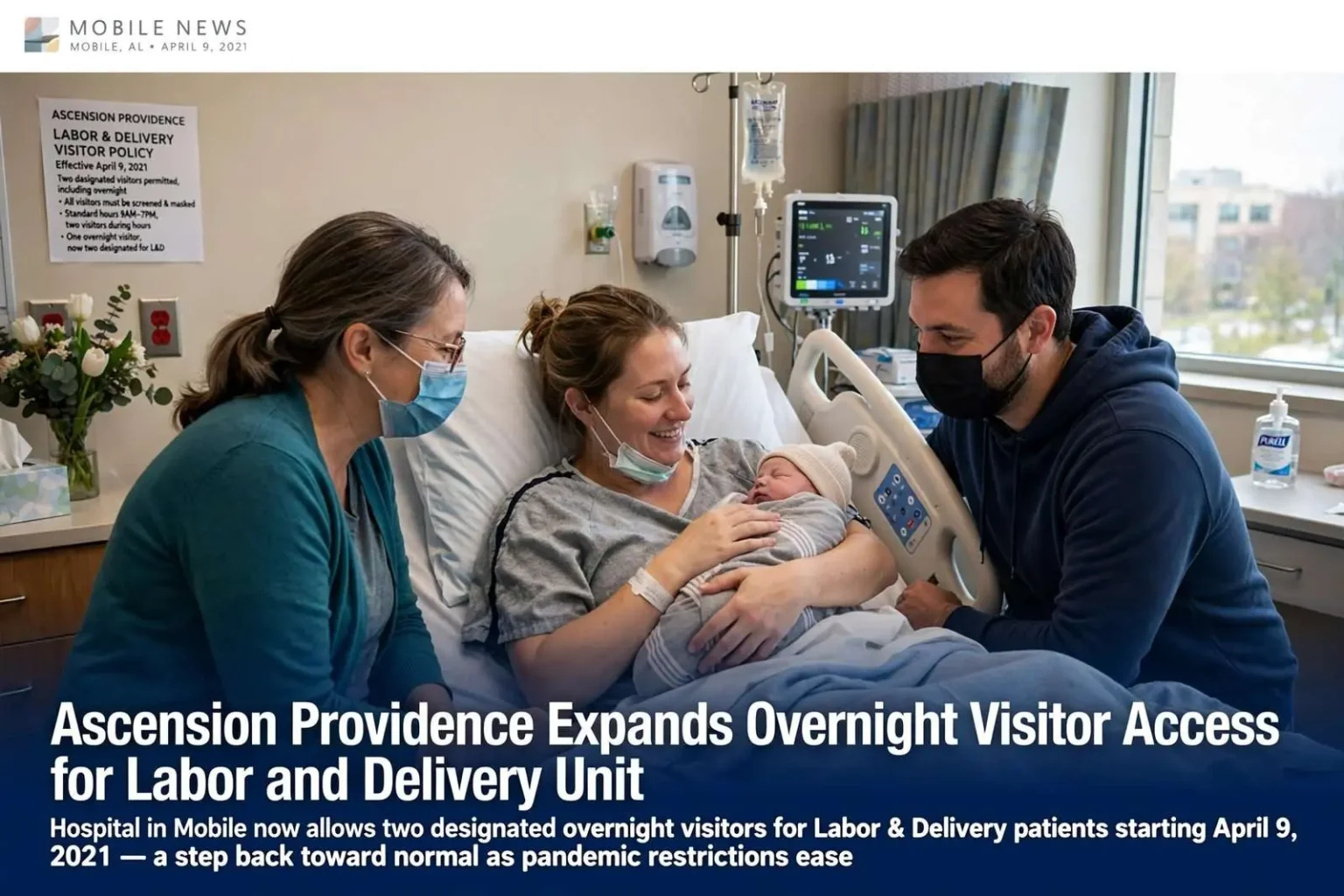
Ascension Providence Hospital in Mobile began allowing two designated overnight visitors for Labor and Delivery patients starting April 9, 2021, expanding access for families welcoming newborns during the pandemic. The change marked one of the most visible steps yet in the hospital’s gradual walk-back of the strict visitor limits imposed during the worst months of the COVID-19 outbreak.
Under the updated policy, Labor and Delivery patients can have two designated visitors throughout their stay, including overnight hours. Standard visiting hours at the hospital run from 9 a.m. to 7 p.m., with patients allowed two visitors at a time during those hours. One visitor can stay overnight, with the exception of ICU patients, whose units remain governed by the tighter rules that intensive care wards have maintained throughout the public health emergency.
For families who had faced the most restrictive visitor rules in a generation — some hospitals limiting patients to a single support person, others barring visitors from certain units entirely — the April policy shift was a meaningful change. Welcoming a newborn is among the most family-centered experiences a hospital offers, and the pandemic-era limits on who could be present in the delivery room and afterward had been among the most difficult restrictions for patients to accept.
The Policy in Detail
The structure of the new rules follows the pattern Mobile-area hospitals have used as they ease access: designated visitors rather than open visiting. Under the Ascension Providence policy, the two overnight visitors for Labor and Delivery patients must be designated for the stay, which allows the hospital to screen and track everyone entering the facility while still permitting a support team through the birth and recovery.
During daytime hours, the two-visitor allowance applies across the patient’s stay, consistent with the hospital’s standard 9 a.m. to 7 p.m. visiting window. The overnight provision — one visitor remaining past 7 p.m., extended to two designated visitors for this unit — addresses the practical reality of labor and delivery, where patients may be in labor overnight, recovering from a cesarean section, or caring for a newborn through the first nights of feedings.
The exception for ICU patients reflects a separate calculation. Intensive care units treat the hospital’s sickest patients, and infection-control precautions there have eased more slowly than in other units. Patients and families navigating both a delivery and a critical care situation — a newborn admitted to intensive care, for example — may find the rules differ between units, and hospital staff typically work with families case by case in those circumstances.
The Road Back From 2020
The change marked a positive shift for families who had faced more restrictive visitor rules throughout much of the COVID-19 pandemic. In March 2020, as the first wave of cases reached Alabama, hospitals across the state and the country moved almost overnight to shut down visitor access: screening at entrances, single-support-person limits for obstetric patients, and in many cases no visitors at all for most units. The measures were aimed squarely at limiting virus transmission inside facilities where staff and vulnerable patients shared space.
Those restrictions held through the summer and winter surges of 2020, and hospitals weighed every reopening step against case counts, hospitalization rates, and testing capacity. By early 2021, the equation had begun to change. Vaccination was underway across Alabama, with healthcare workers and long-term care residents first in line, and case counts improved after the post-holiday winter peak. Hospitals across the region gradually began restoring access, first for obstetric and pediatric patients and end-of-life situations, then more broadly as conditions allowed.
Ascension Providence’s April 9 move fit that regional pattern. The hospital, part of Ascension, one of the nation’s largest nonprofit health systems, had spent the preceding months adjusting policies unit by unit as conditions permitted, and the Labor and Delivery change was the kind of measured reopening hospitals favored: expanded access, but with named visitors, screening, and masking still in place.
Screening and Masking Remain
The expanded access came with continuing precautions. Ascension Providence continued to require screening measures and mask protocols for all visitors entering the facility, meaning visitors should expect health questions and temperature checks at the entrance, masks worn throughout the building, and limits on movement within the hospital. Those measures had become standard practice at hospitals across the region and remained in place even as visitor numbers grew.
Patients preparing for delivery during this period were advised to plan around the rules in advance: choosing designated visitors before admission, knowing what identification and screening each visitor would go through, and understanding that policies could change again if conditions worsened. Hospitals reserved the right to tighten restrictions during outbreaks, and families who followed unit-level guidance avoided surprises at the door.
The mask and screening requirements also applied to the obstetric patients themselves, with masking protocols in place except where clinically impractical during active labor. Staff testing and protective equipment continued across the hospital, the layered approach that public health officials credited with keeping hospital transmission low even as access expanded.
What It Meant for Mobile Families
For expecting parents in Mobile, the policy change arrived at a practical moment. Spring births are busy ones at area hospitals, and the difference between one visitor and two — between a partner staying overnight and a partner plus a mother, sister, or doula — shaped how families planned their deliveries. The two-designated-visitor structure allowed parents to name the people who would be present for the birth and the first days of recovery, rather than rotating support through daytime windows.
Ascension Providence, located in west Mobile, is one of Mobile’s main medical centers and delivers a significant share of the area’s newborns, alongside USA Health’s facilities and the other hospital systems serving the region. Visitor policies across those systems converged during the pandemic and diverged again as each system eased rules on its own timeline, so families often compared policies as they planned where to deliver.
The overnight change also mattered for the practical side of a hospital stay. A support person who stays overnight means someone present for nighttime feedings, for decisions that come up after visiting hours, and for the discharge process the following day. For patients with other children at home or partners who needed to alternate nights, the designation structure provided a workable middle ground between pandemic isolation and fully open visiting.
The Broader Picture in Spring 2021
By April 2021, the state’s pandemic numbers were trending in the direction that allowed these changes. Vaccination eligibility had opened to broader age groups, Alabama’s case counts had fallen well below their January peak, and hospitalizations across the state’s health systems had declined steadily. Health officials continued to urge caution — spring brought variants and pockets of stubborn transmission — but the pressure on hospital capacity had eased enough for administrators to revisit rules that had been frozen for more than a year.
The visitor-access question became one of the most visible markers of that progress. More than almost any other pandemic restriction, hospital visitor limits affected families directly and emotionally, and each reopening announcement carried a meaning beyond its logistics: the hospital experience, for birth and for illness, was becoming recognizable again.
Ascension Providence’s Labor and Delivery change was part of that broader reopening, and the hospital committed to adjusting further as conditions allowed. For the families delivering there in the weeks after April 9, 2021, the policy meant the difference between a birth story told by phone and one experienced in the room — a small restoration, but one that mattered enormously to the patients it affected.
How to Prepare for a Delivery Under Visitor Rules
Families planning a delivery during this period benefited from preparing for the screening and designation process ahead of time. Hospital staff recommended that expecting parents confirm the current policy with the Labor and Delivery unit shortly before their due date, since policies were being updated in stages during the spring of 2021 and could vary between units within the same hospital.
Designating visitors in advance was the other practical step. Because the overnight allowance applied to designated visitors named for the stay, families needed to decide who those people would be before admission rather than deciding at the door. Visitors arriving for a shift were subject to the same screening as patients — health questions, temperature checks and mask requirements — and anyone experiencing symptoms was asked to stay home.
Hospitals also encouraged families to keep copies of important documents and a plan for communication with relatives who could not attend. Throughout the pandemic, video calls had become the standard way to introduce newborns to grandparents and extended family, and even with expanded access, many families continued to share deliveries remotely with relatives out of town or unwilling to enter a healthcare facility.
Looking Ahead
The April 2021 policy was framed as a stage in an ongoing process rather than a final destination. Hospital administrators across the region signaled that visitor policies would continue to move with the public health data, and the general expectation among healthcare planners was that access would keep expanding as long as case counts and hospitalizations allowed.
For the patients of Ascension Providence’s Labor and Delivery unit, the change took effect in time for the spring and summer birth season, and the hospital’s message to families was straightforward: two designated visitors, day and night, with screening and masking still part of the entry process. For a hospital system and a community that had spent more than a year under some of the strictest visitor rules in modern memory, it was a welcome and overdue shift back toward normal.