
Atmore Carver Avenue Shooting Arrest: Man, 21, Charged With Two Counts of Attempted Murder
Atmore police have arrested Michkel Jones, 21, in the Sept. 6 Carver Avenue shooting that wounded a man at a gathering of more than 500 people. Chief Ken Sessions says the investigation remains active and more arrests are possible.
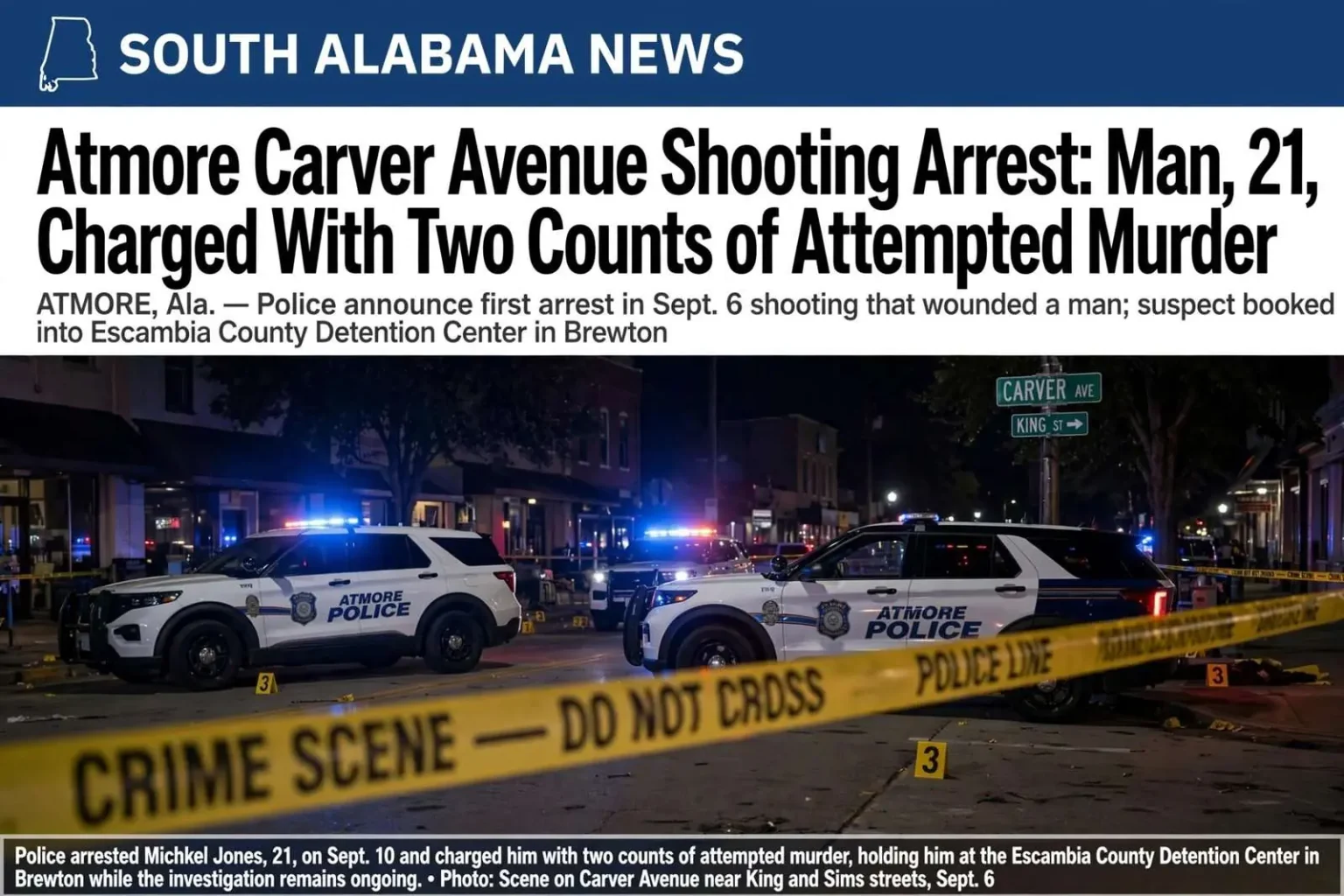
ATMORE, Ala. — Police have announced their first arrest in the Carver Avenue shooting that wounded a man at a gathering estimated at more than 500 people on Sept. 6, charging a 21-year-old with two counts of attempted murder and booking him into the Escambia County Detention Center in Brewton.
Atmore Police Chief Ken Sessions announced the arrest in a release issued Sept. 10, identifying the man taken into custody as Michkel Jones, 21. Sessions said Jones was being held in Brewton awaiting bond, and he cautioned that the department’s work on the case is far from finished.
“This investigation remains active and ongoing, and additional arrests are possible,” Sessions said.
The announcement marks the first publicly disclosed break in a case that had produced no arrests in the days immediately after the shooting, while Atmore officers were still working a scene that police said was crowded with hundreds of people.
Two Descriptions of the Same Defendant
One basic detail about Jones is not consistent across the available accounts, and readers deserve to know that up front. Atmore police identified him as a Bay Minette man; other accounts describe him as a Mobile man. There is no way, from the material at hand, to determine which description is accurate, so both are reported here rather than one being chosen silently.
Neither city is in Escambia County, where the shooting occurred. Bay Minette is the seat of Baldwin County government, and Mobile is the largest city on the Alabama coast. A defendant’s hometown has no bearing on the charges he faces, but it does shape how a case gets described in public, how neighbors and family understand it, and how readers in each community relate to the story. Discrepancies like this one are common in the first days of a fast-moving case, when arrest paperwork, jail records and departmental releases can each carry a slightly different address, and they are usually resolved once the case reaches court.
The Charges Against Jones
The release from Sessions listed two counts of attempted murder. A separate account of the Escambia County case describes a third count as well and puts names to the people investigators say were targeted.
According to that account, investigators allege Jones fired a gun, striking Armani Hooks in the right lower leg and also shooting at Ja’Mere Brow. Those two allegations are the basis for the two attempted murder counts. Investigators further accuse Jones of firing into property — specifically, of shooting into an empty car — which produced a separate count of shooting into an unoccupied vehicle.
The Atmore Police Department, for its part, said in its Sept. 10 release only that it was investigating the shooting of an adult male, that the victim had been taken for medical treatment, and that his identity would not be released at that time. The names of Hooks and Brow come from the account of the charges filed in Escambia County, not from the police department’s own public statement.
Attempted murder is among the most serious accusations Alabama prosecutors can bring short of a completed homicide. Shooting into an unoccupied vehicle is a distinct offense under Alabama law, aimed at gunfire directed into vehicles, dwellings and other structures whether or not anyone is inside at the time — a recognition by the Legislature that firing into an empty car in a crowded street is dangerous in its own right, independent of whether the shooter hits a person.
Charges are accusations, not findings of guilt. Jones has not been tried on any of them, and he is presumed innocent unless and until the state proves its case against him beyond a reasonable doubt in court.
What Police Say Happened on Carver Avenue
The shooting took place on Carver Avenue near King and Sims streets. According to the Atmore Police Department’s Facebook page, officers were dispatched to a call that reported numerous shots and a person struck by a vehicle — two separate emergencies folded into a single dispatch.
What officers encountered when they arrived was not an ordinary street scene. In its public account, the department described a gathering of extraordinary size.
“There had been a large gathering/party, with an estimated crowd of more than 500 people at the location,” officials said. “It was reported by officers to be a large number of people in the area and gathered roadside.”
The department said it was investigating the shooting of an adult male, that the victim was transported for medical treatment, and that he was reported to be in stable condition. Police said his identity would not be released.
The response drew personnel from across the department. Officers from patrol, criminal investigations, narcotics and vice, and crime scene units all worked the incident, according to APD — an all-hands deployment that is unusual for a city of Atmore’s size and a measure of how large and chaotic the scene was.
Why a Crowd of Hundreds Complicates a Shooting Investigation
The size of the gathering is not incidental color. A crowd numbering in the hundreds, much of it spilling into the roadway, changes nearly everything about how investigators approach a shooting scene, and it helps explain why four days elapsed between the incident and the first arrest.
Physical evidence is the first casualty. Shell casings, dropped items and blood evidence sit on open pavement where hundreds of feet are moving, and a scene that would ordinarily be secured in minutes can take far longer to isolate. Establishing a perimeter large enough to capture the relevant ground, while hundreds of people are trying to leave at once, is itself a significant undertaking.
Witnesses are the second challenge. A large crowd theoretically means many people saw something, but in practice it also means many partial, conflicting and secondhand accounts, and a great many people who leave the area before officers can speak with them. Investigators generally have to work backward — from video, from vehicle information, from the accounts of the people who did stay — rather than simply canvassing the scene.
The reported combination of gunfire and a pedestrian struck by a vehicle adds a further layer. Police have not said publicly whether the two elements of the original call were connected, and the department’s statements to date address the shooting investigation specifically. In incidents at large outdoor gatherings, a crowd scattering after shots are fired can produce vehicle-related injuries that are related in time but not necessarily in intent, and sorting out which is which is part of the investigative work.
Sessions Credits His Investigators
In announcing the arrest, Sessions pointed to the sustained effort by the department’s investigative staff over the days following the shooting.
“This arrest is the result of the hard work, persistence and investigative efforts of the Atmore Police Department’s investigators as they continue working to identify and hold those responsible for this incident accountable,” Sessions said.
The phrasing — “those responsible,” plural, and “continue working” — tracks with the chief’s separate statement that further arrests remain possible. Police have not said how many people they believe fired weapons, nor whether they are pursuing others in connection with the same exchange of gunfire.
Held in Brewton While He Awaits Bond
Sessions said Jones is being held at the Escambia County Detention Center in Brewton, the Escambia County seat, awaiting bond. Atmore sits in the southwestern corner of the county, so a defendant arrested there is ordinarily housed at the county jail in Brewton, on the other side of the county from where the arrest was made.
In Alabama, bond in a felony case is ordinarily set by a judge or magistrate, guided by a statewide schedule of recommended ranges for each class of offense. Courts may set an amount within, above or below that range after weighing factors such as the seriousness of the charge, the defendant’s ties to the community, any prior record and the risk that he would fail to appear or pose a danger if released. Defendants who cannot post the amount set remain in custody; those who can are released subject to conditions the court imposes. A defendant may also ask the court to reconsider the amount, and prosecutors may ask that it be raised.
Being held “awaiting bond,” as Sessions described it, generally means the amount had not yet been set at the time of the release, or that Jones had not posted it. Neither circumstance says anything about guilt or innocence.
Background: The Sept. 6 Shooting
The incident on Carver Avenue was first reported publicly in the days after Sept. 6, when police confirmed that a man had been wounded and that no arrests had been made. At that stage, the department’s account consisted largely of the elements described above: the dispatch reporting shots and a pedestrian struck by a vehicle, the enormous crowd, the adult male victim in stable condition, and a multi-unit police response.
Police did not, and still have not, publicly detailed what precipitated the gunfire, how many shots were fired, or how many weapons were involved. Those are ordinarily among the last details released in an active case, because they bear directly on what investigators can test a suspect’s account against.
What Happens Next
A felony arrest in Alabama is the beginning of a court process, not the end of one. Cases typically move from an initial appearance before a judge or magistrate — where the defendant is informed of the charges and bond is addressed — to either a preliminary hearing or presentation to a grand jury. If a grand jury returns an indictment, the case proceeds to arraignment in circuit court, where the defendant enters a plea, and then into pretrial motions and discovery. Most felony cases take many months to reach resolution, and the great majority are resolved by plea rather than by trial.
Whether additional charges are added, or additional people are arrested, will depend on what investigators develop from here. Sessions said additional information will be released as it becomes available and when it is appropriate to do so.
South Alabama News will continue to follow the case as it moves through the Escambia County court system, including any bond determination, indictment or additional arrests. Anyone with information about the Sept. 6 shooting is encouraged to contact the Atmore Police Department.