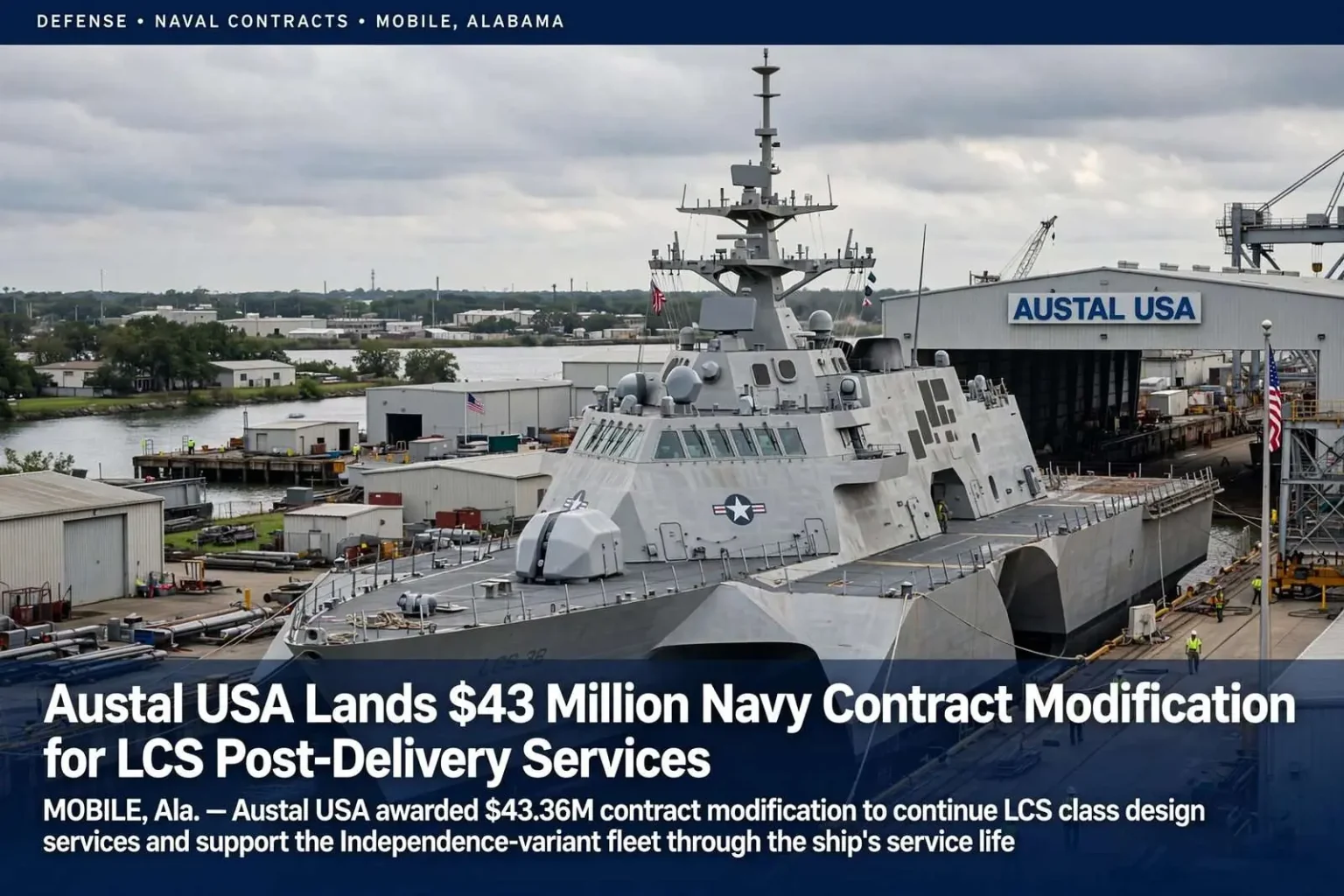
MOBILE, Ala. — Austal USA has been awarded a $43.36 million contract modification from the U.S. Department of Defense covering post-delivery services for the Navy’s Littoral Combat Ship class. The award adds to the steady stream of support work that follows the ships the Mobile shipyard builds into their years of fleet service.
The modification to the previously awarded contract exercises options for LCS class design services, the material needed to support those services, and the Integrated Data Product Model Environment — a system that gives the Navy enterprise-wide access to LCS data management. Together, those pieces keep the design knowledge accumulated during construction flowing to the sailors and support organizations that operate and maintain the ships after they leave the yard.
Under the award, Austal will provide design services across the entire LCS fleet. That work can include program management, fitting-out services, change processing, software maintenance, engineering support and lifecycle efforts that follow each ship from delivery through its years in service. In practical terms, when a fleet question arises about an Independence-variant LCS — whether it involves an engineering change, an upgrade, or a maintenance issue — the design authority in Mobile is part of the answer.
What the Contract Covers
Post-delivery work is a distinct phase of a warship’s life. Construction ends when the Navy accepts the ship, but the vessel then enters a service life measured in decades, and the builder typically remains involved as the class design authority. This modification funds exactly that role: keeping Austal engineers engaged with the fleet as ships operate, age, and receive updates.
The Integrated Data Product Model Environment portion of the award addresses a quieter but increasingly important piece of modern shipbuilding — data. The system gives the Navy enterprise-wide access to LCS data management, meaning design drawings, technical documentation, and ship-specific records are available across the Navy enterprise rather than held in scattered archives. For a class with as many hulls as the LCS program, centralized data access shortens the path from a fleet problem to an engineering answer.
Austal USA President Craig Perciavalle said the continued flow of post-delivery work reflects the Navy’s confidence in the company’s performance over the full life of its ships, adding that his post-delivery service and supply team would help keep supporting the fleet well into the future. The remarks framed the award less as a new chapter than as a continuation of a relationship the yard has built with the Navy across more than a dozen hulls.
The Independence-Variant Fleet in Mobile
Austal USA’s Mobile riverfront yard builds the Independence-variant of the littoral combat ship — the aluminum trimaran design recognizable by its distinctive three-hull configuration — along with Expeditionary Fast Transport vessels for the Navy. The yard is one of the largest private employers in the Mobile area, and its production lines have delivered ships to the Navy at a steady cadence for years.
The LCS program was conceived to produce fast, agile surface ships for near-shore operations, with two competing variants built by two shipbuilders: the Freedom variant constructed in the Midwest and the Independence variant constructed in Mobile. Austal’s trimaran design drew on high-speed ferry technology, and the class has since grown into a workhorse for deployments, mine countermeasure testing, and forward operations.
Expeditionary Fast Transport vessels — built on the same basic hull platform — carry troops, vehicles, and equipment at transit speeds conventional sealift cannot match, adding a second product line that keeps the yard’s workforce engaged between combatant deliveries.
Why Post-Delivery Work Matters to Mobile
Post-delivery contracts like this one are a steady revenue stream alongside new construction at the Mobile yard. New-ship awards arrive in large blocks and dominate headlines, but the support work is the quieter constant: it continues between construction programs, scales with the size of the delivered fleet, and grows as more hulls transition from the building ways to operational service.
For the Mobile economy, that matters in concrete ways. Design services and lifecycle engineering are performed largely by salaried technical professionals — engineers, designers, program managers, and logistics specialists — many of whom build careers in Mobile around the yard. A $43.36 million modification represents months and years of that work rather than a single spike of activity.
The award also reflects how Navy shipbuilding economics have shifted. As new-construction schedules have fluctuated across the industry in recent years, in-service support has become a larger share of shipbuilder workloads, and companies with large delivered fleets — as Austal has with the Independence variant — are positioned to compete for that work.
How Contract Modifications Work
The award announced this week is a modification to a previously awarded contract, exercising options rather than creating a new agreement from scratch. In federal contracting, options are priced and approved up front but exercised later, when the government confirms the need and funding are in place. That structure gives the Navy flexibility while giving the shipbuilder a defined path to continued work.
Modifications of this size are routine in the defense acquisition system, and they are typically announced through Department of Defense contract announcements that summarize the scope, the value, and the contracting office responsible. The $43.36 million figure covers the exercised scope: LCS class design services fleet-wide, the material required to support those services, and the data environment that underpins them.
For a class that has spanned years of construction in Mobile, the design-services role is cumulative. Each delivered ship adds to the technical baseline the yard maintains, and each modification like this one funds the people and systems that keep that baseline current for the operating fleet.
The Broader Gulf Coast Shipbuilding Economy
Austal USA operates in one of the densest shipbuilding corridors in the country. The Gulf Coast region supports major Navy and Coast Guard construction across Alabama, Mississippi, Louisiana, and Florida, and the suppliers, trades, and engineering talent circulate among the yards of the region. Mobile’s riverfront has been central to that ecosystem since the city’s shipbuilding history began, and Austal’s arrival expanded it into the modern era.
The company’s footprint in Mobile has grown well beyond its initial LCS construction role, adding production capacity, repair work, and — as this award shows — a deepening in-services business. Each layer strengthens the others: construction builds the fleet, the fleet generates support work, and support work sustains the skilled workforce that construction depends on.
With this modification, the Navy has once again put dollars behind that cycle in Mobile. The design authority for one of the Navy’s most recognizable surface ship classes will remain anchored on the Mobile River, and the sailors who operate Independence-variant ships around the world will keep drawing on the expertise of the yard that built them.
The LCS Class Design Authority Role
Serving as the design authority for a warship class is a responsibility that begins long before the first ship is delivered and continues for the life of the fleet. The builder holds the technical baseline — the drawings, specifications, models, and engineering analyses that define what each ship is — and the Navy relies on that baseline every time a change is contemplated or a problem needs solving.
Change processing, one of the services funded by this modification, is the formal machinery behind that work. When the fleet identifies a needed improvement, the proposal moves through review, engineering evaluation, design incorporation, and fleet-wide implementation. Software maintenance and fitting-out services follow the same logic: the ships are evolving systems, and the organizations that built them are best positioned to keep the systems coherent as they evolve.
The Integrated Data Product Model Environment represents the modern version of that responsibility. Rather than paper archives and scattered databases, the Navy gains enterprise-wide access to LCS data management, tying design records to the ships they describe. As the fleet ages and personnel rotate, that continuity becomes the difference between a maintenance question answered in days and one answered in months.
Mobile’s Role in the Navy’s Shipbuilding Plans
Mobile’s place in Navy shipbuilding has grown steadily since Austal established its yard on the Mobile River. The facility has expanded its footprint multiple times, adding buildings, production capacity, and workforce to handle simultaneous programs. What began as a single-class construction effort has become a multi-mission shipbuilding and sustainment campus.
That growth has tracked with the region’s broader rise in defense work. The Gulf Coast’s combination of deepwater access, skilled trades, and established supplier networks has made it a natural home for naval construction, and Mobile sits at the center of it, with shipbuilding now among the region’s signature industries alongside aerospace, chemical manufacturing, and the Port of Mobile’s growing cargo business.
Contracts like the one announced this week rarely draw the attention that new-ship awards do, but they are the connective tissue between construction headlines and the day-to-day reality of a working fleet. Every deployed Independence-variant ship depends on the design services, material support, and data infrastructure that this $43.36 million modification funds.
For Austal USA, the award is a vote of continuity — work that extends from the ships already delivered and points toward the years of service those ships have ahead. For Mobile, it is more confirmation that the yard’s business is not just building ships, but keeping them ready for the Navy wherever they sail.