Tater Harris Elected Baldwin County Commission Chair as New Board Sworn In and Meeting Schedule Changes
Baldwin County's new commission chose Tater Harris as chair and Billie Jo Underwood as vice chair Nov. 11 and moved meetings to the first and third weeks of each month.
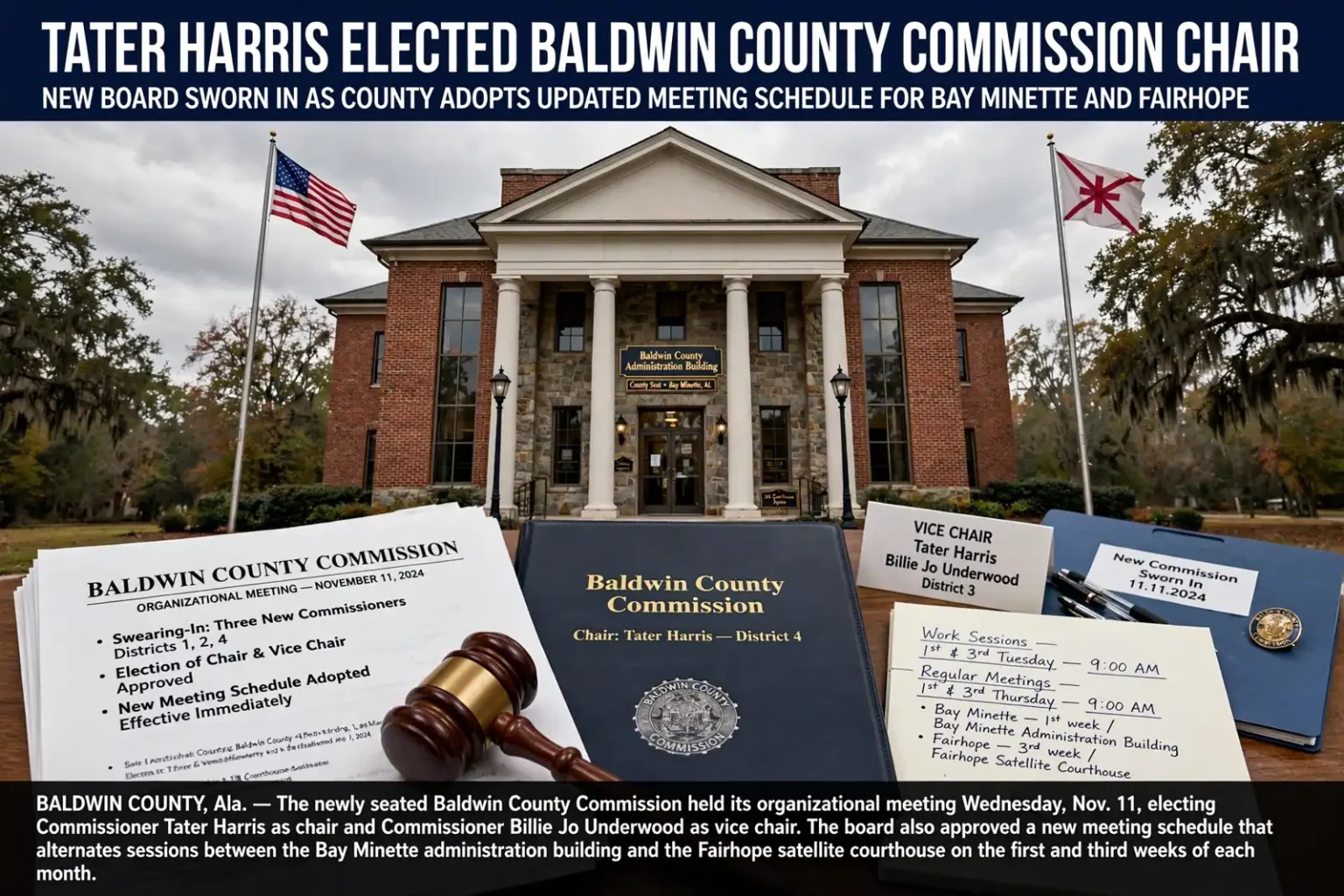
BALDWIN COUNTY, Ala. — A largely new Baldwin County Commission got to work Wednesday, Nov. 11, choosing Commissioner Tater Harris as its chair and Commissioner Billie Jo Underwood as vice chair, and rewriting the calendar residents will use to follow county business for the next several years.
The leadership votes and schedule change came during the board’s organizational meeting, held the same day four commissioners took the oath of office. Three of them are beginning their first terms on the commission, which means three of the four seats on the county’s governing body changed hands this week.
What Changes for Residents Who Follow County Meetings
For anyone who attends commission meetings, watches them or keeps track of agenda items, the most practical news from Wednesday is the new meeting pattern. The commission now ties both its work sessions and its voting meetings to the first and third weeks of each month, and it splits them between the county seat in the north and the county’s satellite courthouse on the Eastern Shore.
- Work sessions: The first and third Tuesday of every month, starting at 9 a.m.
- Regular commission meetings: The Thursday that follows the first and third Tuesday of every month, also at 9 a.m.
- First meeting of each pair: Early in the month, both the work session and the regular meeting are held in Bay Minette, inside the Baldwin County Administration Building, the main county office complex in the county seat.
- Second meeting of each pair: Later in the month, the work session and the regular meeting shift to Fairhope, in the Baldwin County Fairhope Satellite Courthouse, which serves residents of the southern half of the county.
- Road and Bridge Division meetings: Held four times a year at 9 a.m., falling on the third Wednesday in each of the months of January, April, July and October. These sessions will move around the county, rotating among the commission districts.
In practical terms, the setup creates a two-day rhythm twice a month. Commissioners review and discuss items at a Tuesday work session, then return two days later to vote on matters at a Thursday regular meeting held in the same building. Residents in the northern part of the county can plan on early-month sessions in Bay Minette, while those closer to Fairhope and the Eastern Shore can expect the later-month sessions nearer to home.
Harris and Underwood Take the Leadership Posts
Harris, whose formal first name is John, represents District 4 and will lead the board as chair for the first year of the new term. Underwood, who represents District 3, will serve alongside him as vice chair. The commission framed the selections as covering the first year, indicating the leadership roles are expected to be revisited later in the term.
In Alabama county government, the chair of a commission typically presides over meetings, keeps business moving through the agenda and often serves as a public face of the board, while the vice chair steps in when the chair is unavailable. The specific powers of a chair can vary from county to county depending on local law, but the role generally centers on running meetings rather than holding authority beyond that of the other members.
A Board With Three First-Term Members
Wednesday’s swearing-in ceremony, which drew commissioners’ family members, elected officials, county employees and community leaders, marked a significant turnover. Tater Harris, Richard Cox and Angelo Fermo were each sworn in as county commissioners for the first time. Cox represents District 1 and Fermo represents District 2.
Underwood, the lone returning member, began a new term after winning re-election. Her experience gives the board a measure of continuity as the three newcomers settle into their roles.
The new members replace Commissioners Charles Skip Gruber, Jeb Ball and Matt McKenzie, who completed their terms ahead of this week’s transition. The outgoing board held its final meeting of the term in Bay Minette, where state lawmakers presented resolutions honoring the three departing members and the commission voted to rename a South Baldwin maintenance facility in Gruber’s honor.
Priorities the Commission Has Outlined
In a statement released after the meeting, the commission said its members will keep working to meet the needs of residents. It pointed to several areas of focus:
- Governing responsibly
- Planning strategically for the years ahead
- Improving roads, drainage and other infrastructure
- Pursuing public safety efforts
- Providing county services efficiently
The commission also said it looks forward to working with city governments, state partners and community organizations to move ahead on goals that shape where the county is headed.
Those goals reflect the pressures facing a county that has been among the fastest-growing in Alabama. Baldwin is the largest county in the state by land area, covering roughly 1,590 square miles of land, and it is home to more than 230,000 residents. Growth in that population brings steady demand for roads, drainage, emergency services and other county responsibilities, and those demands tend to show up repeatedly on commission agendas.
Why the Road and Bridge Meetings Matter
The separate quarterly schedule for the Road and Bridge Division highlights how central transportation is to the commission’s work. In Alabama, county governments are responsible for maintaining county roads and bridges outside city limits, and in a county the size of Baldwin that network stretches across a wide mix of rural areas, unincorporated communities and fast-developing corridors.
Dedicated meetings give commissioners a regular point to review road and bridge matters in more depth. Putting them on a fixed quarterly calendar also lets residents and contractors know well ahead of time when those discussions are likely to happen.
Under the calendar adopted Wednesday, those quarterly sessions will not stay in one place. They will rotate among the county’s commission districts, giving residents in different parts of Baldwin a chance to attend closer to home. Their scope is also broader than the name suggests: the meetings are intended to give commissioners oversight of drainage, other infrastructure work and transportation planning projects in addition to roads and bridges.
How the County Commission Fits Into Local Government
Alabama’s 67 counties are each governed by a county commission, which serves as both the legislative and administrative body for county government. Commissions adopt the county budget, oversee county departments and set policy on a range of local matters, while many of their powers are defined by state law and by local acts passed by the Legislature for individual counties.
Commissioners are elected to four-year terms. In Baldwin County, the commission has four members, each representing a district. Residents in incorporated cities such as Fairhope, Daphne, Foley or Gulf Shores receive many day-to-day services from their municipal governments, but they still depend on the county for functions such as county roads outside city limits, the courthouse system and a variety of countywide services.
That combination is part of why the commission meets in more than one location. Bay Minette is the county seat and home to the Baldwin County Administration Building, while the Fairhope Satellite Courthouse provides a county government presence in the more heavily populated southern half of the county.
Work Sessions Versus Regular Meetings
The new calendar keeps the familiar distinction between two kinds of public sessions. Work sessions are where commissioners and county staff walk through upcoming items, ask questions, hear presentations and talk through options. They give the board a chance to understand a proposal in detail before it reaches a formal vote, and they often provide the clearest window into how commissioners are thinking about an issue.
Regular meetings are where the board takes official action. Items that were reviewed at a work session typically appear on a regular meeting agenda for approval, and decisions such as contracts, appointments, purchases and resolutions are adopted there. By scheduling each regular meeting two days after a work session in the same location, the commission keeps the review-then-vote cycle short and predictable.
The two meeting sites also reflect Baldwin’s geography. Bay Minette sits in the north-central part of the county, while Fairhope lies on the eastern shore of Mobile Bay, closer to the population centers along the bay and toward the Gulf coast. For residents who live far from Bay Minette, holding half of the month’s meetings in Fairhope can mean a much shorter drive to attend in person.
What to Watch as the New Term Begins
The first months of any new commission term tend to focus on organization: settling committee assignments, learning the details of ongoing projects and reviewing contracts and plans that carry over from the previous board. With three new members, the Baldwin board will also be building working relationships among commissioners and county staff.
Residents who want to follow that work can use the new schedule as a guide. Work sessions offer a look at issues while they are still being discussed, and regular meetings are where formal votes take place. The county has said the complete meeting calendar, along with agendas and public notices, will be posted on the Baldwin County Commission website, and members of the public may attend sessions in Bay Minette or Fairhope depending on the week.
Newly seated commissioners also inherit a long list of projects already in motion, from road and intersection work to drainage, facilities and service contracts approved by the previous board. Some of those efforts span several budget years, so the incoming members will be making decisions on work that began before they took office while also setting their own priorities for the districts they represent. How quickly the new board puts its stamp on county policy will become clearer as its first agendas take shape in the weeks ahead.
The leadership chosen Wednesday covers the first year of the term, so the question of who will chair the board after that will come back before the commission down the road. For now, Harris holds the gavel, Underwood serves as his backup, and the county’s governing body enters a new chapter with a refreshed membership and a meeting calendar that spreads its business between the north and south ends of Alabama’s largest county by land area.