Orange Beach Boatlift Company Owners Indicted on Elder Exploitation, Theft and Stalking Charges
Two owners of an Orange Beach boatlift company face elder financial exploitation, theft and electronic stalking charges after a Baldwin County grand jury indictment.
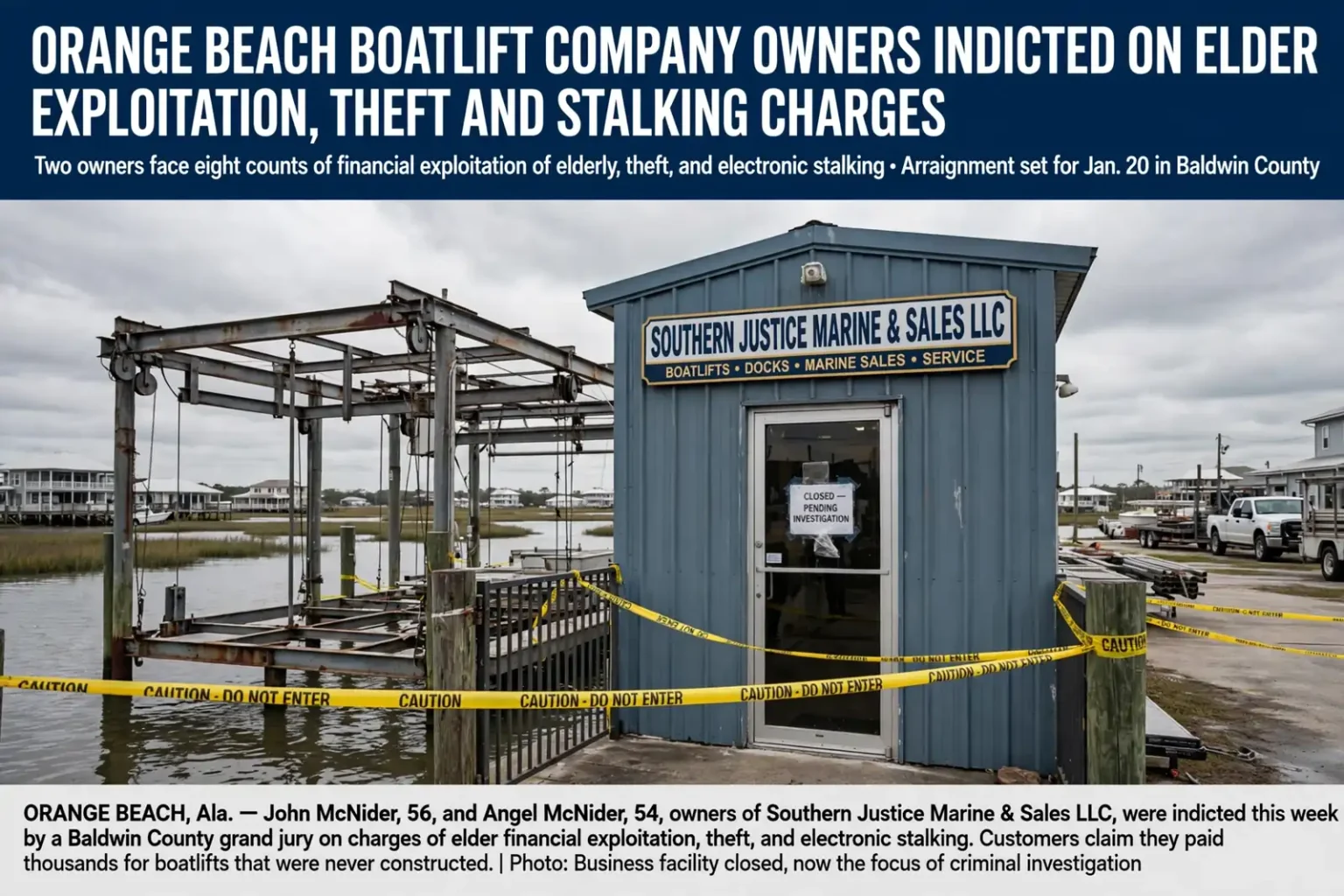
ORANGE BEACH, Ala. — Two owners of an Orange Beach boatlift company are facing felony charges after a Baldwin County grand jury returned indictments accusing them of financially exploiting elderly customers, stealing property and electronically stalking a former employee. The Baldwin County indictments, filed in court this week, come after two customers who say they paid thousands of dollars for boatlifts that were never built already won civil judgments against the pair.
Court records identify the defendants as John McNider, 56, and Angel McNider, 54, a married couple who own Southern Justice Marine & Sales LLC. Official records place the business in the Bear Point area of Orange Beach, and the couple also owns other marine-related businesses. Both were arrested and booked into the Baldwin County Jail, then posted bond and were released. Their arraignment is scheduled for Jan. 20, 2027.
Customers Say Deposits Disappeared
The criminal case follows complaints from customers who said they paid in advance for work that never happened. Two of the people listed as alleged victims in the indictment had already gone to civil court.
In lawsuits filed in May, the two customers said they each put down a deposit in December 2025 to have a boatlift built. One said he paid $10,000; the other said he paid $14,000. Both said no boatlift was ever constructed and that their money was never refunded.
On Oct. 15, a Baldwin County district judge ruled in their favor, ordering the McNiders to pay $17,477 to one customer and $20,252 to the other. Civil judgments often exceed the original amount paid because they can include court costs, interest and other damages allowed by law.
Case at a glance
- Defendants: John McNider, 56, and Angel McNider, 54
- Business: Southern Justice Marine & Sales LLC, Orange Beach
- Court: Baldwin County Circuit Court
- Financial exploitation of the elderly (first degree): eight counts combined, four against each defendant, involving six alleged victims, each above $2,500
- First-degree theft of property: two counts against John McNider and one against Angel McNider
- Additional charge: electronic stalking, against both
- Custody status: both booked into the Baldwin County Jail and released after posting bond
- Next court date: arraignment on Jan. 20, 2027
What the Indictment Alleges
Between them, the two defendants face a combined eight counts, four apiece, accusing them of first-degree financial exploitation of the elderly. The indictments, handed down in Baldwin County Circuit Court, allege that the pair obtained or exerted unauthorized control over money belonging to multiple victims. The court filings list six alleged victims and state that the value involved in each case is more than $2,500.
The theft charges are split between the two. John McNider faces two first-degree counts of theft of property, while Angel McNider faces one. Under Alabama law, theft of property in the first degree generally applies when the value of the property or services involved exceeds $2,500.
The indictment does not, on its own, establish that any crime occurred. It reflects a grand jury’s finding that there is enough evidence for the charges to move forward to trial or another resolution in circuit court.
How grand juries work
In Alabama, felony cases are commonly presented to a grand jury, a panel of citizens that meets in private to hear evidence from prosecutors and decide whether there is probable cause to formally charge someone. Grand jurors do not decide guilt or innocence. When they find the evidence sufficient, they return what is called a true bill, and an indictment is filed with the circuit court. Grand jury proceedings are confidential, so the evidence presented typically does not become public until later in the case, through court filings or at trial.
A single indictment can contain multiple counts, with each count representing a separate alleged offense. That is why the number of counts can be larger than the number of alleged victims, as in this case, where eight exploitation counts are tied to six people.
The Electronic Stalking Charge
Both defendants are also charged with electronic stalking. Court documents allege that a device was placed on property belonging to a person who used to work for Southern Justice Marine & Sales. The indictments describe it as an electronic monitoring device but give no further detail about it.
An attorney for Angel McNider responded to the allegation by saying she has not spoken with the former employee in three years. John McNider’s attorney had not responded.
Laws aimed at electronic stalking and tracking have become more common as small, inexpensive location devices have entered the market. Placing a tracking device on someone’s property without permission can bring criminal charges in many states, and law enforcement agencies encourage anyone who finds an unfamiliar device on a vehicle or belongings to report it rather than remove or discard it, so it can be preserved as potential evidence.
How Elder Financial Exploitation Cases Work in Alabama
Alabama treats financial exploitation of older adults as a distinct crime. State law passed in 2016, known as the Protecting Alabama’s Elders Act, created specific offenses for taking advantage of elderly people through deception, intimidation or undue influence to obtain their money or property. As with theft, the seriousness of the charge depends largely on the value involved.
Older adults are frequent targets of financial schemes, from fraud by strangers to cases involving businesses or people they know and trust. Home improvement and construction work is one area where problems can arise, because customers are often asked to pay large deposits before any work begins.
Warning signs and tips for consumers
Consumer protection agencies generally offer advice like the following to anyone, and especially older residents, hiring a contractor for a large project:
- Get written estimates and a signed contract that spells out the work, the price, the payment schedule and the expected completion date.
- Be cautious about paying a large share of the cost up front, and tie payments to completed stages of the work when possible.
- Check whether the contractor holds any required state or local licenses and look for complaints or court records.
- Pay by check or credit card rather than cash so there is a record of the transaction.
- Keep copies of all contracts, receipts, texts and emails.
- If work stalls and the contractor stops responding, contact local law enforcement, the Alabama Attorney General’s consumer protection section or a private attorney.
Suspected exploitation of an elderly person can also be reported to the Alabama Department of Human Resources, which handles adult protective services.
Boatlifts and Coastal Living in Orange Beach
Boatlifts are a common sight along the canals, bayous and back bays of Orange Beach and the rest of coastal Baldwin County. The structures raise a vessel out of the water when it is not in use, protecting the hull from saltwater, marine growth and storm surge. For waterfront homeowners, a lift can be a significant investment, and installation often involves pilings, framing, motors and electrical work.
Because of that cost, it is common for customers to pay a deposit when they place an order, which can leave them exposed if a project is never completed.
Questions to ask before ordering a boatlift
Waterfront property owners shopping for a lift, dock or seawall can protect themselves by asking a few basic questions before signing anything:
- How long has the company been in business locally, and can it provide references from recent customers?
- Will the company handle any permits required for work over the water, and who is responsible if a permit is delayed?
- What is the expected start date and finish date, and what happens to the deposit if the work is not started on time?
- Is the deposit held in a separate account or used to order materials, and can the company show proof of those orders?
- Does the contract include a refund policy in writing?
Clear answers to those questions will not guarantee a smooth project, but they create a paper trail and help customers recognize red flags early.
A History of Civil Disputes and an Earlier Federal Case
The two judgments described above are not the couple’s only losses in civil court. The McNiders have lost multiple civil lawsuits in which plaintiffs claimed the couple failed to pay for services or accepted money for work that was never performed. Those cases arose from disputes over business operations and contracts tied to marine sales and services.
This is also not the first time Angel McNider has faced criminal charges. She was previously found not guilty on multiple federal fraud charges involving two companies she co-owned, Hometown Hospice and Medical Equipment of Jackson. She later wrote about that experience in a book titled “Southern Justice,” the same name the couple’s Orange Beach marine company carries. The earlier acquittal has no legal bearing on the new charges, which will be decided on their own evidence.
What Happens Next in Court
The McNiders’ next scheduled court appearance is their arraignment on Jan. 20. At an arraignment in Alabama circuit court, defendants are formally advised of the charges against them and are asked to enter a plea. Defendants frequently plead not guilty at this stage, after which the case moves into pretrial proceedings, which can include discovery, motions and plea negotiations, before any trial date is set.
The civil judgments and the criminal case are separate matters, and they follow different rules. Winning a civil judgment does not automatically put money back in a customer’s pocket. If a defendant does not pay voluntarily, the person who won the judgment may have to take further legal steps, such as seeking to garnish wages or place liens on property, to collect what the court awarded.
In short, the two tracks run independently. A civil judgment requires the defendant to pay money to the people who sued, while the criminal case will determine whether the defendants are guilty of the crimes charged and, if so, what penalties apply. In criminal cases involving financial loss, a judge can also order restitution to victims if there is a conviction.
Presumption of Innocence
An indictment is a formal accusation, not a finding of guilt. Angel McNider and John McNider are presumed innocent unless and until they are proven guilty in court. Prosecutors must prove each charge beyond a reasonable doubt, and the defendants have the right to contest the allegations, present a defense and be represented by counsel throughout the process.
Anyone who believes they may have been affected by a similar situation involving a contractor or marine business can contact local law enforcement or the Baldwin County District Attorney’s Office.